sovereign cloud in information technology in 2026

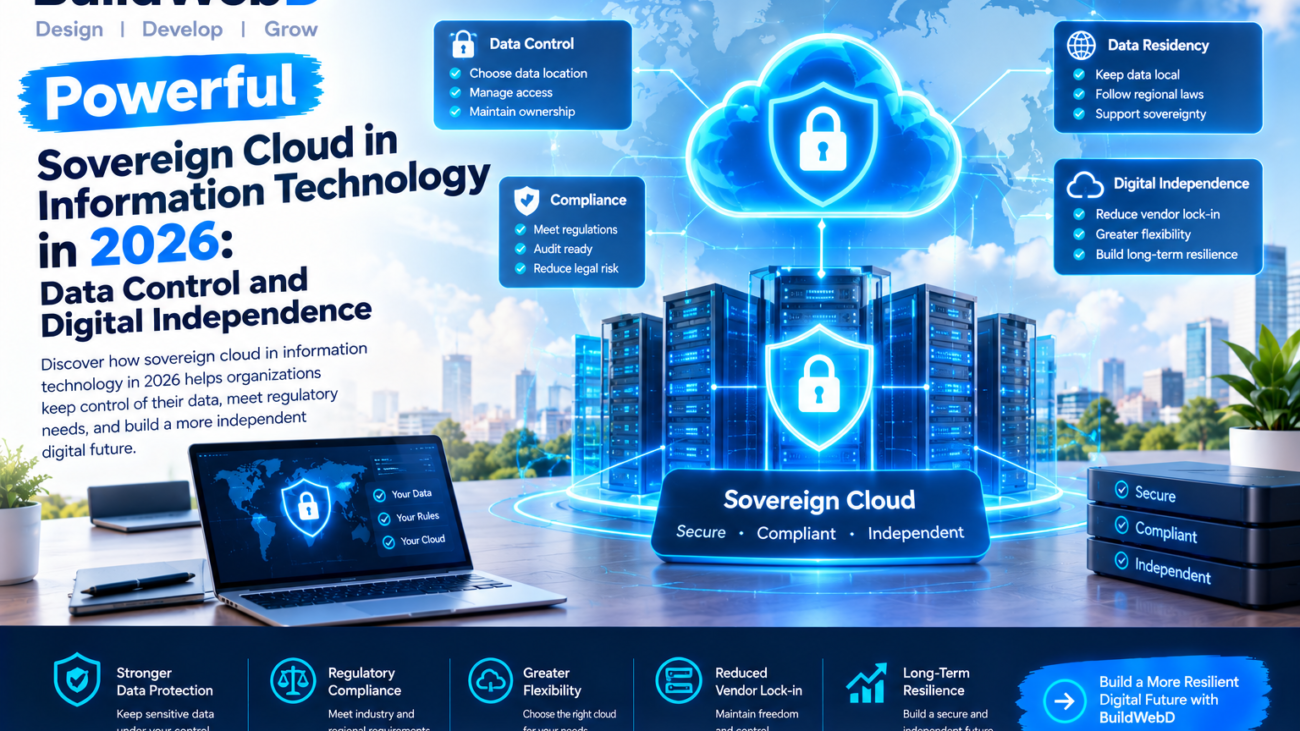
Powerful Sovereign Cloud in Information Technology in 2026: Data Control and Digital Independence

Cloud computing has transformed how businesses store information, run applications, and deliver digital services. Organizations can scale their infrastructure without maintaining every server themselves. However, as more critical operations move to the cloud, businesses are asking an important question: who controls their data, where is it stored, and which laws govern it?

These questions are driving interest in sovereign cloud in information technology in 2026. This approach focuses on giving organizations greater control over data, infrastructure, and cloud operations according to specific legal, regulatory, and business requirements.

For governments, financial institutions, healthcare providers, and companies handling sensitive information, sovereign cloud is becoming an important consideration in long-term IT planning.

What Is a Sovereign Cloud?

A sovereign cloud is a cloud environment designed to support digital sovereignty requirements. Depending on the provider and deployment model, these requirements may include controlling where data resides, who can access it, how services are operated, and which jurisdiction’s laws apply.

Traditional cloud services often emphasize scalability, flexibility, and global availability. Sovereign cloud adds another layer of consideration: the organization’s ability to exercise appropriate control over its digital assets.

It is important to understand that data residency and data sovereignty are not identical. Data residency refers primarily to where information is stored or processed. Data sovereignty includes broader questions about legal jurisdiction, operational authority, access, and control.

A cloud service that stores data in a particular country does not automatically satisfy every sovereignty requirement. Organizations need to evaluate the provider’s legal structure, operational arrangements, technical safeguards, and contractual commitments.

Why Sovereign Cloud Matters in 2026

Digital services now support essential business activities, from payments and customer management to artificial intelligence and public administration. Losing control over critical data or becoming unable to access important systems can create operational, financial, and regulatory risks.

Interest in sovereign cloud in information technology in 2026 is growing as organizations reassess cloud dependency, jurisdictional exposure, and resilience.

Gartner forecasts worldwide sovereign cloud infrastructure-as-a-service spending of approximately $80 billion in 2026, representing 35.6% growth over 2025. This signals increasing investment in cloud environments designed to meet sovereignty requirements. <Cite refs={[“turn905360search0”]} />

For businesses, the implications extend beyond data storage. Cloud decisions can influence vendor risk, disaster recovery, AI deployment, regulatory planning, and the ability to change providers in the future.

How Does Sovereign Cloud Work?

Sovereign cloud is not one single technology. It is a combination of infrastructure, policies, technical controls, contracts, and operational practices.

Data location controls: Organizations can select cloud regions and configurations that help keep specific data within approved geographic boundaries.

Access management: Identity controls, privileged-access restrictions, logging, and approval processes help define who can manage systems or access sensitive information.

Encryption and key control: Encryption protects data, while carefully managed cryptographic keys can provide additional control over who can decrypt it. The precise arrangement depends on the service and its design.

Operational governance: Organizations may require local operational oversight, defined support arrangements, auditability, or restrictions on administrator access.

Compliance monitoring: Policies and monitoring tools can help enforce approved configurations and identify changes that conflict with organizational requirements.

When evaluating sovereign cloud in information technology in 2026, businesses should examine these controls together rather than relying on a provider’s marketing label alone.

Key Benefits for Businesses

1. Greater Data Control

Sovereignty-focused cloud arrangements can help businesses define where sensitive information is stored and which people or systems may access it. This is especially relevant when handling confidential customer, financial, or government data.

2. Support for Regulatory Requirements

Organizations operating in regulated industries may need to demonstrate compliance with data protection, sector-specific, or geographic requirements. A suitable cloud arrangement can support those obligations, although the cloud service alone does not guarantee compliance.

3. Stronger Risk Management

Understanding where data resides and how providers operate can help organizations identify legal, operational, and vendor-related risks before they affect business continuity.

4. Greater Strategic Flexibility

A carefully designed cloud architecture can reduce unnecessary dependence on a single provider. Portable applications, documented data-export procedures, and open standards may make future transitions easier.

5. More Confidence for Sensitive Workloads

Organizations may be more comfortable moving selected workloads to cloud environments when the provider can demonstrate appropriate controls over data, access, and operations.

Who Should Consider Sovereign Cloud?

Government agencies may need cloud environments aligned with national security, public-sector procurement, and public data requirements.

Financial institutions can evaluate sovereignty controls when processing sensitive financial information or supporting regulated operations. Healthcare organizations may consider them for systems that handle patient information, subject to applicable laws and security requirements.

Businesses using AI may also need to examine where training data, prompts, model outputs, and related records are processed. A sovereignty-focused cloud arrangement can be part of the solution, but AI governance and model security require additional controls.

Not every organization needs a dedicated sovereign cloud. The appropriate approach depends on the sensitivity of the data, regulatory obligations, risk tolerance, and available budget.

Challenges and Limitations

Sovereign cloud can introduce higher costs, fewer service choices, or additional operational complexity compared with some standard cloud configurations. Specialized services may not be available in every region, and geographic restrictions can affect performance or resilience planning.

Another challenge is understanding what a provider’s sovereignty claims actually cover. Data location alone may not address foreign legal access, software supply-chain dependencies, support access, or control over encryption keys.

Organizations should also avoid assuming that local infrastructure is automatically more secure. Security still depends on sound architecture, identity management, patching, monitoring, incident response, and reliable backup procedures.

How to Prepare Your IT Strategy

Start by classifying your data and identifying the systems that face the strictest legal or business requirements. Map where information is stored, processed, backed up, and accessed by third parties.

Next, define the controls your organization needs. These may include geographic restrictions, customer-managed keys, local operational oversight, audit logs, recovery arrangements, and clear contractual commitments.

Compare providers against documented requirements instead of relying only on product names. Test recovery procedures, assess service portability, and review the cost of meeting sovereignty requirements over time.

Finally, maintain a balanced architecture. Use sovereignty-focused controls where they address real risks, while selecting other cloud models for workloads that do not require the same level of restriction.

Conclusion

Sovereign cloud in information technology in 2026 reflects a broader shift toward treating data control and digital independence as strategic IT priorities. By evaluating data location, jurisdiction, operational access, encryption, and vendor dependency, organizations can make more informed cloud decisions.

The best approach is not automatically to move every workload into a sovereign environment. It is to identify genuine requirements, compare providers carefully, and build a cloud strategy that balances control, resilience, cost, and innovation.

At BuildWebD, we believe successful digital transformation starts with thoughtful technology decisions. Whether you are developing business applications, modernizing IT systems, or planning secure cloud-based services, a clear strategy can help you build a more resilient digital future.

Ready to strengthen your digital foundation? Connect with BuildWebD to plan practical, reliable technology solutions for your business.
spec-driven web development in 2026

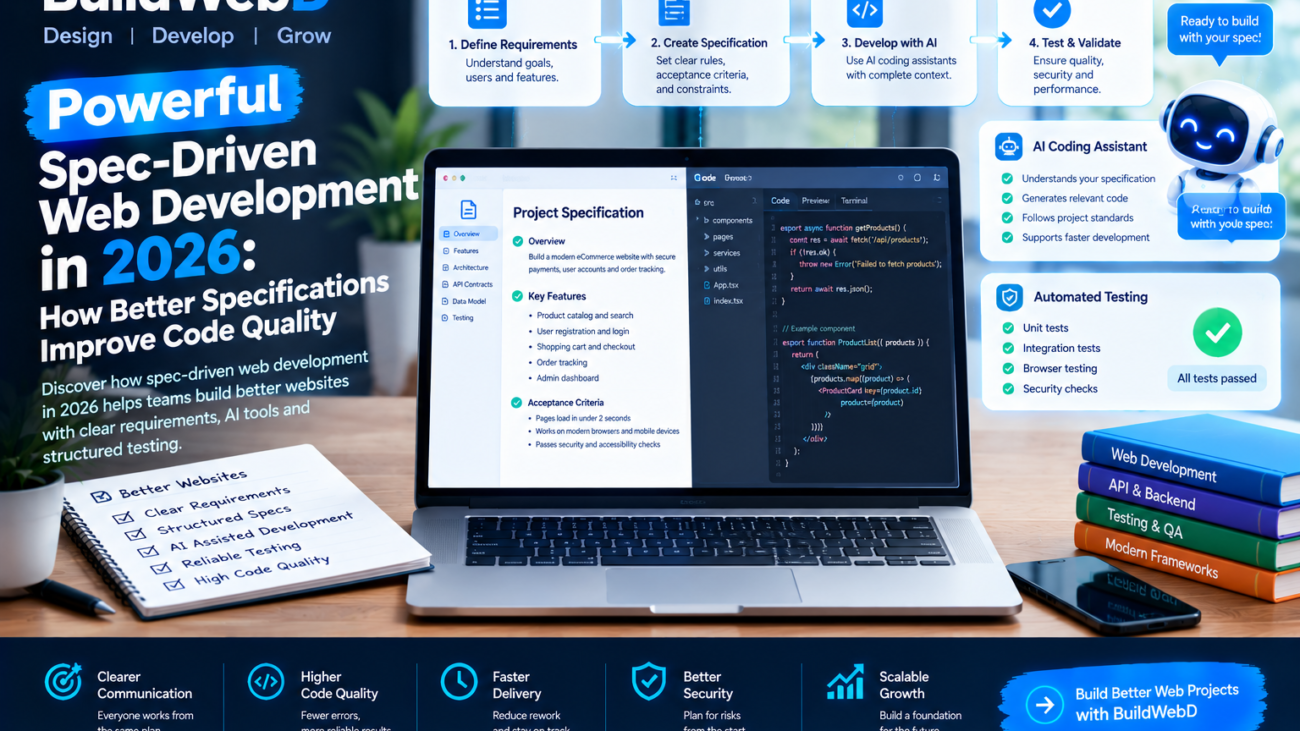
Powerful Spec-Driven Web Development in 2026: How Better Specifications Improve Code Quality

Building a website has become faster with modern frameworks, AI coding assistants, and automated development tools. However, generating code quickly does not guarantee that the finished website will meet business requirements, provide a good user experience, or remain easy to maintain.

This is why spec-driven web development in 2026 is gaining attention. Instead of starting with code or relying entirely on conversational prompts, developers first define what a website must do, how its features should behave, and how success will be measured.

These specifications become a shared reference for developers, designers, testers, and AI tools. The result can be a more organized development process, fewer misunderstandings, and better alignment between the original idea and the finished product.

What Is Spec-Driven Web Development?

Spec-driven development is a software development approach in which a structured specification guides implementation and verification. A specification documents the expected behavior of a feature, its requirements, constraints, and acceptance criteria.

For example, an online store might need product search, customer accounts, secure checkout, order tracking, and inventory updates. Rather than simply asking an AI assistant to build an online store, a development team defines how each feature should work and what conditions it must satisfy.

The developer or AI coding assistant can then implement the feature against those requirements. Tests and reviews help determine whether the result matches the specification.

In spec-driven web development in 2026, this structured approach is especially relevant because AI tools can generate substantial amounts of code while still misunderstanding requirements or making inconsistent architectural decisions.

Why Is This Approach Important in 2026?

AI-assisted coding makes it easier to create prototypes, generate components, and automate repetitive tasks. Yet a vague request can produce a polished-looking website that lacks essential functionality or handles important edge cases incorrectly.

Microsoft’s 2026 guidance on spec-driven development emphasizes using structured specifications as a shared source of truth for humans and AI systems. IBM similarly describes specifications as a way to establish implementation details before development begins. <Cite refs={[“turn388417search0″,”turn388417search1”]} />

For web development teams, the benefit is clarity. Developers can establish requirements before implementation, use AI tools with better context, and evaluate completed work against agreed criteria.

This does not eliminate bugs or guarantee a successful project. It creates a more repeatable process for identifying gaps before they become expensive problems.

How Does Spec-Driven Web Development Work?

1. Define the Project Requirements

Begin by identifying the website’s purpose, intended users, required features, and business objectives. A service website may need lead-generation forms, service pages, customer testimonials, and appointment booking.

Requirements should describe what users need to accomplish, not simply list technologies the team wants to use.

2. Write a Structured Specification

Document the behavior of each feature, including its inputs, outputs, constraints, error states, and acceptance criteria.

For example, a password-reset feature should specify how users request a reset, how verification works, how long reset links remain valid, and what happens when a link expires.

A clear specification gives developers and AI assistants practical guidance instead of leaving critical decisions to guesswork.

3. Plan the Architecture

Decide how the frontend, backend, database, authentication, and external services will work together. Document important technical choices, API contracts, data models, and security requirements.

This step is particularly valuable for larger applications where changing an early architectural decision can affect many components.

4. Implement the Features

Developers can build features manually, use AI coding assistants, or combine both approaches. The specification provides a reference for implementation, helping the team maintain consistency across files, components, and development sessions.

With spec-driven web development in 2026, AI-generated code should still be reviewed rather than accepted automatically.

5. Test Against Acceptance Criteria

Create automated and manual tests that check whether the implementation meets the requirements. Depending on the project, this may include unit tests, integration tests, browser testing, accessibility checks, and security validation.

6. Maintain the Specification

Specifications should evolve alongside the product. When a requirement changes, update the relevant documentation and tests so future development remains aligned with the intended behavior.

Key Benefits for Web Development Teams

Better communication: Developers, designers, clients, and project managers can refer to the same documented expectations.

More consistent AI-generated code: AI tools receive clearer instructions about architecture, naming conventions, functionality, and constraints.

Earlier issue detection: Missing requirements and conflicting decisions can be identified before they create larger implementation problems.

Improved maintainability: Updated specifications help future contributors understand why features exist and how they are expected to behave.

More predictable testing: Acceptance criteria provide a practical basis for checking whether a feature is complete.

These benefits depend on the quality of the specifications and how consistently the team uses them. Documentation that is vague, outdated, or unnecessarily complicated can become another source of confusion.

Practical Example: Building an E-Commerce Website

Imagine a business planning an online store with product listings, customer accounts, a shopping cart, and online payments.

Without a detailed specification, a developer might build the product pages first and discover later that inventory rules, payment failures, or order confirmations were never properly defined.

Using spec-driven web development in 2026, the team can document these workflows before implementation. The payment specification could explain how successful transactions are confirmed, how failed payments are handled, and how duplicate submissions are prevented.

The team can then create tests for those scenarios and check the implementation against the expected behavior.

This approach does not make payment integration automatically secure, but it helps ensure that critical scenarios are considered, implemented, and tested deliberately.

Common Mistakes to Avoid

The first mistake is writing specifications that are too broad. Statements such as “make the website user-friendly” are difficult to test. Define observable outcomes, such as enabling visitors to find a service and submit an inquiry through a clearly labeled form.

Another mistake is documenting every minor detail before learning anything from a prototype. Specifications should provide enough clarity to guide development while allowing teams to refine uncertain requirements through feedback.

Teams should also avoid treating AI-generated output as verified simply because it matches a written prompt. Code review, testing, security checks, and human judgment remain essential.

Finally, do not let specifications become disconnected from the actual application. Keep them version-controlled and update them whenever important requirements change.

The Future of Spec-Driven Web Development

As AI coding assistants become more capable, clear requirements may become increasingly important for controlling the quality and consistency of generated software. Structured specifications can help teams move from one-off prompts toward repeatable workflows in which implementation, testing, and review follow documented expectations.

However, this approach is not a replacement for experienced developers. People still need to make architectural decisions, understand user needs, assess risks, and determine whether a solution is appropriate for the business.

The most effective teams will combine clear specifications, suitable development tools, automated testing, and human oversight.

Conclusion

Spec-driven web development in 2026 offers a practical way to align project requirements, implementation, and testing. By documenting expected behavior before writing code, teams can give developers and AI coding assistants clearer direction while making it easier to evaluate completed features.

Success depends on maintaining useful specifications, testing real user scenarios, reviewing generated code, and updating requirements as projects evolve.

At BuildWebD, we believe high-quality websites start with clear goals and thoughtful planning. Whether you are creating a business website, an e-commerce platform, or a custom web application, a structured development process can help turn your ideas into reliable digital experiences.

Ready to build your next website? Partner with BuildWebD to turn your requirements into a practical web development solution.