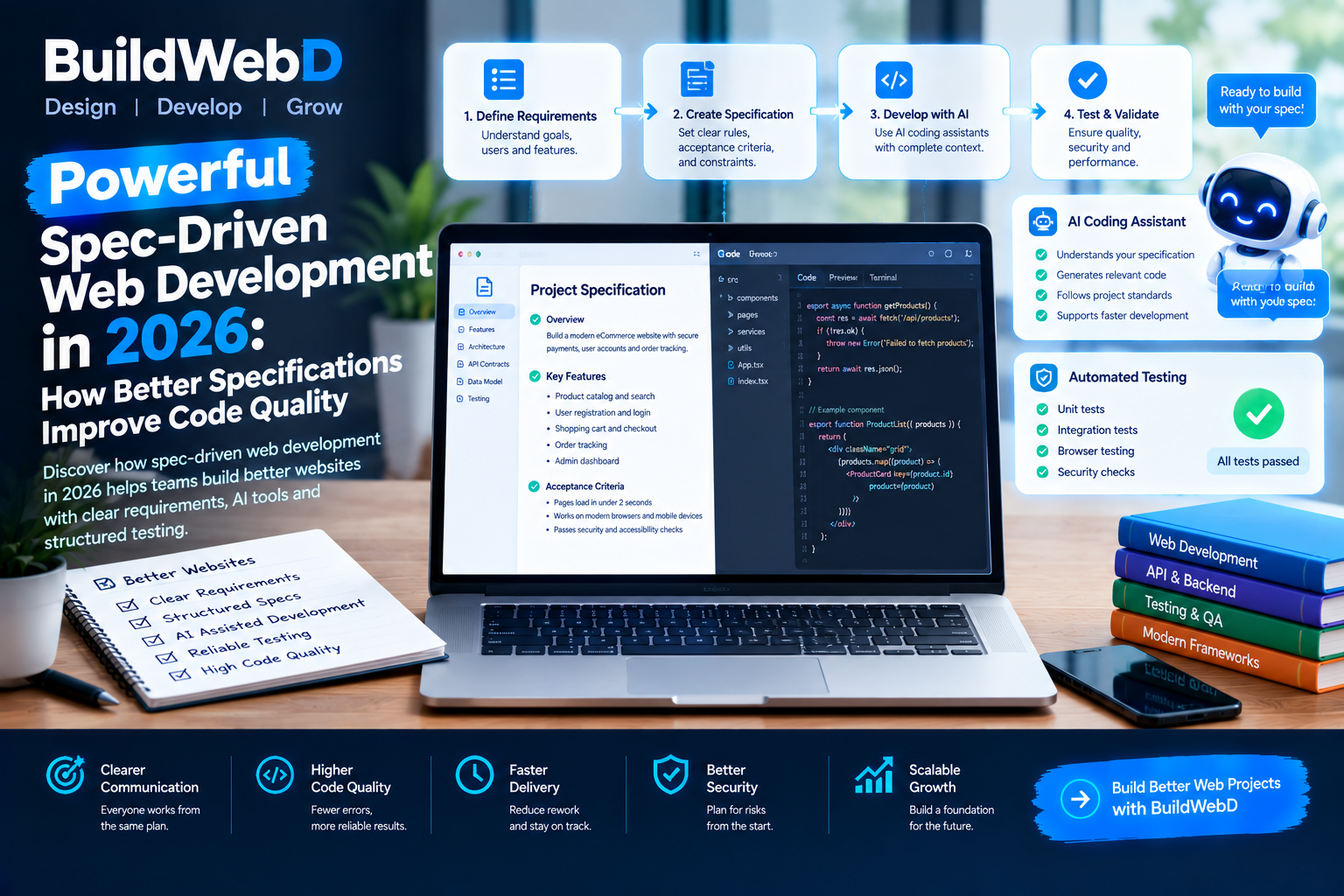
Building a website has become faster with modern frameworks, AI coding assistants, and automated development tools. However, generating code quickly does not guarantee that the finished website will meet business requirements, provide a good user experience, or remain easy to maintain.
This is why spec-driven web development in 2026 is gaining attention. Instead of starting with code or relying entirely on conversational prompts, developers first define what a website must do, how its features should behave, and how success will be measured.
These specifications become a shared reference for developers, designers, testers, and AI tools. The result can be a more organized development process, fewer misunderstandings, and better alignment between the original idea and the finished product.
What Is Spec-Driven Web Development?
Spec-driven development is a software development approach in which a structured specification guides implementation and verification. A specification documents the expected behavior of a feature, its requirements, constraints, and acceptance criteria.
For example, an online store might need product search, customer accounts, secure checkout, order tracking, and inventory updates. Rather than simply asking an AI assistant to build an online store, a development team defines how each feature should work and what conditions it must satisfy.
The developer or AI coding assistant can then implement the feature against those requirements. Tests and reviews help determine whether the result matches the specification.
In spec-driven web development in 2026, this structured approach is especially relevant because AI tools can generate substantial amounts of code while still misunderstanding requirements or making inconsistent architectural decisions.
Why Is This Approach Important in 2026?
AI-assisted coding makes it easier to create prototypes, generate components, and automate repetitive tasks. Yet a vague request can produce a polished-looking website that lacks essential functionality or handles important edge cases incorrectly.
Microsoft’s 2026 guidance on spec-driven development emphasizes using structured specifications as a shared source of truth for humans and AI systems. IBM similarly describes specifications as a way to establish implementation details before development begins. <Cite refs={[“turn388417search0″,”turn388417search1”]} />
For web development teams, the benefit is clarity. Developers can establish requirements before implementation, use AI tools with better context, and evaluate completed work against agreed criteria.
This does not eliminate bugs or guarantee a successful project. It creates a more repeatable process for identifying gaps before they become expensive problems.
How Does Spec-Driven Web Development Work?
1. Define the Project Requirements
Begin by identifying the website’s purpose, intended users, required features, and business objectives. A service website may need lead-generation forms, service pages, customer testimonials, and appointment booking.
Requirements should describe what users need to accomplish, not simply list technologies the team wants to use.
2. Write a Structured Specification
Document the behavior of each feature, including its inputs, outputs, constraints, error states, and acceptance criteria.
For example, a password-reset feature should specify how users request a reset, how verification works, how long reset links remain valid, and what happens when a link expires.
A clear specification gives developers and AI assistants practical guidance instead of leaving critical decisions to guesswork.
3. Plan the Architecture
Decide how the frontend, backend, database, authentication, and external services will work together. Document important technical choices, API contracts, data models, and security requirements.
This step is particularly valuable for larger applications where changing an early architectural decision can affect many components.
4. Implement the Features
Developers can build features manually, use AI coding assistants, or combine both approaches. The specification provides a reference for implementation, helping the team maintain consistency across files, components, and development sessions.
With spec-driven web development in 2026, AI-generated code should still be reviewed rather than accepted automatically.
5. Test Against Acceptance Criteria
Create automated and manual tests that check whether the implementation meets the requirements. Depending on the project, this may include unit tests, integration tests, browser testing, accessibility checks, and security validation.
6. Maintain the Specification
Specifications should evolve alongside the product. When a requirement changes, update the relevant documentation and tests so future development remains aligned with the intended behavior.
Key Benefits for Web Development Teams
Better communication: Developers, designers, clients, and project managers can refer to the same documented expectations.
More consistent AI-generated code: AI tools receive clearer instructions about architecture, naming conventions, functionality, and constraints.
Earlier issue detection: Missing requirements and conflicting decisions can be identified before they create larger implementation problems.
Improved maintainability: Updated specifications help future contributors understand why features exist and how they are expected to behave.
More predictable testing: Acceptance criteria provide a practical basis for checking whether a feature is complete.
These benefits depend on the quality of the specifications and how consistently the team uses them. Documentation that is vague, outdated, or unnecessarily complicated can become another source of confusion.
Practical Example: Building an E-Commerce Website
Imagine a business planning an online store with product listings, customer accounts, a shopping cart, and online payments.
Without a detailed specification, a developer might build the product pages first and discover later that inventory rules, payment failures, or order confirmations were never properly defined.
Using spec-driven web development in 2026, the team can document these workflows before implementation. The payment specification could explain how successful transactions are confirmed, how failed payments are handled, and how duplicate submissions are prevented.
The team can then create tests for those scenarios and check the implementation against the expected behavior.
This approach does not make payment integration automatically secure, but it helps ensure that critical scenarios are considered, implemented, and tested deliberately.
Common Mistakes to Avoid
The first mistake is writing specifications that are too broad. Statements such as “make the website user-friendly” are difficult to test. Define observable outcomes, such as enabling visitors to find a service and submit an inquiry through a clearly labeled form.
Another mistake is documenting every minor detail before learning anything from a prototype. Specifications should provide enough clarity to guide development while allowing teams to refine uncertain requirements through feedback.
Teams should also avoid treating AI-generated output as verified simply because it matches a written prompt. Code review, testing, security checks, and human judgment remain essential.
Finally, do not let specifications become disconnected from the actual application. Keep them version-controlled and update them whenever important requirements change.
The Future of Spec-Driven Web Development
As AI coding assistants become more capable, clear requirements may become increasingly important for controlling the quality and consistency of generated software. Structured specifications can help teams move from one-off prompts toward repeatable workflows in which implementation, testing, and review follow documented expectations.
However, this approach is not a replacement for experienced developers. People still need to make architectural decisions, understand user needs, assess risks, and determine whether a solution is appropriate for the business.
The most effective teams will combine clear specifications, suitable development tools, automated testing, and human oversight.
Conclusion
Spec-driven web development in 2026 offers a practical way to align project requirements, implementation, and testing. By documenting expected behavior before writing code, teams can give developers and AI coding assistants clearer direction while making it easier to evaluate completed features.
Success depends on maintaining useful specifications, testing real user scenarios, reviewing generated code, and updating requirements as projects evolve.
At BuildWebD, we believe high-quality websites start with clear goals and thoughtful planning. Whether you are creating a business website, an e-commerce platform, or a custom web application, a structured development process can help turn your ideas into reliable digital experiences.
Ready to build your next website? Partner with BuildWebD to turn your requirements into a practical web development solution.
Add a Comment