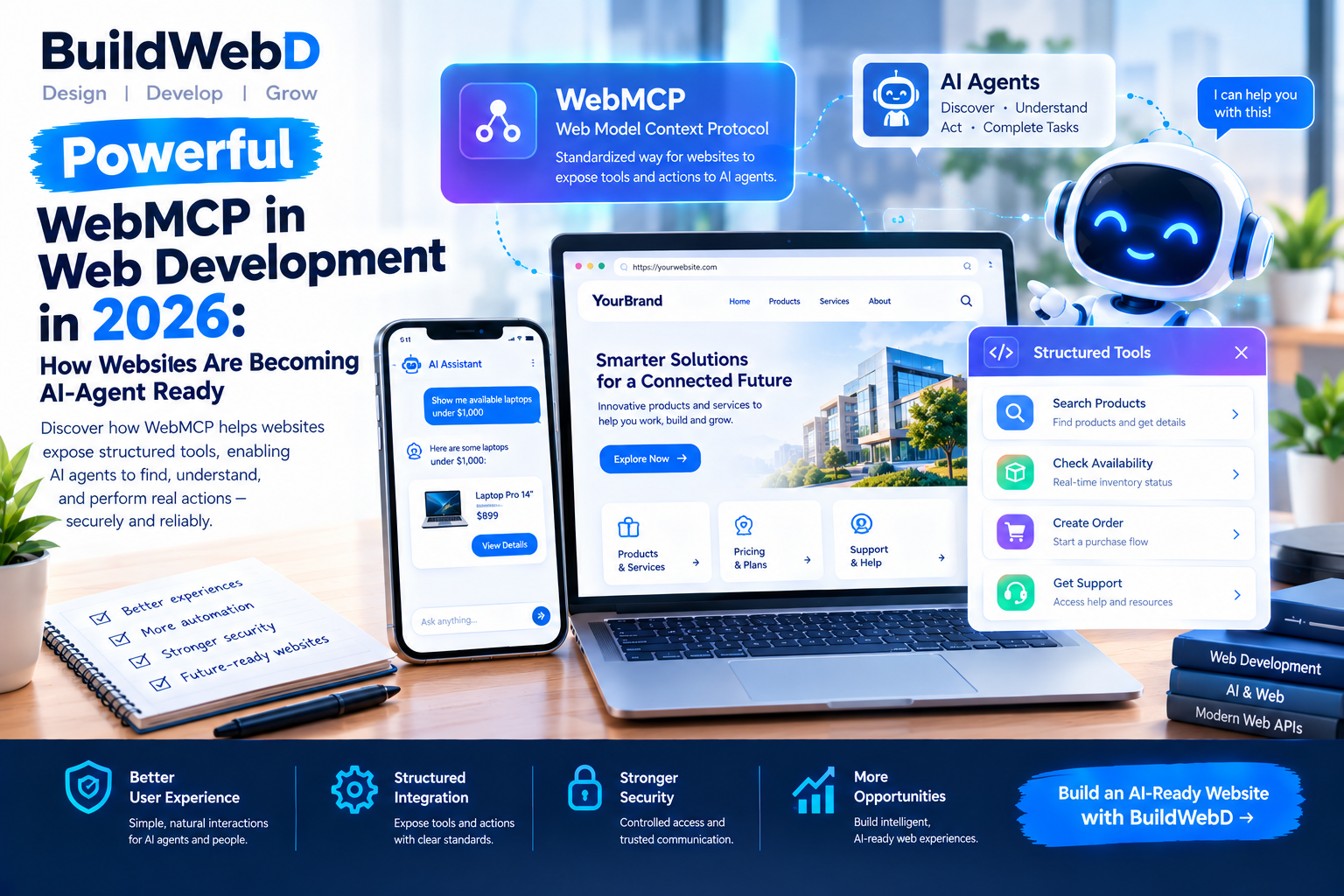
Web development is entering a new phase in which websites must serve not only human visitors but also AI agents that can help users complete online tasks. From searching for products to comparing services and filling out forms, these agents need reliable ways to understand website functionality and interact with it correctly.
This is where WebMCP in web development in 2026 becomes an important emerging technology. WebMCP aims to give websites a structured way to expose tools that compatible AI agents can discover and invoke. Rather than relying entirely on visual browsing, agents can potentially use clearly defined website actions to perform supported tasks more reliably.
What Is WebMCP?
WebMCP stands for Web Model Context Protocol. It is an emerging web platform initiative intended to help websites expose structured capabilities to AI agents.
Traditional websites are primarily designed around visual interfaces, links, buttons, and forms. People understand these elements by looking at the page and interacting with them. AI agents, however, may need additional information about available actions, required inputs, and expected outcomes.
WebMCP aims to make these interactions more structured. Developers can describe supported website actions so compatible agents can understand which operations are available and what information is required.
As an emerging technology, WebMCP should not be treated as a universally supported production standard. Developers should check the latest browser documentation, availability, and implementation requirements before adopting it.
Why WebMCP Matters in 2026
AI-assisted browsing is changing how users discover information and complete online tasks. Instead of manually navigating multiple pages, users may increasingly ask an AI assistant to find a product, check information, or help complete a transaction.
This creates a challenge for website owners. A website may look excellent to a human visitor but still be difficult for an AI agent to navigate consistently.
WebMCP in web development in 2026 offers a potential approach to this problem by making website capabilities more explicit. Rather than requiring an agent to infer every action from page structure, a website can expose documented operations that compatible agents may use.
For businesses, this could create new opportunities to make online services easier to access through AI-assisted experiences.
How WebMCP Works
The basic concept is to expose specific website actions through structured interfaces.
For example, an ecommerce website might support product search, inventory checks, or shopping-cart operations. A travel website could provide structured tools for searching available options or retrieving booking details.
Developers define the actions, the information each action requires, and the logic used to process requests. A compatible AI agent can then discover supported tools and request an action when appropriate.
The website remains responsible for validating inputs, enforcing permissions, processing requests, and returning results.
Importantly, exposing a tool does not mean an agent should automatically receive permission to perform every action. Sensitive operations, particularly payments, account changes, and final bookings, require suitable authentication, authorization, and user confirmation.
WebMCP and Traditional Website Interfaces
WebMCP is not intended to eliminate conventional website interfaces.
Human visitors still need accessible navigation, readable content, clear forms, and useful visual feedback. Websites must continue to work for people who do not use AI assistants.
Instead, developers can think of WebMCP as a complementary interaction layer.
A website may offer buttons and forms for people while exposing structured tools to compatible agents. Both interaction paths can connect to the same secure backend business logic.
This approach may reduce duplication and help maintain consistent behavior across human-driven and agent-assisted workflows.
Practical Use Cases for Businesses
Ecommerce websites are a natural area to explore. An agent might search a catalog, compare product specifications, check stock availability, or prepare a cart for the user to review.
SaaS platforms could expose supported operations for retrieving reports, organizing information, or managing routine workflows. With suitable access controls, business users might ask an agent to gather data from several parts of an application.
Customer-service websites could provide structured ways to check order status, locate support information, or begin a service request.
Travel and booking platforms could expose search and availability functions while preserving user approval for important decisions.
These examples illustrate potential applications rather than a guarantee that every browser or agent currently supports all such workflows.
How Developers Can Prepare for WebMCP
Businesses do not need to rebuild their websites around an emerging protocol immediately. A better starting point is to improve the foundations that make websites understandable, reliable, and secure.
First, organize website functionality into clear operations. Product search, account details, support requests, and booking searches should have predictable inputs and outputs.
Second, maintain semantic HTML and accessible interfaces. Well-structured pages help people, assistive technologies, search systems, and development tools understand content more effectively.
Third, separate business logic from presentation. When the same validated backend operations can support different interfaces, adding another interaction method becomes easier to manage.
Finally, monitor browser compatibility and official WebMCP documentation. Prototype with low-risk actions before considering sensitive workflows, and test behavior across the specific agents and environments your users rely on.
Security and Privacy Considerations
AI-agent access introduces important security questions. A website must never assume that a request is trustworthy simply because it comes from an AI agent.
Every operation should validate inputs on the server and enforce the same authentication, authorization, rate limits, and business rules used by conventional interfaces.
Developers should also minimize the data returned to agents. Private account information should only be available to authorized users, and sensitive actions should require appropriate confirmation.
Prompt injection and misleading content are additional risks when agents interpret untrusted website data. Clear tool definitions can help structure interactions, but they do not replace comprehensive application security.
The Future of WebMCP in Web Development
The web is evolving to support more than direct human interaction. As AI agents become more capable, developers will need to consider how digital services can expose functionality in a predictable and controlled way.
WebMCP in web development in 2026 represents one approach to this emerging challenge. Its long-term value will depend on browser adoption, compatible agent support, security practices, and how effectively it fits into existing web architectures.
Businesses should follow the standard’s development without confusing early experimentation with universal readiness. Clean APIs, accessible HTML, reliable backend logic, and strong permissions remain valuable regardless of how the ecosystem develops.
Conclusion
Websites are becoming more than collections of pages. They are evolving into digital services that may be accessed by people, applications, and AI agents.
WebMCP in web development in 2026 offers an emerging way to expose website actions through structured tools, potentially making supported tasks easier for compatible AI agents to perform. The most effective approach is to combine experimentation with strong engineering fundamentals, security, accessibility, and user control.
For businesses preparing for the next generation of web experiences, BuildWebD can help build modern, secure, and scalable websites designed to evolve alongside emerging web technologies.
Add a Comment