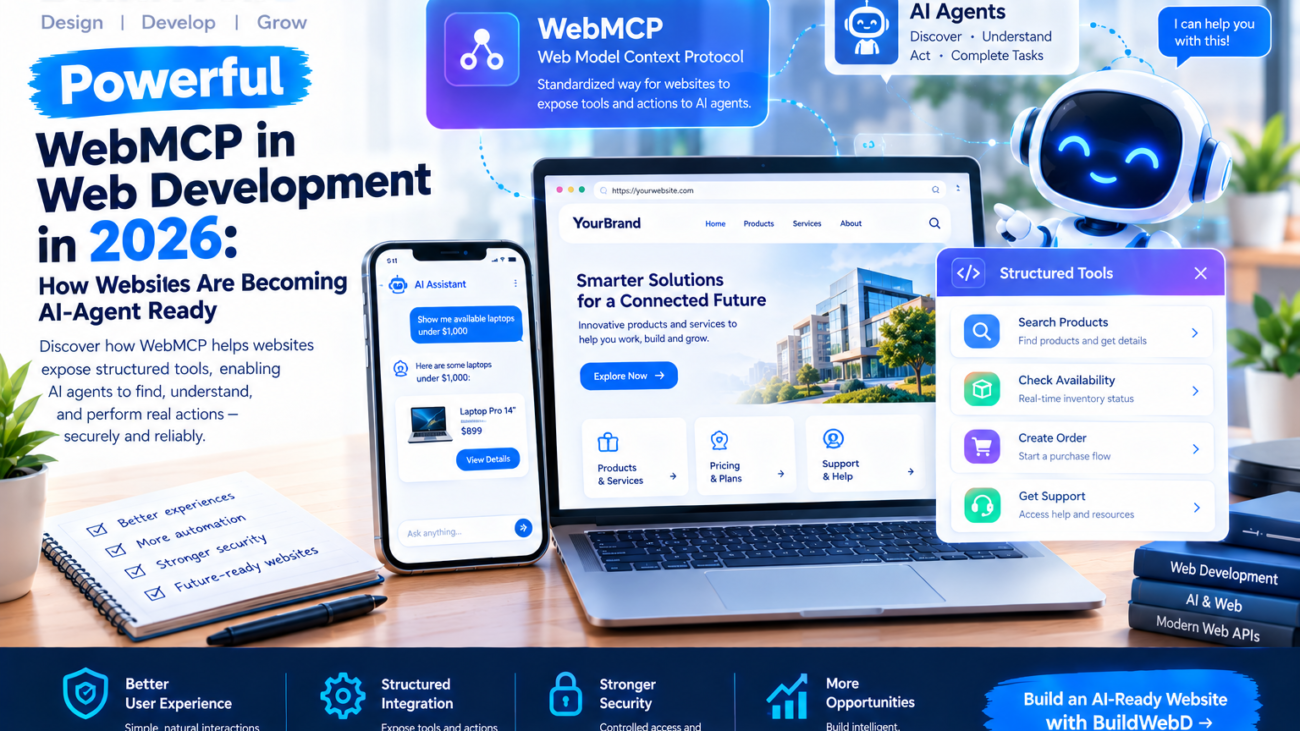
WebMCP in web development in 2026

Powerful WebMCP in Web Development in 2026: How Websites Are Becoming AI-Agent Ready

Web development is entering a new phase in which websites must serve not only human visitors but also AI agents that can help users complete online tasks. From searching for products to comparing services and filling out forms, these agents need reliable ways to understand website functionality and interact with it correctly.

This is where WebMCP in web development in 2026 becomes an important emerging technology. WebMCP aims to give websites a structured way to expose tools that compatible AI agents can discover and invoke. Rather than relying entirely on visual browsing, agents can potentially use clearly defined website actions to perform supported tasks more reliably.

What Is WebMCP?

WebMCP stands for Web Model Context Protocol. It is an emerging web platform initiative intended to help websites expose structured capabilities to AI agents.

Traditional websites are primarily designed around visual interfaces, links, buttons, and forms. People understand these elements by looking at the page and interacting with them. AI agents, however, may need additional information about available actions, required inputs, and expected outcomes.

WebMCP aims to make these interactions more structured. Developers can describe supported website actions so compatible agents can understand which operations are available and what information is required.

As an emerging technology, WebMCP should not be treated as a universally supported production standard. Developers should check the latest browser documentation, availability, and implementation requirements before adopting it.

Why WebMCP Matters in 2026

AI-assisted browsing is changing how users discover information and complete online tasks. Instead of manually navigating multiple pages, users may increasingly ask an AI assistant to find a product, check information, or help complete a transaction.

This creates a challenge for website owners. A website may look excellent to a human visitor but still be difficult for an AI agent to navigate consistently.

WebMCP in web development in 2026 offers a potential approach to this problem by making website capabilities more explicit. Rather than requiring an agent to infer every action from page structure, a website can expose documented operations that compatible agents may use.

For businesses, this could create new opportunities to make online services easier to access through AI-assisted experiences.

How WebMCP Works

The basic concept is to expose specific website actions through structured interfaces.

For example, an ecommerce website might support product search, inventory checks, or shopping-cart operations. A travel website could provide structured tools for searching available options or retrieving booking details.

Developers define the actions, the information each action requires, and the logic used to process requests. A compatible AI agent can then discover supported tools and request an action when appropriate.

The website remains responsible for validating inputs, enforcing permissions, processing requests, and returning results.

Importantly, exposing a tool does not mean an agent should automatically receive permission to perform every action. Sensitive operations, particularly payments, account changes, and final bookings, require suitable authentication, authorization, and user confirmation.

WebMCP and Traditional Website Interfaces

WebMCP is not intended to eliminate conventional website interfaces.

Human visitors still need accessible navigation, readable content, clear forms, and useful visual feedback. Websites must continue to work for people who do not use AI assistants.

Instead, developers can think of WebMCP as a complementary interaction layer.

A website may offer buttons and forms for people while exposing structured tools to compatible agents. Both interaction paths can connect to the same secure backend business logic.

This approach may reduce duplication and help maintain consistent behavior across human-driven and agent-assisted workflows.

Practical Use Cases for Businesses

Ecommerce websites are a natural area to explore. An agent might search a catalog, compare product specifications, check stock availability, or prepare a cart for the user to review.

SaaS platforms could expose supported operations for retrieving reports, organizing information, or managing routine workflows. With suitable access controls, business users might ask an agent to gather data from several parts of an application.

Customer-service websites could provide structured ways to check order status, locate support information, or begin a service request.

Travel and booking platforms could expose search and availability functions while preserving user approval for important decisions.

These examples illustrate potential applications rather than a guarantee that every browser or agent currently supports all such workflows.

How Developers Can Prepare for WebMCP

Businesses do not need to rebuild their websites around an emerging protocol immediately. A better starting point is to improve the foundations that make websites understandable, reliable, and secure.

First, organize website functionality into clear operations. Product search, account details, support requests, and booking searches should have predictable inputs and outputs.

Second, maintain semantic HTML and accessible interfaces. Well-structured pages help people, assistive technologies, search systems, and development tools understand content more effectively.

Third, separate business logic from presentation. When the same validated backend operations can support different interfaces, adding another interaction method becomes easier to manage.

Finally, monitor browser compatibility and official WebMCP documentation. Prototype with low-risk actions before considering sensitive workflows, and test behavior across the specific agents and environments your users rely on.

Security and Privacy Considerations

AI-agent access introduces important security questions. A website must never assume that a request is trustworthy simply because it comes from an AI agent.

Every operation should validate inputs on the server and enforce the same authentication, authorization, rate limits, and business rules used by conventional interfaces.

Developers should also minimize the data returned to agents. Private account information should only be available to authorized users, and sensitive actions should require appropriate confirmation.

Prompt injection and misleading content are additional risks when agents interpret untrusted website data. Clear tool definitions can help structure interactions, but they do not replace comprehensive application security.

The Future of WebMCP in Web Development

The web is evolving to support more than direct human interaction. As AI agents become more capable, developers will need to consider how digital services can expose functionality in a predictable and controlled way.

WebMCP in web development in 2026 represents one approach to this emerging challenge. Its long-term value will depend on browser adoption, compatible agent support, security practices, and how effectively it fits into existing web architectures.

Businesses should follow the standard’s development without confusing early experimentation with universal readiness. Clean APIs, accessible HTML, reliable backend logic, and strong permissions remain valuable regardless of how the ecosystem develops.

Conclusion

Websites are becoming more than collections of pages. They are evolving into digital services that may be accessed by people, applications, and AI agents.

WebMCP in web development in 2026 offers an emerging way to expose website actions through structured tools, potentially making supported tasks easier for compatible AI agents to perform. The most effective approach is to combine experimentation with strong engineering fundamentals, security, accessibility, and user control.

For businesses preparing for the next generation of web experiences, BuildWebD can help build modern, secure, and scalable websites designed to evolve alongside emerging web technologies.
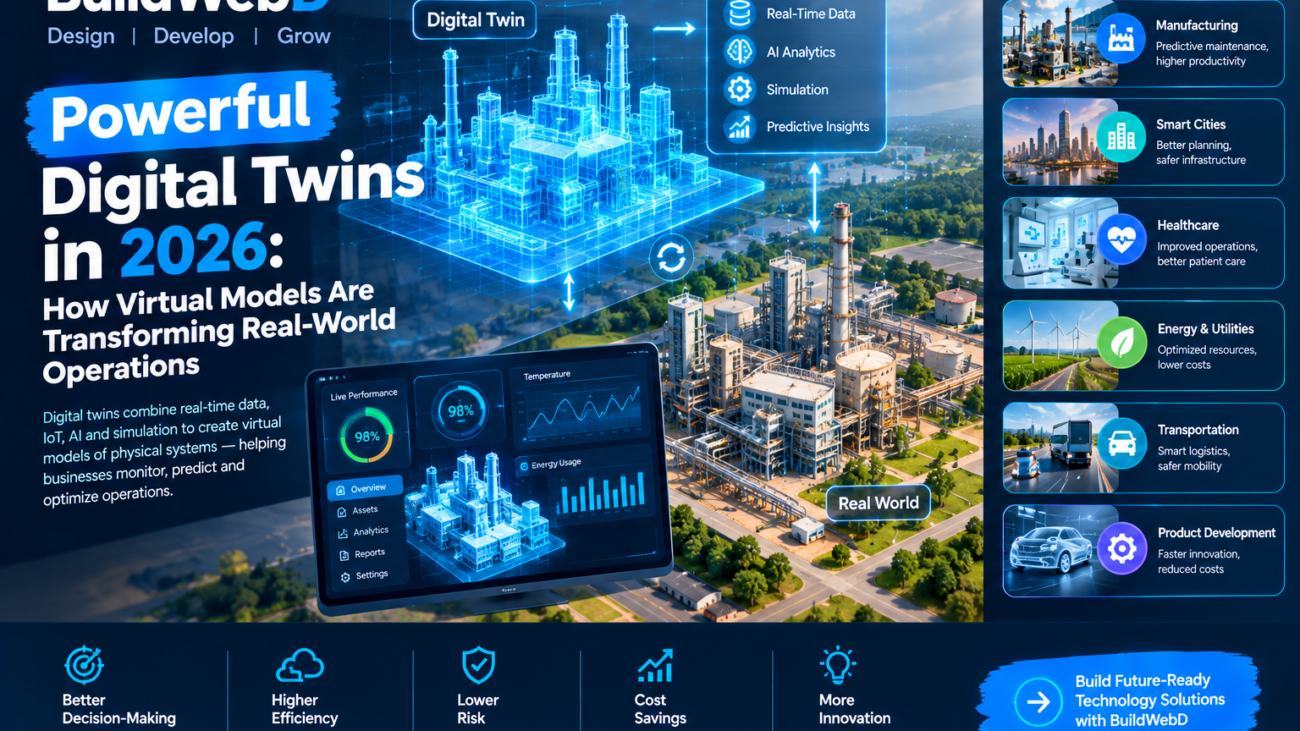
digital twins in 2026

Powerful Digital Twins in 2026: How Virtual Models Are Transforming Real-World Operations

Technology is increasingly connecting the physical and digital worlds. Businesses can now collect information from machines, buildings, vehicles, production systems, and infrastructure and use that information to create intelligent digital representations.

This is why digital twins in 2026 are becoming an important part of modern information technology. A digital twin can represent a physical object, system, process, or environment and continuously use data to provide a clearer understanding of what is happening in the real world.

When combined with artificial intelligence, Internet of Things devices, cloud platforms, and real-time analytics, digital twins can help organizations monitor operations, test scenarios, identify potential problems, and make better decisions.

What Are Digital Twins?

A digital twin is a virtual representation of a physical object or system. Unlike a basic 3D model, it can be connected to real-world data and updated as the physical environment changes.

For example, a manufacturer could create a digital representation of a production machine. Sensors can provide information about temperature, vibration, energy consumption, and operating conditions. The virtual model can then help engineers understand the machine’s current state and identify potential issues.

The growing importance of digital twins in 2026 comes from their ability to connect data with real-world operations rather than simply displaying information.

How Digital Twins Work

A typical digital twin ecosystem combines several technologies.

IoT sensors collect information from physical equipment or environments. Connectivity systems transfer that information to software platforms. Cloud or edge infrastructure processes the data, while analytics and AI can identify patterns and generate predictions.

The digital twin uses these inputs to represent the current condition of the physical system.

Organizations can then use dashboards, simulations, alerts, and analytics to understand what is happening and evaluate possible actions.

This creates a continuous relationship between the physical asset and its digital representation.

Why Digital Twins Are Growing in 2026

Organizations are under pressure to improve efficiency while controlling operational costs. They also need better ways to manage increasingly complex infrastructure.

Digital twins in 2026 can support this shift by allowing companies to observe systems continuously and test potential decisions before applying them to real environments.

Instead of waiting for a machine to fail, teams can analyze performance patterns. Instead of making infrastructure changes entirely through physical testing, engineers can evaluate scenarios digitally.

This approach can make technology-driven decision-making more proactive.

Digital Twins and Artificial Intelligence

Artificial intelligence is making digital twins more useful.

A traditional digital twin can show the current state of an asset or process. AI can go further by analyzing historical and real-time information to identify patterns and potential future outcomes.

For example, an AI-enabled industrial twin could identify unusual equipment behavior and alert an engineering team before a major failure occurs.

AI can also help organizations compare different scenarios. Teams may be able to evaluate how changing production schedules, equipment settings, resource allocation, or infrastructure configurations could affect performance.

This combination is one reason digital twins in 2026 are becoming increasingly relevant to enterprise technology strategies.

Digital Twins in Manufacturing

Manufacturing is one of the clearest applications.

Factories contain complex combinations of machines, software, employees, materials, and production processes. A digital representation can help organizations visualize and analyze these systems.

Engineers can use virtual models to investigate production bottlenecks, evaluate equipment performance, and explore process improvements.

Digital twins can also support predictive maintenance. Instead of relying only on fixed maintenance schedules, organizations can use operational data to better understand when equipment may require attention.

This can help reduce unexpected downtime and improve resource planning.

Digital Twins for Smart Cities and Infrastructure

The concept extends beyond factories.

Cities and infrastructure operators can use digital representations of roads, buildings, transport systems, utilities, and other physical environments.

A smart-city digital twin can combine information from sensors, geographic systems, traffic networks, and other data sources. This can help planners evaluate infrastructure changes and understand how different systems interact.

Recent initiatives in India are also exploring digital twins alongside AI and climate-risk modeling for infrastructure planning and resilience.

As urban environments become more connected, digital twins in 2026 can become useful tools for planning, monitoring, and optimization.

Digital Twins in Healthcare

Healthcare is another area where digital modeling can provide opportunities.

Hospitals contain complex environments involving medical equipment, facilities, patient flows, energy systems, and operational processes.

Digital twins can help organizations model these environments and identify ways to improve resource utilization.

In the longer term, increasingly sophisticated digital models could also support personalized simulations and advanced medical research, although healthcare applications require strong privacy, security, validation, and regulatory controls.

Digital Twins and Product Development

Digital twins can also change how companies design products.

Engineers can create a digital representation of a product and use simulations to study how it may perform under different conditions.

This can reduce dependence on repeated physical prototypes for certain stages of development.

Automotive, aerospace, electronics, energy, and industrial companies can benefit from this approach because product development often involves expensive testing and complex engineering requirements.

By connecting digital models with real-world product data, organizations can create a continuous feedback loop between design, production, operation, and improvement.

Security and Data Challenges

Despite their advantages, digital twins introduce new technology challenges.

A digital twin can depend on large amounts of operational data. If that data is inaccurate, incomplete, delayed, or compromised, the resulting model may provide misleading information.

Security is therefore essential.

Organizations need to protect sensors, networks, APIs, cloud systems, databases, and digital-twin platforms. Access controls and monitoring are also important because a compromised digital representation could expose information about real-world infrastructure.

Data governance is equally important when multiple systems and departments contribute information.

What Businesses Should Consider

Companies interested in adopting digital twins in 2026 should begin with a clearly defined business problem rather than building a digital model simply because the technology is available.

A practical starting point could be predictive maintenance, production optimization, energy management, infrastructure monitoring, or product simulation.

Businesses should then identify the required data sources, sensors, connectivity infrastructure, analytics capabilities, security controls, and software platforms.

The goal should be measurable business value.

A smaller digital-twin project with a clear operational objective can provide a better foundation than an unnecessarily complex enterprise-wide implementation.

The Future of Digital Twin Technology

The future of digital twins in 2026 is likely to involve deeper integration with AI, IoT, cloud computing, real-time analytics, and simulation technologies.

As organizations collect more operational data, digital representations can become increasingly detailed and responsive.

The technology may eventually become part of broader intelligent operating environments where physical systems continuously communicate with software platforms and AI-driven decision systems.

This could shift organizations from reactive operations toward predictive and simulation-based decision-making.

Conclusion

Technology is moving beyond simply digitizing information. The next stage is creating connected digital representations that help organizations understand and optimize the physical world.

Digital twins in 2026 are emerging as an important information technology capability because they bring together IoT, AI, cloud computing, analytics, and simulation. From manufacturing and infrastructure to product development and smart environments, the technology can help businesses make more informed decisions.

The most successful implementations will focus on real business outcomes, reliable data, security, and scalable technology architecture.

For businesses exploring emerging technology, BuildWebD can help create modern digital solutions that connect software, data, automation, and intelligent technologies to support future-ready operations.