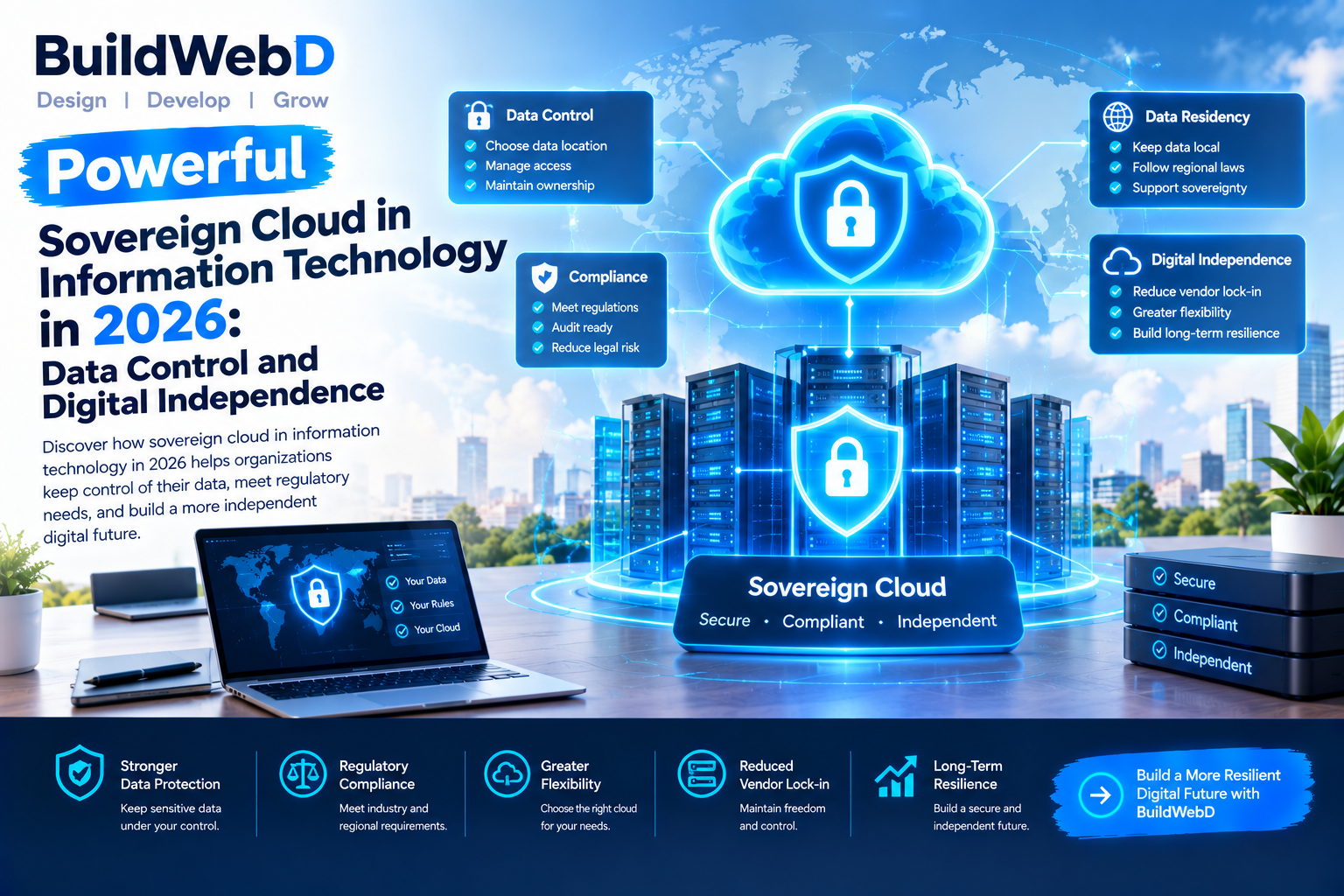
Cloud computing has transformed how businesses store information, run applications, and deliver digital services. Organizations can scale their infrastructure without maintaining every server themselves. However, as more critical operations move to the cloud, businesses are asking an important question: who controls their data, where is it stored, and which laws govern it?
These questions are driving interest in sovereign cloud in information technology in 2026. This approach focuses on giving organizations greater control over data, infrastructure, and cloud operations according to specific legal, regulatory, and business requirements.
For governments, financial institutions, healthcare providers, and companies handling sensitive information, sovereign cloud is becoming an important consideration in long-term IT planning.
What Is a Sovereign Cloud?
A sovereign cloud is a cloud environment designed to support digital sovereignty requirements. Depending on the provider and deployment model, these requirements may include controlling where data resides, who can access it, how services are operated, and which jurisdiction’s laws apply.
Traditional cloud services often emphasize scalability, flexibility, and global availability. Sovereign cloud adds another layer of consideration: the organization’s ability to exercise appropriate control over its digital assets.
It is important to understand that data residency and data sovereignty are not identical. Data residency refers primarily to where information is stored or processed. Data sovereignty includes broader questions about legal jurisdiction, operational authority, access, and control.
A cloud service that stores data in a particular country does not automatically satisfy every sovereignty requirement. Organizations need to evaluate the provider’s legal structure, operational arrangements, technical safeguards, and contractual commitments.
Why Sovereign Cloud Matters in 2026
Digital services now support essential business activities, from payments and customer management to artificial intelligence and public administration. Losing control over critical data or becoming unable to access important systems can create operational, financial, and regulatory risks.
Interest in sovereign cloud in information technology in 2026 is growing as organizations reassess cloud dependency, jurisdictional exposure, and resilience.
Gartner forecasts worldwide sovereign cloud infrastructure-as-a-service spending of approximately $80 billion in 2026, representing 35.6% growth over 2025. This signals increasing investment in cloud environments designed to meet sovereignty requirements. <Cite refs={[“turn905360search0”]} />
For businesses, the implications extend beyond data storage. Cloud decisions can influence vendor risk, disaster recovery, AI deployment, regulatory planning, and the ability to change providers in the future.
How Does Sovereign Cloud Work?
Sovereign cloud is not one single technology. It is a combination of infrastructure, policies, technical controls, contracts, and operational practices.
Data location controls: Organizations can select cloud regions and configurations that help keep specific data within approved geographic boundaries.
Access management: Identity controls, privileged-access restrictions, logging, and approval processes help define who can manage systems or access sensitive information.
Encryption and key control: Encryption protects data, while carefully managed cryptographic keys can provide additional control over who can decrypt it. The precise arrangement depends on the service and its design.
Operational governance: Organizations may require local operational oversight, defined support arrangements, auditability, or restrictions on administrator access.
Compliance monitoring: Policies and monitoring tools can help enforce approved configurations and identify changes that conflict with organizational requirements.
When evaluating sovereign cloud in information technology in 2026, businesses should examine these controls together rather than relying on a provider’s marketing label alone.
Key Benefits for Businesses
1. Greater Data Control
Sovereignty-focused cloud arrangements can help businesses define where sensitive information is stored and which people or systems may access it. This is especially relevant when handling confidential customer, financial, or government data.
2. Support for Regulatory Requirements
Organizations operating in regulated industries may need to demonstrate compliance with data protection, sector-specific, or geographic requirements. A suitable cloud arrangement can support those obligations, although the cloud service alone does not guarantee compliance.
3. Stronger Risk Management
Understanding where data resides and how providers operate can help organizations identify legal, operational, and vendor-related risks before they affect business continuity.
4. Greater Strategic Flexibility
A carefully designed cloud architecture can reduce unnecessary dependence on a single provider. Portable applications, documented data-export procedures, and open standards may make future transitions easier.
5. More Confidence for Sensitive Workloads
Organizations may be more comfortable moving selected workloads to cloud environments when the provider can demonstrate appropriate controls over data, access, and operations.
Who Should Consider Sovereign Cloud?
Government agencies may need cloud environments aligned with national security, public-sector procurement, and public data requirements.
Financial institutions can evaluate sovereignty controls when processing sensitive financial information or supporting regulated operations. Healthcare organizations may consider them for systems that handle patient information, subject to applicable laws and security requirements.
Businesses using AI may also need to examine where training data, prompts, model outputs, and related records are processed. A sovereignty-focused cloud arrangement can be part of the solution, but AI governance and model security require additional controls.
Not every organization needs a dedicated sovereign cloud. The appropriate approach depends on the sensitivity of the data, regulatory obligations, risk tolerance, and available budget.
Challenges and Limitations
Sovereign cloud can introduce higher costs, fewer service choices, or additional operational complexity compared with some standard cloud configurations. Specialized services may not be available in every region, and geographic restrictions can affect performance or resilience planning.
Another challenge is understanding what a provider’s sovereignty claims actually cover. Data location alone may not address foreign legal access, software supply-chain dependencies, support access, or control over encryption keys.
Organizations should also avoid assuming that local infrastructure is automatically more secure. Security still depends on sound architecture, identity management, patching, monitoring, incident response, and reliable backup procedures.
How to Prepare Your IT Strategy
Start by classifying your data and identifying the systems that face the strictest legal or business requirements. Map where information is stored, processed, backed up, and accessed by third parties.
Next, define the controls your organization needs. These may include geographic restrictions, customer-managed keys, local operational oversight, audit logs, recovery arrangements, and clear contractual commitments.
Compare providers against documented requirements instead of relying only on product names. Test recovery procedures, assess service portability, and review the cost of meeting sovereignty requirements over time.
Finally, maintain a balanced architecture. Use sovereignty-focused controls where they address real risks, while selecting other cloud models for workloads that do not require the same level of restriction.
Conclusion
Sovereign cloud in information technology in 2026 reflects a broader shift toward treating data control and digital independence as strategic IT priorities. By evaluating data location, jurisdiction, operational access, encryption, and vendor dependency, organizations can make more informed cloud decisions.
The best approach is not automatically to move every workload into a sovereign environment. It is to identify genuine requirements, compare providers carefully, and build a cloud strategy that balances control, resilience, cost, and innovation.
At BuildWebD, we believe successful digital transformation starts with thoughtful technology decisions. Whether you are developing business applications, modernizing IT systems, or planning secure cloud-based services, a clear strategy can help you build a more resilient digital future.
Ready to strengthen your digital foundation? Connect with BuildWebD to plan practical, reliable technology solutions for your business.
Add a Comment