web development trends in 2026

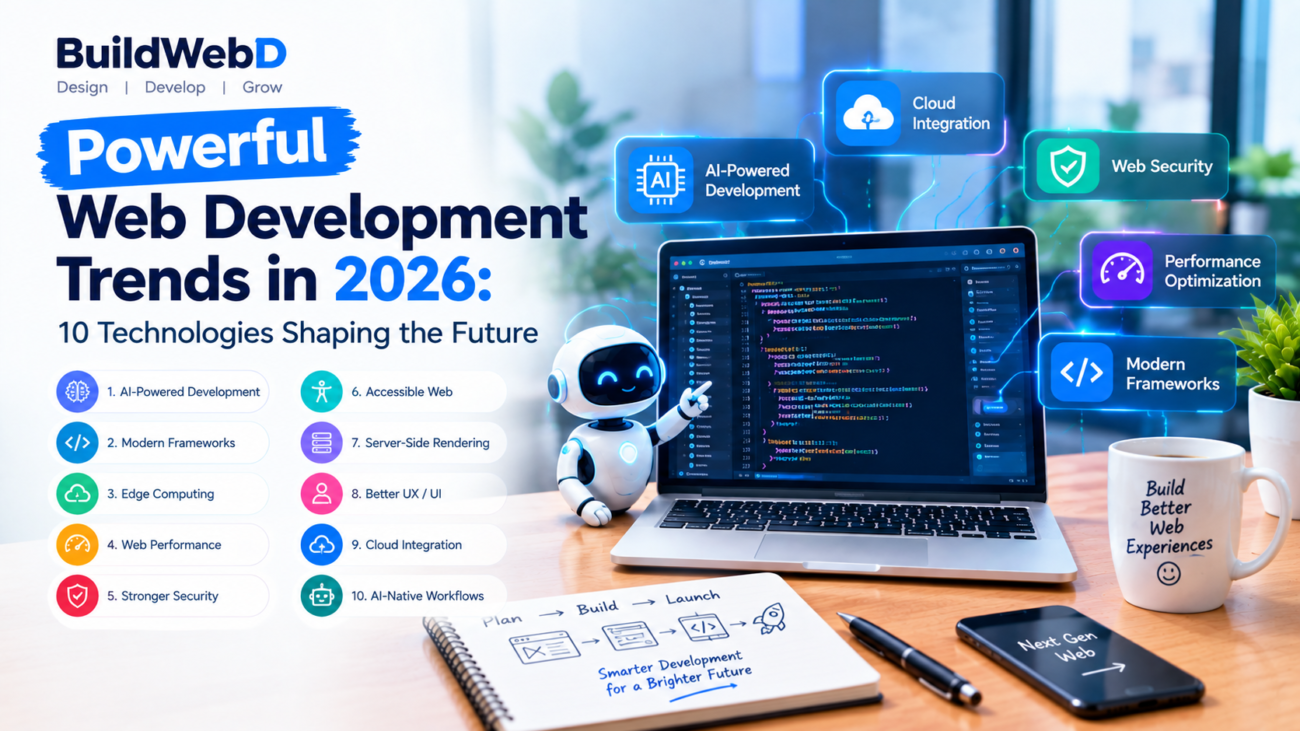
Powerful Web Development Trends in 2026: 10 Technologies Shaping the Future

The web development industry is changing rapidly. Artificial intelligence, modern frontend frameworks, edge computing, stronger security, and performance-focused architectures are changing how websites and web applications are designed and developed.

For businesses, keeping up with the latest web development trends in 2026 can help them make better decisions when building or upgrading their online platforms.

Modern websites are no longer simply digital brochures. They are becoming faster, more interactive, personalized, intelligent, and closely connected with business systems.

Here are 10 important web development trends shaping the future of the web in 2026.

1. AI-Powered Web Development

Artificial intelligence is becoming an important part of the development process.

Developers can now use AI tools to assist with:

  • Code generation
  • Debugging
  • Testing
  • Documentation
  • Code reviews
  • Website components
  • Development workflows

The major change is moving from simple AI code suggestions toward AI agents that can handle multiple development tasks.

This makes AI-powered development one of the most important web development trends in 2026.

However, AI-generated code still requires human review, testing, security checks, and proper architecture.

2. AI-Powered Websites and User Experiences

AI is also becoming part of the websites themselves.

Businesses can use AI to provide:

  • Intelligent chatbots
  • Personalized recommendations
  • AI-powered search
  • Automated customer support
  • Content assistance
  • Smart product discovery
  • Personalized user experiences

Instead of creating the same experience for every visitor, websites can increasingly respond to user needs and behavior.

3. Server-First Web Architecture

Modern web development is increasingly focusing on server-side rendering and server-first approaches.

Frameworks and architectures that move more work to the server can reduce unnecessary client-side JavaScript and potentially improve performance.

This approach is particularly useful for websites where loading speed, SEO, and user experience are important.

Server-first development is therefore becoming an important consideration for modern web projects.

4. Edge Computing and Edge Deployment

Edge computing brings application processing closer to users.

Instead of every request traveling to a distant central server, edge infrastructure can process certain requests closer to the user.

Potential benefits include:

  • Lower latency
  • Faster responses
  • Better global performance
  • Improved scalability

For websites serving users across different countries or regions, edge-based architectures can become increasingly useful.

5. Core Web Vitals and Website Performance

Website performance remains important in 2026.

Users expect websites to load quickly and respond smoothly across mobile devices, desktops, and different network conditions.

Developers should pay attention to:

  • Loading performance
  • Interaction responsiveness
  • Visual stability
  • Image optimization
  • JavaScript performance
  • Mobile performance
  • Server response times

A visually attractive website is not enough if users have to wait for pages or interactions to respond.

6. Stronger Web Security

As websites become more connected to APIs, databases, cloud services, and AI systems, security becomes even more important.

Modern development should consider:

  • Secure authentication
  • Data protection
  • API security
  • Dependency security
  • Access control
  • Secure coding practices
  • Regular updates
  • Monitoring

Security should be considered during development rather than added only after a website is completed.

Zero-trust approaches and software supply-chain security are also receiving more attention in modern web-development workflows.

7. Modern Web Frameworks and Meta-Frameworks

Web developers are increasingly using frameworks that provide both frontend and server-side capabilities.

Modern frameworks can help teams build:

  • Dynamic websites
  • Web applications
  • Ecommerce platforms
  • Dashboards
  • SaaS products
  • API-connected applications

The goal is not simply to choose the newest framework.

Businesses should choose technologies based on project requirements, performance, scalability, developer expertise, maintenance, and long-term support.

8. Better Design-to-Development Workflows

The connection between UI design and development is becoming more integrated.

Modern tools can help designers and developers share components, design systems, specifications, and implementation details.

AI is also making it easier to transform structured design information into development-ready components.

This can reduce unnecessary communication gaps between designers and developers and help teams maintain more consistent interfaces. Figma’s 2026 web-development research specifically highlights AI-driven workflows and more automated design-to-development handoffs.

9. Accessibility as a Development Priority

Modern websites need to work for a wide range of users and devices.

Developers should consider:

  • Keyboard navigation
  • Readable typography
  • Color contrast
  • Alternative text
  • Accessible forms
  • Semantic HTML
  • Screen-reader compatibility

Accessibility is not only about compliance. It can also improve usability and make websites easier for more people to navigate.

10. Web Development Becomes More AI-Native

One of the biggest changes in web development trends in 2026 is the shift toward AI-native development workflows.

Developers can increasingly use AI agents to help plan tasks, generate code, run tests, investigate problems, and prepare changes for review.

A 2026 JetBrains developer survey reported widespread weekly use of AI coding agents among professional developers, showing how quickly agent-based development is becoming part of everyday workflows.

The important point is that AI does not remove the need for experienced developers. Instead, developers increasingly need to know how to direct, review, test, secure, and improve AI-generated work.

What Do These Web Development Trends Mean for Businesses?

Businesses do not need to adopt every new technology.

Instead, focus on technologies that solve actual business problems.

For example:

Need better search visibility?
Focus on performance, technical SEO, structured content, and server-side rendering.

Need a faster ecommerce website?
Focus on performance optimization, modern architecture, caching, image optimization, and reliable infrastructure.

Need automation?
Explore AI-powered workflows and integrations.

Need a global audience?
Consider scalable cloud and edge infrastructure.

Technology should support business objectives rather than being adopted simply because it is trending.

How to Prepare Your Website for 2026

If you are planning a new website or redesign, consider these priorities:

  1. Build a mobile-first experience.
  2. Choose a scalable technology stack.
  3. Optimize website performance.
  4. Follow strong security practices.
  5. Make the website accessible.
  6. Build SEO into the development process.
  7. Consider AI where it provides genuine value.
  8. Monitor performance after launch.
  9. Keep dependencies and software updated.
  10. Plan for future integrations.

A good website should not only look modern when it launches. It should also be maintainable and adaptable as technology changes.

Conclusion

The latest web development trends in 2026 show that the future of websites is becoming more intelligent, faster, more secure, and increasingly AI-assisted.

AI-powered development, server-first architecture, edge computing, performance optimization, modern frameworks, accessibility, and stronger security are all influencing how businesses build digital experiences.

However, the right technology depends on the individual project. Businesses should choose technologies based on their customers, goals, budget, performance requirements, and long-term plans.

BuildWebD helps businesses build modern websites and web applications using practical development strategies, modern technologies, SEO-friendly architecture, ecommerce solutions, and digital solutions. If you are planning a new website or want to modernize your existing website, BuildWebD can help you build a fast, scalable, and future-ready digital presence.
AI-native software development in 2026

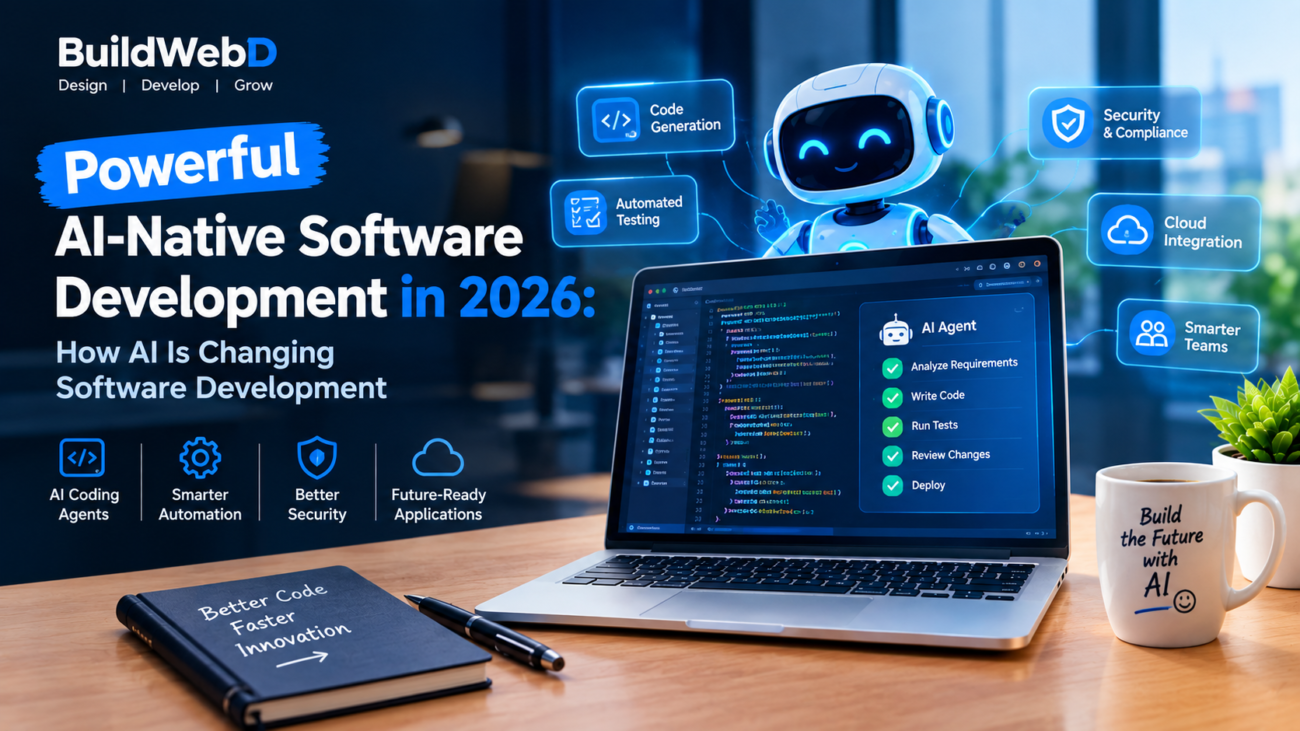
Powerful AI-Native Software Development in 2026: How AI Is Changing Software Development

Software development is entering a new phase. Artificial intelligence is no longer used only for answering questions or completing small pieces of code. AI tools can now assist with planning, writing code, testing, debugging, documentation, code review, and other development tasks.

This shift is driving interest in AI-native software development in 2026, where AI becomes part of the development workflow rather than simply an additional tool.

For developers and businesses, this can change how software products are planned, built, tested, and maintained.

What Is AI-Native Software Development?

AI-native software development means designing development workflows around AI capabilities from the beginning.

Traditional development usually follows a process such as:

Plan → Design → Code → Test → Deploy → Maintain

With AI-native development, AI can participate across multiple stages:

Plan → AI Assistance → Build → AI Testing → Review → Deploy → Monitor

AI does not necessarily replace developers. Instead, it can automate repetitive tasks and help developers spend more time on architecture, business logic, security, user experience, and complex problem-solving.

Why AI-Native Software Development Is Growing in 2026

The development ecosystem is moving beyond simple AI code completion toward AI agents that can handle larger, multi-step tasks.

AI coding agents can potentially work on tasks such as:

  • Creating application components
  • Generating code
  • Finding bugs
  • Writing tests
  • Explaining existing code
  • Updating documentation
  • Reviewing changes
  • Refactoring code
  • Working with development environments

This makes AI-native software development in 2026 an important technology trend for companies building new digital products.

How AI Is Changing the Software Development Process

1. Faster Code Generation

Developers can describe a requirement in natural language and use AI tools to generate an initial implementation.

For example, a developer could request a login system, dashboard component, API endpoint, or database operation.

The generated code still needs human review, but the initial development process can become faster.

2. AI-Assisted Testing

Testing is another area where AI can help.

AI-powered development tools can assist with generating test cases, identifying potential problems, and analyzing code changes.

Developers can then validate the results and make the final decisions.

3. Automated Code Review

AI can help identify potential bugs, duplicated code, security concerns, and coding issues during the review process.

This can give developers another layer of feedback before software changes reach production.

4. Better Documentation

Software projects often contain complicated code that can be difficult for new developers to understand.

AI can help generate explanations, documentation, comments, and summaries of existing code.

This can make large projects easier to maintain and understand.

AI Coding Agents vs Traditional Coding Assistants

There is an important difference between AI coding assistants and AI coding agents.

A coding assistant may help complete a function or suggest code while the developer remains directly involved in every step.

An AI coding agent can be designed to perform a larger sequence of tasks, such as understanding an issue, modifying multiple files, running tests, and preparing changes for review.

This is one reason agentic development is becoming an important part of AI-native software development in 2026.

Benefits for Businesses

AI-native development can provide several potential benefits for technology businesses.

Faster Development Cycles

Automating repetitive development tasks can help teams move from an idea to a working prototype more efficiently.

Improved Developer Productivity

Developers can spend less time on repetitive tasks and more time on architecture, product decisions, and complex technical problems.

Faster Prototyping

Businesses can experiment with new product ideas and prototypes without manually building every component from the beginning.

Better Software Maintenance

AI tools can assist with documentation, debugging, refactoring, and understanding existing codebases.

However, businesses should measure actual results instead of assuming that AI automatically makes every development project faster or cheaper.

What Are the Risks?

AI-native development also introduces challenges.

AI-generated code can contain bugs, security weaknesses, incorrect assumptions, or code that does not properly fit the existing application.

There can also be concerns around:

  • Data privacy
  • Security
  • Code quality
  • Intellectual property
  • AI-generated errors
  • Dependency management
  • Testing
  • Human oversight

For this reason, AI should be combined with strong development practices rather than treated as an automatic replacement for engineering judgment.

Will AI Replace Software Developers?

AI is changing software development, but software engineering involves much more than writing code.

Developers still need to understand:

  • Business requirements
  • System architecture
  • Security
  • Databases
  • User experience
  • Performance
  • Scalability
  • Testing
  • Deployment
  • Maintenance

The role of developers may increasingly involve directing AI tools, reviewing their output, designing systems, and solving complex problems.

The future is therefore likely to involve developers working alongside increasingly capable AI systems rather than simply choosing between humans and AI.

How Businesses Can Prepare for AI-Native Development

Businesses interested in AI-native software development in 2026 can start with a practical approach.

First, identify repetitive development tasks that could benefit from AI assistance.

Next, establish rules for security, code review, testing, and data handling.

Then, introduce AI tools into selected workflows and measure their impact.

A useful approach is:

Identify → Experiment → Review → Measure → Improve

This allows businesses to adopt AI gradually while maintaining control over software quality and security.

The Future of AI-Native Software Development

The future of software development is likely to become increasingly collaborative between humans and AI.

AI agents may take on more development tasks, while engineers focus more heavily on architecture, product requirements, system design, validation, security, and strategic decisions.

The important change is not simply that AI can write code. The bigger change is that AI is becoming part of the overall software delivery workflow.

For companies, this creates opportunities to build products faster while also requiring stronger governance, testing, security, and human oversight.

Conclusion

AI-native software development in 2026 represents a major evolution in how software can be planned, developed, tested, and maintained.

AI coding assistants and agents can help automate repetitive work, accelerate prototyping, support testing, improve documentation, and assist developers throughout the software lifecycle.

However, successful AI adoption requires more than choosing an AI tool. Businesses need skilled developers, clear processes, security controls, testing, and human review.

As AI continues to evolve, companies that understand how to combine human expertise with intelligent software-development tools can build a stronger foundation for the next generation of digital products.

BuildWebD helps businesses create modern digital solutions through website development, software development, ecommerce solutions, SEO, digital marketing, and other technology services. If your business is exploring AI-powered software or modern digital solutions, BuildWebD can help turn your technology ideas into practical digital products.