If you’re planning to build a website for your business, one of the first questions you probably have is: How much does website development cost in India in 2026?
The answer can range from a few thousand rupees for a simple landing page to several lakhs for an ecommerce platform or custom web application.
The reason for this huge difference is simple: not every website is the same.
A five-page business website, an online store with hundreds of products, and a custom customer portal require completely different levels of design, development, testing, integrations, and maintenance.
In this guide, we’ll explain the typical website development cost in India, what affects the price, what you should expect from different budgets, and how to compare website development quotes.
Quick Answer: How Much Does a Website Cost in India?
As a general 2026 market reference, website development costs in India can fall into these broad ranges:
| Website Type | Indicative Cost in India |
|---|---|
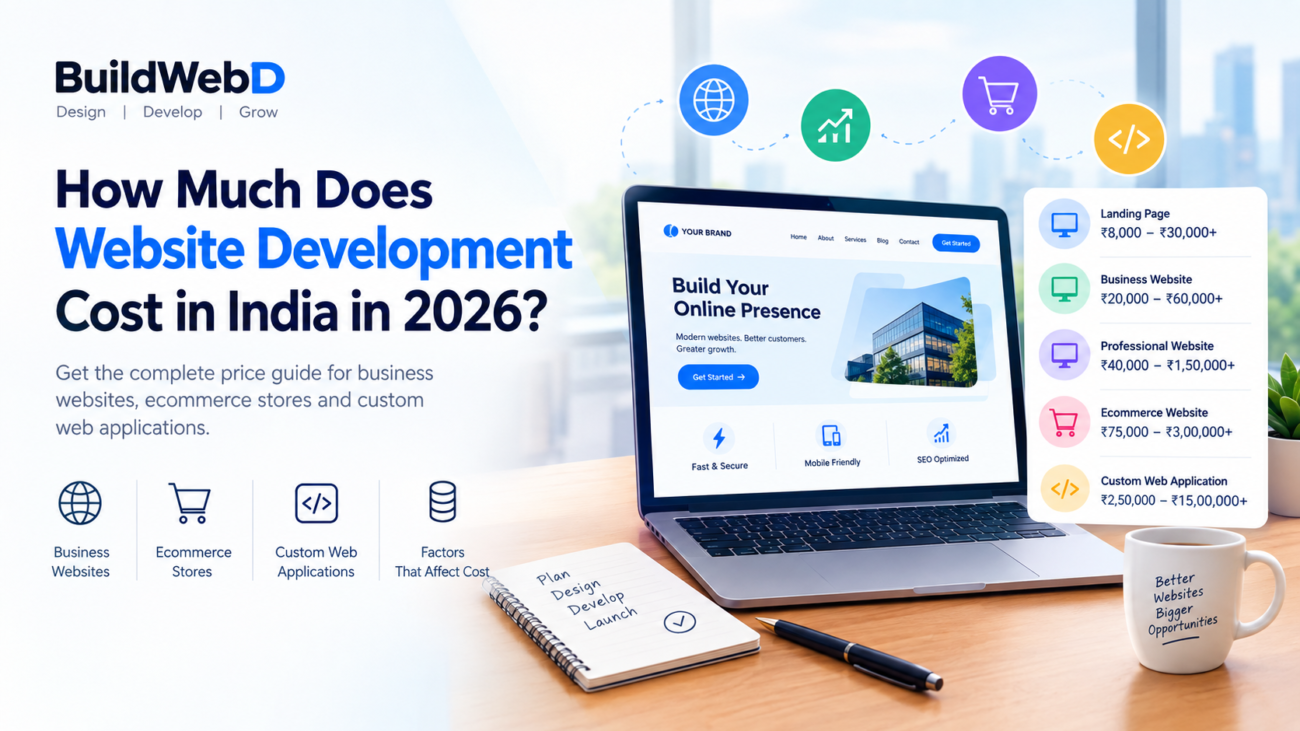
| Landing page / single-page website | ₹8,000 – ₹30,000+ |
| Basic business website | ₹20,000 – ₹60,000+ |
| Professional business website | ₹40,000 – ₹1,50,000+ |
| Ecommerce website | ₹75,000 – ₹3,00,000+ |
| Custom web application | ₹2,50,000 – ₹15,00,000+ |
These are indicative market ranges, not fixed prices. Recent Indian pricing guides show considerable variation because the final cost depends on the number of pages, design requirements, functionality, integrations, content, SEO, and development approach.
The best way to get an accurate price is to define the website’s requirements before comparing quotes.
1. Landing Page Website Cost
A landing page is usually a single page designed for a specific purpose, such as:
- Generating leads
- Promoting a service
- Running an advertising campaign
- Promoting an event
- Collecting enquiries
- Launching a product
Typical cost
₹8,000 – ₹30,000+
The cost can increase if you need:
- Custom UI/UX design
- Animations
- Lead-generation integrations
- CRM integration
- Advanced forms
- Conversion tracking
- Copywriting
- Professional graphics
A landing page can be a good choice when you don’t need a complete business website yet.
2. Basic Business Website Cost
A basic business website generally includes pages such as:
- Home
- About Us
- Services
- Contact
- Privacy Policy
It may also include a blog, enquiry form, WhatsApp button, Google Maps integration, and basic SEO setup.
Typical cost
₹20,000 – ₹60,000+
This type of website is suitable for:
- Local businesses
- Consultants
- Service providers
- Startups
- Professionals
- Small companies
The exact price depends heavily on whether the website uses a ready-made theme or receives a more customised design.
3. Professional Business Website Cost
A professional business website goes beyond simply putting your company information online.
It may include:
- Custom UI/UX
- Mobile-first design
- Multiple service pages
- Blog
- Lead-generation sections
- Contact forms
- Analytics
- Search Console
- On-page SEO
- Schema markup
- Performance optimisation
- Content management system
- Security configuration
Typical cost
₹40,000 – ₹1,50,000+
For businesses that depend on Google search and online enquiries, investing in the website’s structure, performance, content, and SEO from the beginning can be more useful than focusing only on the lowest development quote.
4. Ecommerce Website Cost in India
An ecommerce website requires considerably more functionality than a normal company website.
Depending on the project, it may require:
- Product catalogue
- Product variations
- Shopping cart
- Checkout
- Online payments
- Shipping integration
- Order management
- Inventory management
- Customer accounts
- Coupons
- Tax configuration
- Automated emails
- Ecommerce SEO
- Analytics
Typical cost
₹75,000 – ₹3,00,000+
Larger ecommerce projects can cost considerably more when they require custom integrations, large product catalogues, ERP connections, advanced shipping logic, or custom checkout functionality.
5. Custom Web Application Cost
A custom web application is different from a normal business website.
Examples include:
- Customer portals
- Booking systems
- Dealer portals
- Learning platforms
- CRM systems
- SaaS products
- Business dashboards
- Marketplace platforms
Typical cost
₹2,50,000 – ₹15,00,000+
Complex applications can go beyond this range depending on functionality, users, integrations, security requirements, infrastructure, and development time.
What Actually Determines Website Development Cost?
Two companies can ask for a “business website” and receive completely different quotes.
Here are the major factors that affect the final price.
1. Number of Pages
A five-page website requires less design, development, content, testing, and maintenance than a 30-page website.
For example, a website with dedicated pages for 20 services requires substantially more work than a simple company profile website.
2. Template vs Custom Design
A pre-designed theme can reduce development time.
A custom-designed website requires additional work involving:
- Wireframes
- UI design
- Brand integration
- Responsive layouts
- Custom components
- User experience optimisation
Neither approach is automatically right or wrong. The correct choice depends on the business and its goals.
3. Website Functionality
Features can significantly change the development cost.
Examples include:
- Appointment booking
- Payment gateways
- User login
- Membership systems
- CRM integration
- WhatsApp integration
- API integrations
- Advanced search
- Multilingual functionality
- Customer dashboards
The more functionality a website requires, the more development and testing it needs.
4. Content
Website development and website content are not always the same service.
You may need:
- Website copy
- Product descriptions
- Blog articles
- Images
- Videos
- Graphics
- Infographics
If an agency is responsible for creating these, the project cost may increase.
5. SEO
A website can look excellent and still struggle to generate organic traffic.
SEO-related development can include:
- SEO-friendly URLs
- Page titles
- Meta descriptions
- Heading structure
- XML sitemap
- Robots.txt
- Schema markup
- Internal linking
- Image optimisation
- Page-speed optimisation
- Search Console setup
If SEO is important to your business, it is better to consider it during development rather than treating it as an afterthought.
6. Website Speed and Performance
A slow website can create a poor user experience.
Development may therefore include:
- Image compression
- Code optimisation
- Caching
- Lazy loading
- Responsive images
- CDN configuration
- Core Web Vitals optimisation
The exact work depends on the technology and website architecture.
What Is Usually Included in a Professional Website?
Before accepting a quotation, ask exactly what is included.
A professional website package may include:
- Responsive design
- Mobile optimisation
- Website development
- CMS integration
- Contact forms
- Basic SEO setup
- Analytics
- Search Console
- Security configuration
- Speed optimisation
- Social media integration
- Basic post-launch support
However, every company defines its packages differently.
Don’t compare only the final price. Compare the scope.
Don’t Choose a Website Developer Based Only on Price
Suppose one company quotes ₹25,000 and another quotes ₹75,000.
That doesn’t automatically mean the second company is expensive.
The two proposals may be completely different.
The ₹25,000 quote might include:
- Template design
- Five pages
- Basic contact form
- Limited revisions
The ₹75,000 quote might include:
- Custom UI/UX
- Ten to fifteen pages
- Content assistance
- SEO setup
- Analytics
- Speed optimisation
- Multiple revisions
- Post-launch support
This is why you should request an itemised website development proposal.
Questions to Ask Before Hiring a Web Development Company
Before signing a contract, ask:
1. Is the design custom or template-based?
This helps you understand what you’re actually paying for.
2. How many pages are included?
Make sure service pages, blog pages, legal pages, and other required pages are clearly defined.
3. Is SEO included?
Ask what “SEO included” actually means.
4. Is mobile optimisation included?
Your website should work properly across phones, tablets, and desktops.
5. Who owns the domain and hosting?
Make sure your business retains appropriate access and ownership.
6. Are website backups included?
Ask how backups are handled and how often they are created.
7. What happens after launch?
Check whether the proposal includes maintenance, support, bug fixes, or additional charges.
8. How many revisions are included?
This prevents misunderstandings during the design stage.
Website Development Cost vs Website Maintenance Cost
The initial website development cost isn’t necessarily your only expense.
You may also have ongoing costs such as:
- Domain renewal
- Hosting
- Business email
- Website maintenance
- Security updates
- Backups
- Premium plugins
- Content updates
- SEO
- Design changes
These costs depend on your technology stack and requirements.
For example, a simple brochure website may require relatively little ongoing maintenance, while an ecommerce website needs regular updates, security monitoring, backups, and technical support.
How to Reduce Website Development Costs
If your budget is limited, you don’t necessarily need to compromise on your entire website.
Instead:
Start with the most important pages
Build your core pages first and add additional sections later.
Use a CMS
A CMS can make it easier to manage content without requiring a developer for every small change.
Avoid unnecessary features
Don’t add functionality simply because it sounds impressive.
Build features that solve a real business problem.
Prepare your content early
Having your logo, images, service information, company details, and content ready can reduce delays.
Plan SEO from the beginning
Retrofitting website structure later can require additional work.
How Much Should You Budget for Your Business Website?
There is no universal price that applies to every business.
A useful starting point is:
Small business website: ₹20,000 – ₹60,000+
Professional business website: ₹40,000 – ₹1,50,000+
Ecommerce website: ₹75,000 – ₹3,00,000+
Custom web application: ₹2,50,000+
Your actual budget should be based on what the website needs to accomplish rather than simply choosing the cheapest quotation.
Final Thoughts
The cost of website development in India in 2026 varies significantly because websites vary significantly.
A simple landing page and a custom ecommerce platform are completely different projects.
When comparing website development companies, look beyond the headline price. Compare:
- Design
- Functionality
- SEO
- Performance
- Security
- Ownership
- Support
- Scalability
A well-planned website should not just look professional. It should help your business generate enquiries, build credibility, reach customers through search, and support long-term growth.
If you’re planning a new website or considering redesigning your existing website, BuildWebD can help you plan and develop a website around your business goals.
Frequently Asked Questions
How much does a website cost in India in 2026?
A basic business website may start around ₹20,000, while professional business websites, ecommerce stores, and custom applications can cost considerably more depending on their requirements.
What is the cost of a 5-page website in India?
A simple five-page website may fall within the basic business website range, but the final cost depends on design, content, functionality, SEO, and development approach.
How much does an ecommerce website cost in India?
A small ecommerce website may start around ₹75,000, while more advanced stores can cost several lakhs depending on products, integrations, payment systems, shipping, and custom functionality.
Is WordPress cheaper than custom website development?
WordPress can reduce development time for many business websites, particularly when existing themes and plugins meet the requirements. A custom website may cost more when it requires unique functionality and design.
Does website development include SEO?
Not always. Ask the developer exactly what SEO services are included. Basic technical SEO setup may be included in some projects, while ongoing SEO is usually a separate service.
How long does it take to build a business website?
A simple business website may take a few weeks, while larger ecommerce websites and custom applications can take considerably longer. The timeline depends on scope, content availability, design, development, revisions, and integrations.
Disclaimer
This article is for informational purposes only. Website development costs mentioned in this guide are indicative and may vary based on project requirements, features, technology, and service provider.
Author
Lakshmi S. Doddapaneni is a results-driven digital strategist and the founder of Doddapaneni Group, specializing in SEO, web development, and AI-powered business solutions. He is passionate about helping students, job seekers, and businesses grow by leveraging practical, skill-based strategies in today’s fast-changing digital world.
In my business career, I have observed that real-world skills, hands-on experience, and consistency play a much bigger role in success than traditional degrees. This belief drives Lakshmi’s approach to mentoring beginners and building job-ready talent through internships and live project training.
With a diverse professional background, Lakshmi has experience in web design, digital marketing, and real estate in India, along with valuable exposure to the healthcare sector in both India and the United States. He has also worked for nearly three years with a Durable Medical Equipment (DME) company in the U.S., gaining strong insights into healthcare operations and patient support systems.
Through Doddapaneni Group, his mission is to provide practical, performance-focused solutions and career opportunities that empower individuals to start and grow in IT, digital marketing, and AI-driven industries.