Technology is increasingly connecting the physical and digital worlds. Businesses can now collect information from machines, buildings, vehicles, production systems, and infrastructure and use that information to create intelligent digital representations.
This is why digital twins in 2026 are becoming an important part of modern information technology. A digital twin can represent a physical object, system, process, or environment and continuously use data to provide a clearer understanding of what is happening in the real world.
When combined with artificial intelligence, Internet of Things devices, cloud platforms, and real-time analytics, digital twins can help organizations monitor operations, test scenarios, identify potential problems, and make better decisions.
What Are Digital Twins?
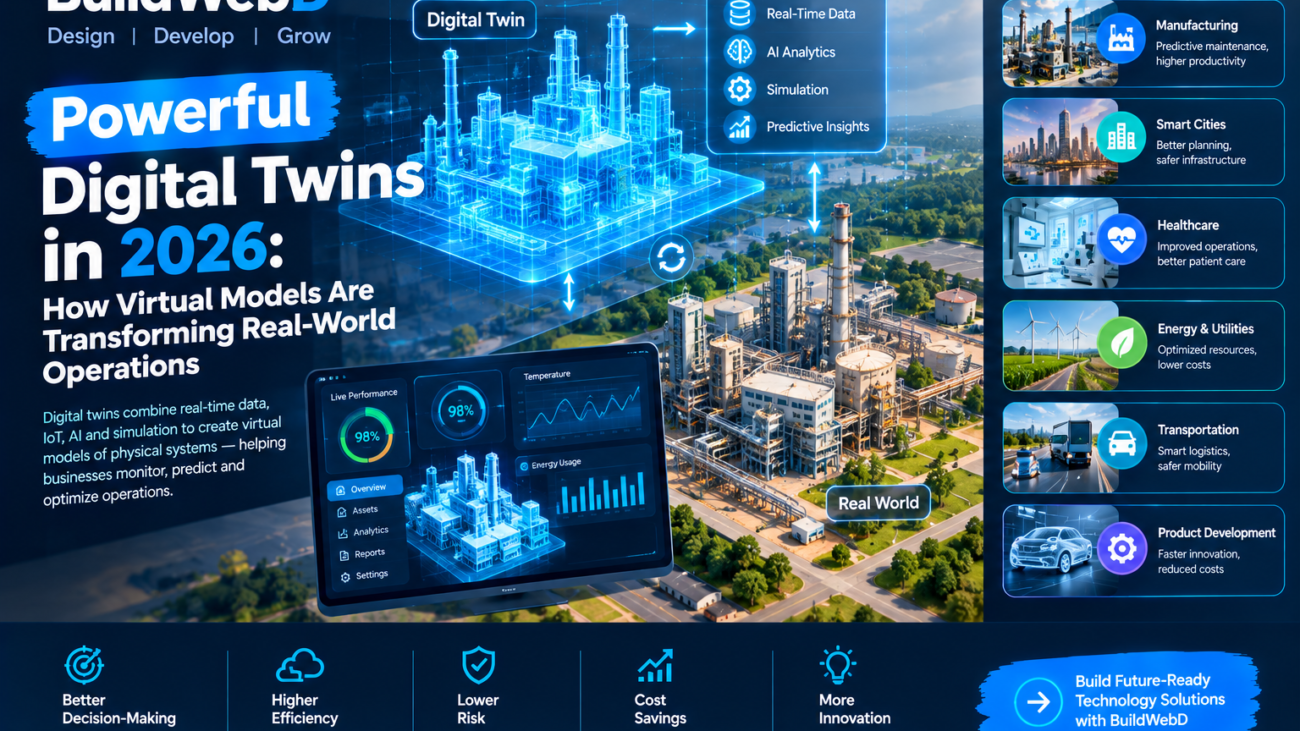
A digital twin is a virtual representation of a physical object or system. Unlike a basic 3D model, it can be connected to real-world data and updated as the physical environment changes.
For example, a manufacturer could create a digital representation of a production machine. Sensors can provide information about temperature, vibration, energy consumption, and operating conditions. The virtual model can then help engineers understand the machine’s current state and identify potential issues.
The growing importance of digital twins in 2026 comes from their ability to connect data with real-world operations rather than simply displaying information.
How Digital Twins Work
A typical digital twin ecosystem combines several technologies.
IoT sensors collect information from physical equipment or environments. Connectivity systems transfer that information to software platforms. Cloud or edge infrastructure processes the data, while analytics and AI can identify patterns and generate predictions.
The digital twin uses these inputs to represent the current condition of the physical system.
Organizations can then use dashboards, simulations, alerts, and analytics to understand what is happening and evaluate possible actions.
This creates a continuous relationship between the physical asset and its digital representation.
Why Digital Twins Are Growing in 2026
Organizations are under pressure to improve efficiency while controlling operational costs. They also need better ways to manage increasingly complex infrastructure.
Digital twins in 2026 can support this shift by allowing companies to observe systems continuously and test potential decisions before applying them to real environments.
Instead of waiting for a machine to fail, teams can analyze performance patterns. Instead of making infrastructure changes entirely through physical testing, engineers can evaluate scenarios digitally.
This approach can make technology-driven decision-making more proactive.
Digital Twins and Artificial Intelligence
Artificial intelligence is making digital twins more useful.
A traditional digital twin can show the current state of an asset or process. AI can go further by analyzing historical and real-time information to identify patterns and potential future outcomes.
For example, an AI-enabled industrial twin could identify unusual equipment behavior and alert an engineering team before a major failure occurs.
AI can also help organizations compare different scenarios. Teams may be able to evaluate how changing production schedules, equipment settings, resource allocation, or infrastructure configurations could affect performance.
This combination is one reason digital twins in 2026 are becoming increasingly relevant to enterprise technology strategies.
Digital Twins in Manufacturing
Manufacturing is one of the clearest applications.
Factories contain complex combinations of machines, software, employees, materials, and production processes. A digital representation can help organizations visualize and analyze these systems.
Engineers can use virtual models to investigate production bottlenecks, evaluate equipment performance, and explore process improvements.
Digital twins can also support predictive maintenance. Instead of relying only on fixed maintenance schedules, organizations can use operational data to better understand when equipment may require attention.
This can help reduce unexpected downtime and improve resource planning.
Digital Twins for Smart Cities and Infrastructure
The concept extends beyond factories.
Cities and infrastructure operators can use digital representations of roads, buildings, transport systems, utilities, and other physical environments.
A smart-city digital twin can combine information from sensors, geographic systems, traffic networks, and other data sources. This can help planners evaluate infrastructure changes and understand how different systems interact.
Recent initiatives in India are also exploring digital twins alongside AI and climate-risk modeling for infrastructure planning and resilience.
As urban environments become more connected, digital twins in 2026 can become useful tools for planning, monitoring, and optimization.
Digital Twins in Healthcare
Healthcare is another area where digital modeling can provide opportunities.
Hospitals contain complex environments involving medical equipment, facilities, patient flows, energy systems, and operational processes.
Digital twins can help organizations model these environments and identify ways to improve resource utilization.
In the longer term, increasingly sophisticated digital models could also support personalized simulations and advanced medical research, although healthcare applications require strong privacy, security, validation, and regulatory controls.
Digital Twins and Product Development
Digital twins can also change how companies design products.
Engineers can create a digital representation of a product and use simulations to study how it may perform under different conditions.
This can reduce dependence on repeated physical prototypes for certain stages of development.
Automotive, aerospace, electronics, energy, and industrial companies can benefit from this approach because product development often involves expensive testing and complex engineering requirements.
By connecting digital models with real-world product data, organizations can create a continuous feedback loop between design, production, operation, and improvement.
Security and Data Challenges
Despite their advantages, digital twins introduce new technology challenges.
A digital twin can depend on large amounts of operational data. If that data is inaccurate, incomplete, delayed, or compromised, the resulting model may provide misleading information.
Security is therefore essential.
Organizations need to protect sensors, networks, APIs, cloud systems, databases, and digital-twin platforms. Access controls and monitoring are also important because a compromised digital representation could expose information about real-world infrastructure.
Data governance is equally important when multiple systems and departments contribute information.
What Businesses Should Consider
Companies interested in adopting digital twins in 2026 should begin with a clearly defined business problem rather than building a digital model simply because the technology is available.
A practical starting point could be predictive maintenance, production optimization, energy management, infrastructure monitoring, or product simulation.
Businesses should then identify the required data sources, sensors, connectivity infrastructure, analytics capabilities, security controls, and software platforms.
The goal should be measurable business value.
A smaller digital-twin project with a clear operational objective can provide a better foundation than an unnecessarily complex enterprise-wide implementation.
The Future of Digital Twin Technology
The future of digital twins in 2026 is likely to involve deeper integration with AI, IoT, cloud computing, real-time analytics, and simulation technologies.
As organizations collect more operational data, digital representations can become increasingly detailed and responsive.
The technology may eventually become part of broader intelligent operating environments where physical systems continuously communicate with software platforms and AI-driven decision systems.
This could shift organizations from reactive operations toward predictive and simulation-based decision-making.
Conclusion
Technology is moving beyond simply digitizing information. The next stage is creating connected digital representations that help organizations understand and optimize the physical world.
Digital twins in 2026 are emerging as an important information technology capability because they bring together IoT, AI, cloud computing, analytics, and simulation. From manufacturing and infrastructure to product development and smart environments, the technology can help businesses make more informed decisions.
The most successful implementations will focus on real business outcomes, reliable data, security, and scalable technology architecture.
For businesses exploring emerging technology, BuildWebD can help create modern digital solutions that connect software, data, automation, and intelligent technologies to support future-ready operations.