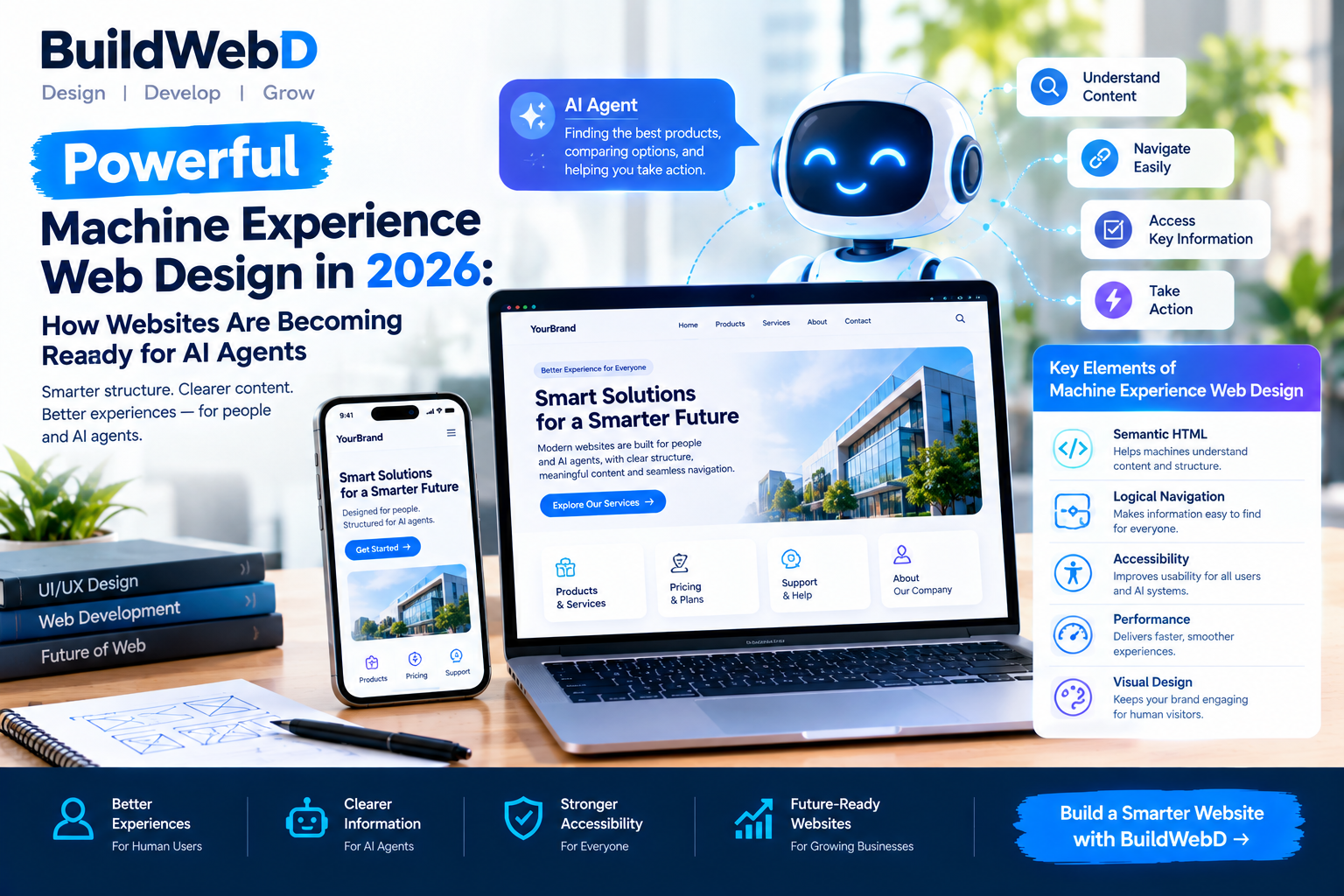
The way people interact with websites is changing, but humans are no longer the only users that websites need to consider. AI assistants and intelligent agents are increasingly capable of finding information, interpreting pages, comparing options, and helping users complete tasks. This shift is creating a new design consideration: websites need to communicate clearly with both humans and machines.
Machine experience web design in 2026 focuses on creating digital experiences that are visually useful for people while remaining structured, understandable, and accessible to intelligent software.
What Is Machine Experience Web Design?
Machine experience web design is an approach that considers how AI systems and software agents interpret and interact with a website.
Traditional web design focuses heavily on visual hierarchy, navigation, typography, interaction, responsiveness, and user experience. These fundamentals remain essential. However, websites are increasingly becoming sources of information for AI-powered tools.
A machine-friendly website should make its content, relationships, actions, and important information easy to interpret. Clear headings, semantic HTML, descriptive links, structured content, accessible components, and logical navigation can all contribute to this goal.
Machine experience web design in 2026 does not mean designing websites exclusively for AI. Instead, it means improving the underlying structure so that both people and intelligent systems can understand the experience more effectively.
Why Machine Experience Matters in 2026
AI agents are becoming more capable of interacting with digital environments. Instead of simply displaying search results, future interfaces can increasingly help users research products, compare services, summarize information, and perform actions.
This creates a new challenge for website owners. If important information is hidden inside complicated layouts, unclear components, poorly labeled buttons, or inconsistent content structures, both human users and automated systems may struggle to understand the site.
Good machine experience web design in 2026 therefore starts with a simple principle: make important information clear, connected, and meaningful.
Clear Content Structure Becomes More Important
One of the easiest ways to improve a website is to create a strong information hierarchy.
Every page should have a clear purpose. Headings should explain what each section contains. Paragraphs should answer specific questions. Links should describe their destinations instead of relying on vague phrases.
For example, a button labeled “Learn More” provides less context than “Explore Website Maintenance Services.” The second option communicates the destination more clearly to users and software systems.
This is why machine experience web design in 2026 increasingly overlaps with good content design. Clear communication benefits everyone.
Semantic HTML and Meaningful Components
Modern websites are often built with reusable components, but visual consistency should not come at the expense of semantic meaning.
Using appropriate HTML elements can help browsers, assistive technologies, search systems, and other software understand a page.
Navigation should behave like navigation. Headings should represent content hierarchy. Buttons should perform actions. Links should navigate to resources. Forms should have understandable labels.
These details may not look revolutionary, but they create a stronger foundation for machine experience web design in 2026.
Designing for AI Agents
AI agents may interact with websites differently from traditional human visitors. An agent could need to locate product information, identify pricing, understand availability, find contact details, or determine the next appropriate action.
Designers can prepare for this by making important information explicit.
Product pages should clearly identify product names, features, prices, availability, specifications, and policies. Service websites should clearly explain offerings, locations, pricing models, contact methods, and business information.
The objective of machine experience web design in 2026 is not to manipulate AI systems. It is to remove unnecessary ambiguity.
Navigation Should Be Simple and Logical
Complex navigation can create friction for users and make automated interpretation harder.
A strong website should have a logical navigation structure where important pages can be reached without unnecessary steps. Related pages should connect naturally, and important services should not be buried several levels deep.
Breadcrumbs, descriptive internal links, consistent menus, and clear page relationships can make large websites easier to understand.
For designers, this means information architecture is becoming just as important as visual styling.
Visual Design Still Matters
Machine experience does not replace human experience.
People still respond to typography, spacing, color, imagery, layout, branding, and motion. A website that is technically structured but visually confusing will not provide a good experience.
The strongest machine experience web design in 2026 combines machine-readable structure with distinctive human-centered design.
That means designers should not remove creativity. Instead, they should make creativity work within a strong information architecture.
Performance Is Part of the Experience
A beautiful website that takes too long to load can lose users before they interact with it.
Performance should therefore be considered during the design process rather than after development. Designers can help by choosing efficient visual assets, avoiding unnecessary effects, simplifying complex interfaces, and prioritizing important content.
Purposeful motion can improve feedback and orientation, but excessive animation can distract users and increase technical complexity.
In machine experience web design in 2026, performance, usability, accessibility, and machine readability should work together rather than being treated as separate goals.
Accessibility and Machine Experience
Accessibility and machine experience often reinforce each other.
Descriptive labels, logical headings, keyboard-friendly controls, readable text, appropriate contrast, meaningful form fields, and understandable error messages make websites easier for people with different abilities.
At the same time, many of these practices create clearer structures for software to interpret.
This makes accessibility a valuable part of machine experience web design in 2026, rather than an optional design feature.
How Businesses Can Prepare
Businesses do not need to completely redesign their websites overnight.
The first step is to audit the existing information architecture. Identify important pages, confusing navigation paths, unclear buttons, duplicated content, missing labels, and inconsistent terminology.
Next, review page structure. Make sure headings, links, forms, service descriptions, product information, and calls to action communicate their purpose clearly.
Design teams should also create reusable components with defined states and consistent behavior. This makes websites easier to maintain as they grow.
Finally, designers and developers should work together. Machine-friendly experiences depend on both visual decisions and technical implementation.
The Future of Web Design
The future of web design will not be about choosing between human experience and machine experience. Websites will increasingly need to support both.
People will continue to expect attractive, fast, accessible, personalized experiences. At the same time, AI systems will need clear information, understandable structures, and predictable interactions.
This makes machine experience web design in 2026 an important direction for businesses preparing their websites for the next generation of digital interaction.
The websites that perform best will not necessarily be the ones with the most visual effects. They will be the ones that communicate clearly, load efficiently, guide users naturally, and expose meaningful information through a well-designed structure.
Conclusion
Machine experience web design in 2026 represents a broader evolution in how websites are designed. Instead of thinking only about how a page looks to a human visitor, designers can also consider how its structure, content, controls, and relationships are interpreted by intelligent software.
The goal is not to create cold or machine-focused websites. It is to build digital experiences that are clearer, faster, more accessible, easier to navigate, and more useful for everyone.
As AI agents become a larger part of the digital ecosystem, businesses that invest in strong information architecture and thoughtful machine experience web design in 2026 can create websites that are better prepared for the future.
BuildWebD can help businesses create modern websites that combine strong visual design, performance, usability, accessibility, and future-ready technology.
Add a Comment