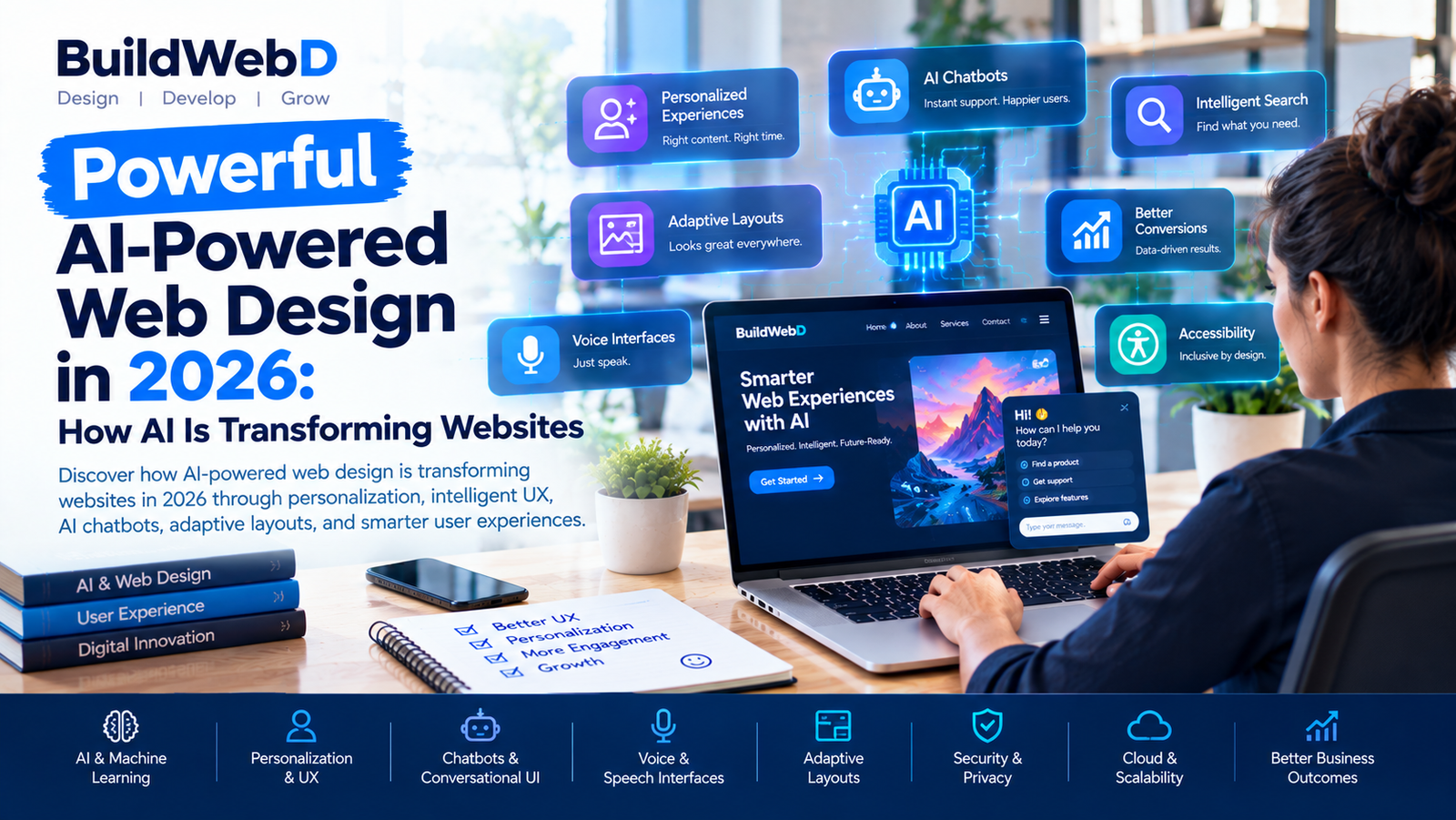
Web design is entering a new phase. Websites are no longer limited to static pages, fixed layouts, and the same experience for every visitor. Artificial intelligence is helping designers and businesses create websites that can understand users, personalize experiences, automate tasks, and deliver more interactive digital journeys.
As AI tools become more accessible, AI-powered web design is becoming an important part of modern website strategy.
In 2026, AI is influencing everything from the initial design process to personalization, search, customer support, and website optimization.
What Is AI-Powered Web Design?
AI-powered web design means using artificial intelligence to improve the way websites are designed, built, personalized, and experienced.
AI can assist with:
- Website layout ideas
- Content creation
- User experience research
- Personalized content
- Intelligent search
- AI chatbots
- Customer recommendations
- Automated testing
- Conversion optimization
- Accessibility checks
The objective is not to replace designers. Instead, AI can help designers explore more ideas and automate repetitive work while humans remain responsible for creativity, strategy, brand identity, and user experience.
1. AI Is Accelerating the Design Process
One of the biggest changes in AI-powered web design is how quickly designers can move from an idea to a working concept.
AI tools can help generate design directions, content structures, interface concepts, and visual variations.
This allows designers to explore multiple possibilities before choosing a final direction.
Figma’s 2026 research, based on 8,403 survey responses and 639 qualitative interviews across designers, developers, and product managers, shows how AI is becoming increasingly integrated into design and development workflows.
However, human judgment remains important. A generated design still needs to match the brand, audience, accessibility requirements, and business objectives.
2. Personalized Website Experiences
Traditional websites often show essentially the same content to every visitor.
AI can change this model.
A website can use available behavioral or contextual signals to help personalize recommendations, content, search results, and user journeys.
For example, an ecommerce website could highlight products related to a visitor’s interests, while a B2B website could surface information relevant to different customer segments.
Personalization should provide useful information without making visitors feel that their privacy is being ignored.
3. AI Chatbots Are Becoming More Useful
AI chatbots are moving beyond simple FAQ widgets.
Modern conversational interfaces can help visitors find products, answer questions, explain services, recommend content, and guide users toward relevant pages.
Figma’s current 2026 web-design research specifically identifies conversational and agentic chatbots as an emerging AI design direction.
For businesses, an intelligent website assistant can provide support outside traditional business hours while helping visitors find information faster.
4. Smarter Website Search
Website search is also changing.
Instead of requiring users to type exact keywords, AI-powered search can interpret natural-language questions.
A visitor might ask:
“Which website package is suitable for a small ecommerce business?”
Instead of returning pages containing matching words, an intelligent search experience can potentially understand the question and guide the visitor toward relevant information.
This can be particularly useful for ecommerce stores, documentation websites, large content platforms, and service businesses.
5. Voice and Conversational Interfaces
Voice interaction is another area gaining attention.
Users can increasingly interact with digital experiences through natural language instead of relying entirely on menus and buttons.
Voice interfaces can support accessibility, hands-free interactions, search, customer assistance, and conversational navigation.
Figma identifies voice-activated interfaces as one of its AI-related web design directions for 2026.
Designers should nevertheless provide traditional navigation as an alternative so users can choose how they interact with the website.
6. AI-Driven Conversion Optimization
AI can also be used to analyze how visitors interact with a website.
Businesses can test different headlines, layouts, calls to action, forms, and content variations to understand what works for different audiences.
Webflow’s 2026 website research identifies AI-driven search optimization, personalization, analytics, and automated processes among areas attracting business interest.
The important principle is to use data to improve the user journey rather than manipulate visitors.
7. AI and Accessibility
AI can support accessibility workflows by helping identify potential problems in content, structure, images, and interfaces.
For example, AI-assisted tools can help designers review content alternatives, identify possible accessibility issues, or create initial descriptions for visual content.
But automated checking should not replace proper accessibility testing.
Designers and developers should still test keyboard navigation, contrast, screen-reader compatibility, forms, focus states, and responsive behavior.
8. Human Creativity Still Matters
The growth of AI-powered web design does not make human designers less important.
In fact, distinctive human creativity can become more valuable as AI makes generic design easier to produce.
Webflow’s 2026 trend research highlights human craft and distinctive visual systems as important differentiators in an environment where AI-assisted creation is increasingly accessible.
A strong website still needs a clear brand voice, thoughtful visual identity, useful content, and an understanding of real users.
How Businesses Can Prepare
Businesses do not need to add AI to every part of their website.
Start by identifying areas where AI can provide genuine value.
Consider:
- Can AI improve customer support?
- Can personalization make content more relevant?
- Can intelligent search help visitors?
- Can AI reduce repetitive design or content work?
- Can AI help analyze website performance?
- Can AI improve the overall customer journey?
The best implementation combines AI capabilities with strong design fundamentals.
Conclusion
AI-powered web design is changing how businesses think about websites in 2026. AI-assisted design, personalization, conversational interfaces, intelligent search, voice interaction, accessibility support, and automated optimization are creating new possibilities for digital experiences.
But technology should support the user rather than overwhelm them. The strongest websites will combine AI with clear navigation, strong branding, accessibility, performance, useful content, and human creativity.
BuildWebD helps businesses create modern websites that combine professional web design, development, AI capabilities, SEO, performance, and user experience. If you want to transform your website into a smarter and more engaging digital experience, BuildWebD can help you plan and build a solution around your business goals.
The future of AI-powered web design is not simply about adding artificial intelligence to a website. It is about using technology thoughtfully to create better experiences for real people.
Add a Comment