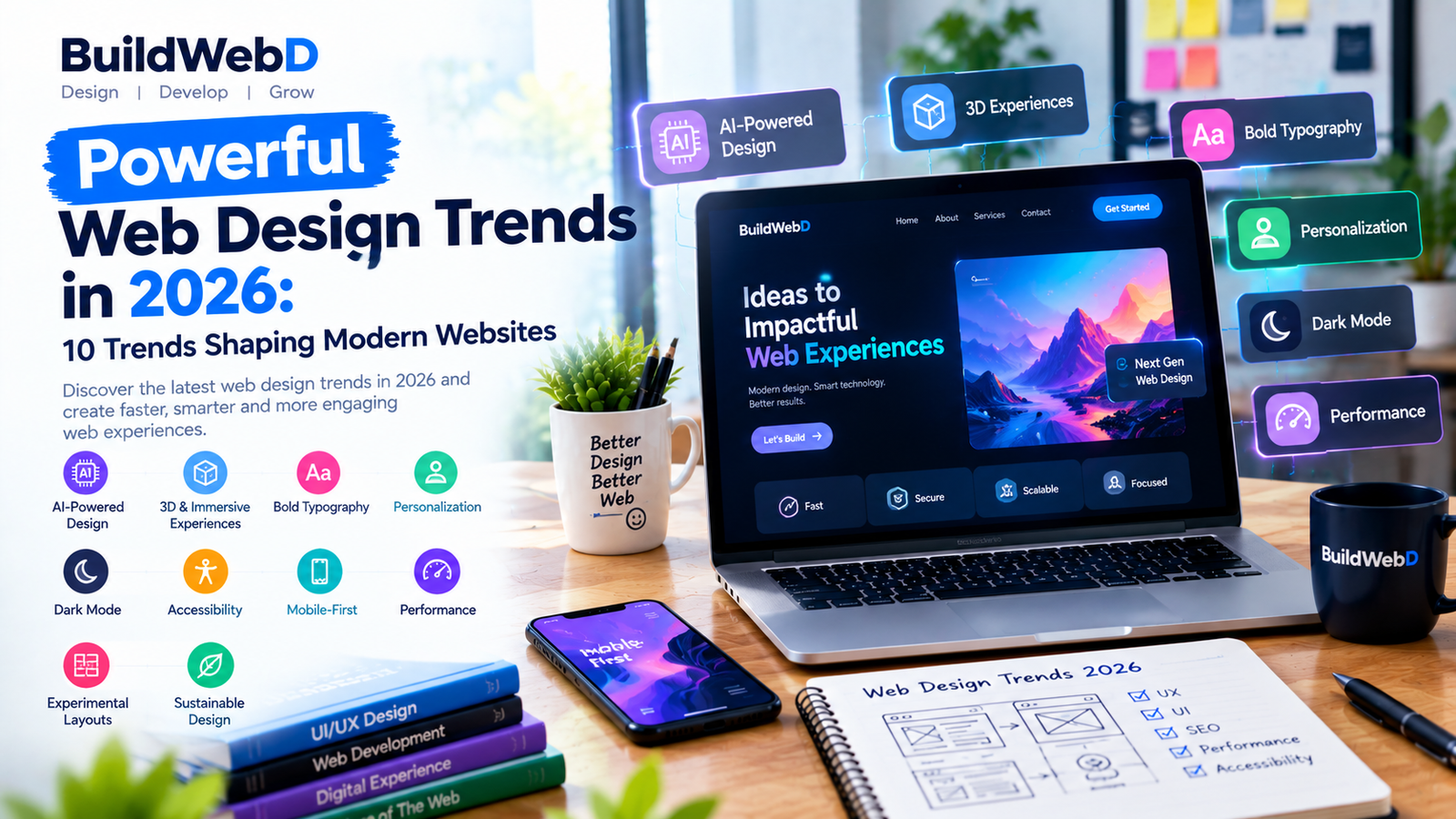
The way people interact with websites is changing quickly. Modern users expect websites to be attractive, fast, accessible, interactive, and easy to use on every device. At the same time, artificial intelligence, immersive experiences, personalization, and new web technologies are changing how designers create digital experiences.
Understanding the latest web design trends in 2026 can help businesses create websites that look modern while delivering a better experience for visitors.
Here are 10 important web design trends in 2026 that businesses and designers should know.
1. AI-Powered Web Design
Artificial intelligence is becoming an important part of the web design process. Designers can use AI tools to explore layouts, generate ideas, create content variations, and speed up repetitive tasks.
AI can also help websites become more interactive through intelligent chatbots, recommendations, search experiences, and personalized content.
However, AI should support human creativity rather than replace design thinking. A successful website still needs a clear brand identity, strong user experience, and meaningful content.
2. Immersive 3D Experiences
Three-dimensional elements are becoming increasingly popular in modern website design. Interactive 3D graphics, product models, animations, and immersive visuals can make websites more engaging.
For ecommerce businesses, 3D product experiences can help customers understand products before making a purchase. Technology companies can also use interactive visualizations to explain complex products or services.
The key is balance. Heavy visual effects should not negatively affect loading speed or usability.
3. Bold Typography and Strong Visual Identity
Typography is becoming a major design element rather than simply a way to display text.
Large headlines, custom fonts, variable typography, creative text layouts, and strong visual hierarchy can help websites communicate their message immediately.
One of the important web design trends in 2026 is using typography to create personality and make a brand memorable.
Businesses should choose typography that matches their brand while maintaining readability across desktop and mobile screens.
4. Motion and Micro-Interactions
Small animations can make a website feel more responsive and engaging.
Examples include animated buttons, hover effects, scrolling transitions, loading animations, menu interactions, and subtle feedback after completing an action.
These micro-interactions can guide users through a website and make interfaces feel more intuitive.
However, animation should have a purpose. Too many effects can distract visitors and make a website difficult to navigate.
5. Personalized User Experiences
Personalization is another major direction in web design trends in 2026.
Websites can increasingly adapt content, recommendations, messages, and user journeys based on visitor behavior or preferences.
For example, an ecommerce website can display relevant product recommendations, while a service website can present different content based on the visitor’s interests.
Personalization should remain transparent and useful. Businesses should avoid making the experience feel intrusive.
6. Dark Mode and Flexible Interfaces
Dark mode has moved from a niche feature to a common interface option.
Modern websites can provide light and dark themes while allowing users to choose the appearance that works best for them.
Good dark-mode design requires careful attention to contrast, typography, icons, images, and interactive elements.
Flexible interfaces can also improve the overall user experience by giving visitors more control over how they interact with a website.
7. Accessibility-First Design
Accessibility is becoming an essential part of professional web design.
A website should be usable by people with different abilities and assistive technologies. Designers should consider color contrast, readable typography, keyboard navigation, focus states, semantic structure, alternative text, and accessible forms.
Accessibility should be considered from the beginning of a project instead of being treated as a final checklist.
This is one of the most important web design trends in 2026 because inclusive design can help businesses reach a wider audience while creating a better experience for everyone.
8. Mobile-First and Performance-Focused Design
A modern website must work well on smartphones, tablets, laptops, and large screens.
Responsive layouts, optimized images, efficient animations, lightweight code, and smart content structures can help websites perform better across different devices.
Designers should consider mobile layouts from the beginning rather than simply shrinking a desktop design.
Performance and design should work together. A visually impressive website is less effective if visitors have to wait too long for it to load.
9. Experimental Navigation and Layouts
Traditional website layouts are evolving.
Designers are experimenting with unconventional navigation, overlapping sections, asymmetrical layouts, horizontal scrolling, interactive menus, and creative page transitions.
These approaches can help brands stand out, particularly in creative industries, portfolios, technology products, and premium brand websites.
Still, experimentation should never come at the expense of usability. Visitors should always understand where they are and how to find important information.
10. Sustainable and Human-Centered Design
Sustainable web design focuses on creating digital experiences that use resources efficiently.
Optimized images, cleaner code, efficient animations, lightweight pages, and efficient hosting can contribute to better performance and lower resource usage.
At the same time, human-centered design remains essential. Technology should solve user problems rather than simply add visual complexity.
The strongest web design trends in 2026 combine technology with simplicity, accessibility, performance, and genuine user needs.
How Businesses Can Use These Web Design Trends
Businesses do not need to implement every trend on their website.
Instead, start with the target audience and business objectives. A corporate website may need a professional and accessible design, while an ecommerce brand may benefit more from personalization, product visualization, and interactive experiences.
Before redesigning a website, consider:
- Is the website easy to navigate?
- Does it work well on mobile devices?
- Is the content easy to understand?
- Are important pages accessible?
- Does the website load quickly?
- Does the design match the brand?
- Can new technologies improve the customer experience?
Choosing the right combination of trends is more valuable than following every popular design style.
Conclusion
The latest web design trends in 2026 show that modern websites are becoming more intelligent, interactive, personalized, accessible, and performance-focused.
AI, 3D experiences, bold typography, micro-interactions, personalization, dark mode, accessibility, responsive design, experimental layouts, and sustainable practices are shaping the next generation of websites.
Businesses should focus on using these trends strategically rather than adding technology simply for visual appeal.
BuildWebD helps businesses create modern websites that combine professional web design, development, performance, SEO, and user experience. If you are planning a new website or redesigning an existing one, BuildWebD can help turn modern web design trends in 2026 into a practical website that supports your business goals.
Add a Comment