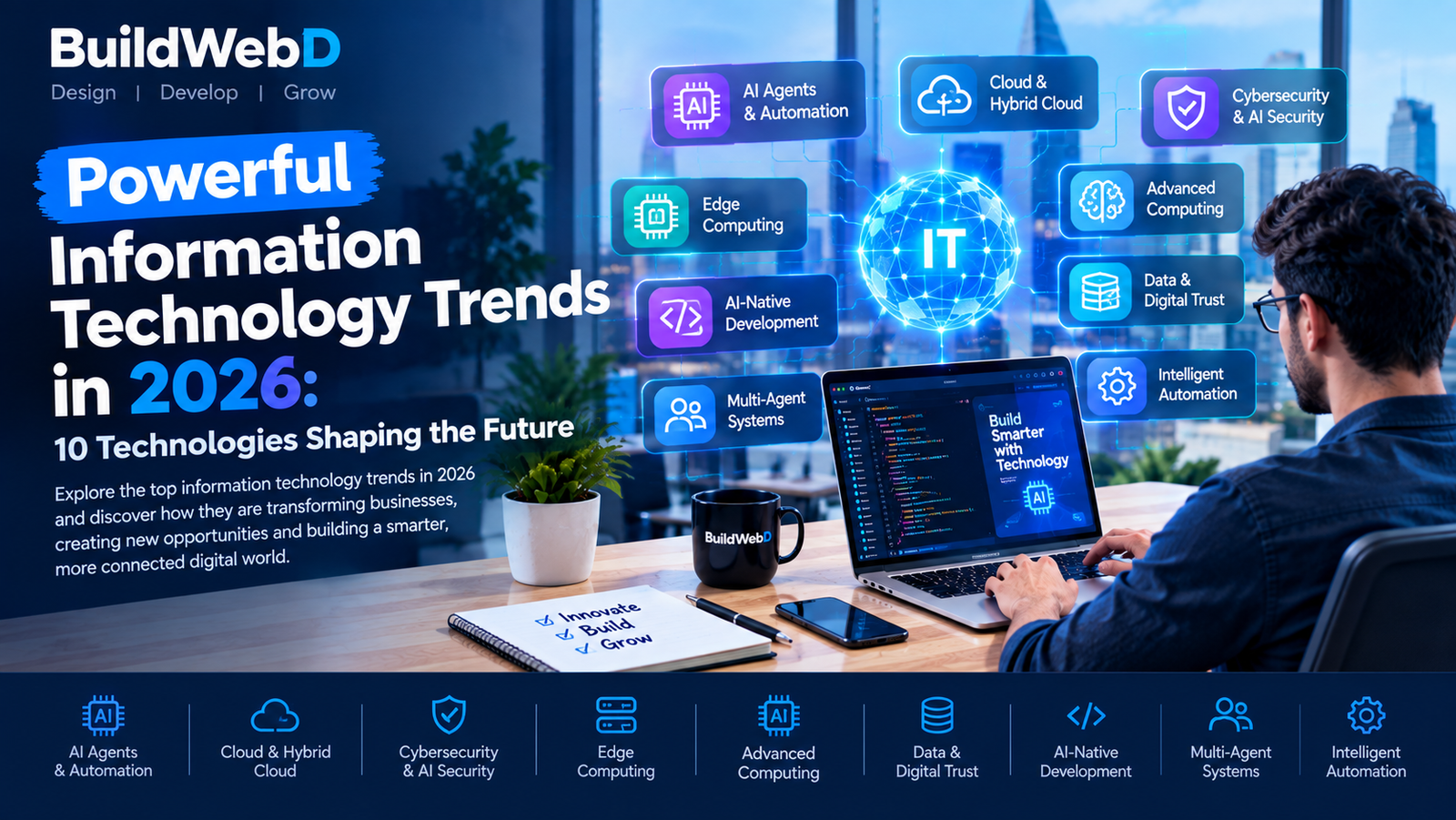
Information technology is evolving faster than ever. Artificial intelligence, cybersecurity, cloud computing, automation, advanced computing, and connected systems are changing how businesses build products and operate their digital infrastructure.
Understanding the latest information technology trends in 2026 can help businesses and technology professionals prepare for changing customer expectations, new digital opportunities, and emerging technical challenges.
Here are 10 important information technology trends in 2026 that are shaping the future of technology.
1. AI Agents and Autonomous Systems
AI is moving beyond simple question-and-answer applications. AI agents can be designed to complete multi-step tasks, interact with software tools, analyze information, and support business workflows.
This makes agentic AI one of the most important areas in current information technology.
Businesses are exploring AI agents for customer support, software development, research, workflow automation, data analysis, and internal operations.
The important consideration is control. AI systems need appropriate permissions, monitoring, security, and human oversight when they interact with important business systems.
2. AI-Native Software Development
Software development is also being transformed by AI.
Developers can use AI coding assistants and coding agents to generate code, explain existing systems, create tests, identify errors, and accelerate development workflows.
AI-native development is changing the role of developers from simply writing code toward designing systems, reviewing AI-generated work, managing architecture, and solving complex problems.
For businesses, this can create opportunities to develop and improve digital products more efficiently.
3. Cybersecurity and AI Security
As technology becomes more connected, cybersecurity is becoming increasingly important.
AI creates new security opportunities but also introduces new risks. Organizations need to protect applications, APIs, cloud environments, databases, identities, and AI systems.
Modern security strategies increasingly involve continuous monitoring, identity management, access controls, threat detection, secure development, and governance.
Businesses should treat security as part of technology planning rather than something added after a digital product is completed.
4. Cloud and Hybrid Cloud Computing
Cloud computing remains an important part of modern IT infrastructure.
Organizations are increasingly using combinations of public cloud, private infrastructure, and edge environments depending on their performance, security, cost, and regulatory requirements.
Hybrid cloud architectures can help businesses choose where different workloads should run.
The focus is shifting from simply moving applications to the cloud toward creating efficient, scalable, observable, and well-managed cloud environments.
5. Edge Computing
Edge computing brings processing closer to the location where data is generated or consumed.
This can be useful for applications that require low latency, including connected devices, industrial systems, real-time analytics, smart infrastructure, and certain AI workloads.
Instead of sending every piece of information to a distant centralized environment, some processing can happen closer to users and devices.
Edge computing will become increasingly relevant as connected devices and real-time applications expand.
6. Confidential and Privacy-Focused Computing
Data privacy is becoming an increasingly important technology consideration.
Confidential computing focuses on protecting sensitive data while it is being processed through specialized hardware and security technologies.
Organizations handling financial, healthcare, enterprise, or sensitive customer information can benefit from stronger approaches to protecting data throughout its lifecycle.
Privacy-focused technology will become increasingly important as organizations use more AI and cloud-based systems.
7. Multi-Agent AI Systems
Another emerging area is multi-agent AI.
Instead of relying on one AI agent, multiple specialized agents can potentially work together on different parts of a larger task.
For example, one agent might gather information, another could analyze it, and another could help prepare an output.
This approach creates new possibilities for business automation, but it also creates additional requirements for permissions, monitoring, coordination, and accountability.
8. AI Infrastructure and Advanced Computing
The growth of AI is increasing demand for powerful computing infrastructure.
AI applications require substantial processing resources, storage, networking, and specialized hardware.
This is encouraging investment in advanced data centers, AI accelerators, high-performance computing, efficient networking, and energy-conscious infrastructure.
As AI becomes part of more business applications, infrastructure will become an increasingly important part of technology strategy.
9. Digital Trust and Data Provenance
As AI-generated content becomes more common, businesses need better ways to understand where digital information comes from and whether it has been modified.
Digital provenance can help organizations establish information history, ownership, authenticity, and traceability.
This can become especially valuable for businesses working with sensitive documents, digital media, financial information, and AI-generated content.
Trust will become an important part of the digital experience.
10. Intelligent Automation
Automation is expanding beyond simple repetitive tasks.
Modern automation can combine AI, APIs, cloud platforms, analytics, and business applications to create more intelligent workflows.
Businesses can automate processes such as customer support, reporting, document processing, data entry, notifications, and internal operations.
The goal is not simply to automate everything. Effective automation should reduce unnecessary manual work while maintaining quality, security, and appropriate human control.
How Businesses Can Prepare for These Technology Trends
Businesses do not need to adopt every emerging technology immediately.
A better approach is to identify specific business problems and determine whether new technology can solve them.
Start by reviewing:
- Current IT infrastructure
- Cybersecurity practices
- Cloud strategy
- Data management
- AI opportunities
- Software development processes
- Business automation
- Customer experience
- Scalability requirements
Technology decisions should be connected to measurable business objectives.
Conclusion
The latest information technology trends in 2026 demonstrate how quickly AI, cloud computing, cybersecurity, automation, advanced infrastructure, and digital trust are changing the technology landscape.
AI agents, AI-native development, cybersecurity, hybrid cloud, edge computing, confidential computing, multi-agent systems, AI infrastructure, digital provenance, and intelligent automation are creating new opportunities for businesses and technology professionals.
The future of IT will not depend on one technology alone. It will come from combining multiple technologies into secure, scalable, and useful digital solutions.
BuildWebD helps businesses turn modern technology into practical digital solutions through web development, AI-powered solutions, digital platforms, ecommerce development, SEO, and technology-focused services.
If your business is preparing for the future of technology, BuildWebD can help you create digital solutions designed around your goals, customers, and long-term growth.
Add a Comment