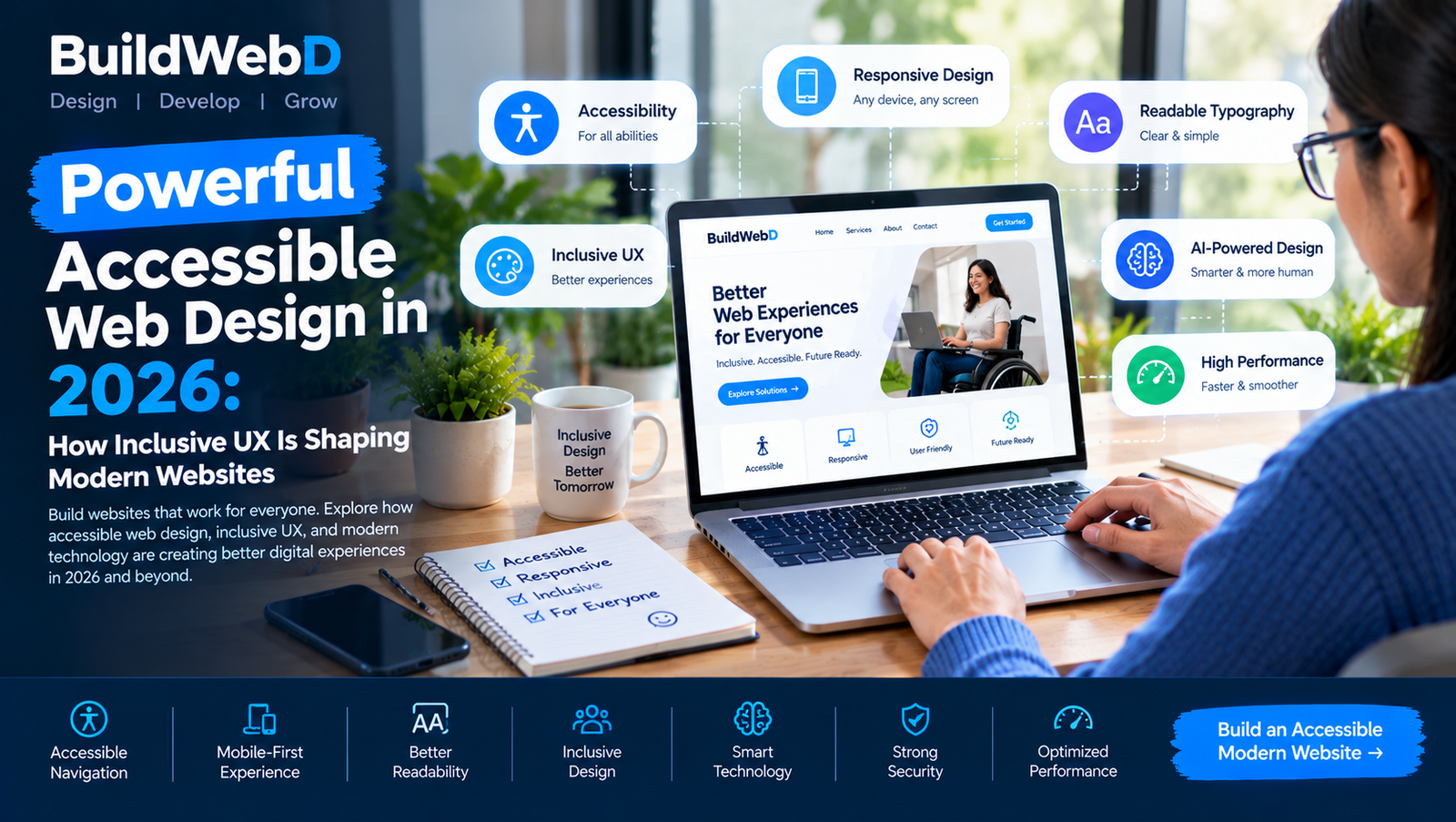
Web design is no longer only about creating attractive pages. Modern websites need to be easy to navigate, fast to use, responsive across devices, and accessible to as many people as possible. As digital experiences become more sophisticated, accessible web design in 2026 is becoming an important part of building websites that work effectively for different users and situations.
Accessibility is also closely connected with good user experience. Clear navigation, readable typography, sufficient color contrast, keyboard-friendly interactions, meaningful buttons, and responsive layouts can make websites easier to use for everyone. Modern web guidance from Google emphasizes building websites that are accessible, fast, secure, and usable across browsers and devices.
What Is Accessible Web Design?
Accessible web design means creating websites that people with different abilities can use effectively. This includes people who may have visual, hearing, mobility, cognitive, or other accessibility needs.
However, accessibility is not only about permanent disabilities. Someone may temporarily have an injury that makes mouse usage difficult, experience poor lighting that makes a screen harder to read, or use a slow connection while traveling.
Accessible web design in 2026 therefore focuses on creating flexible experiences that can adapt to different users, devices, and circumstances.
Why Accessibility Matters in Modern Web Design
A website can look visually impressive and still provide a poor experience if users cannot understand its content or navigate its interface.
For example, a low-contrast text color can make content difficult to read. A navigation menu that works only with a mouse can create problems for keyboard users. Small touch targets can make mobile interaction frustrating.
Accessibility encourages designers to consider these situations during the design process instead of trying to fix them after the website has already been built.
Accessible Navigation Is Becoming Essential
Navigation is one of the most important elements of a website. Visitors should be able to understand where they are, what information is available, and how to move between pages.
Modern accessible navigation should have clear labels, logical structure, visible focus states, and keyboard support. Designers should avoid unnecessarily complicated menus that force users to search for basic information.
A simple navigation structure can also benefit businesses because visitors can reach important pages more quickly.
Typography and Readability
Typography plays a major role in website accessibility. Designers need to consider font size, line spacing, character spacing, paragraph width, and visual hierarchy.
A modern website should make important information easy to scan without forcing visitors to read large blocks of tightly packed text.
Responsive typography is particularly important because users may access the same website on a large desktop monitor, tablet, or smartphone.
Modern CSS capabilities are also giving designers more options for responsive and adaptive interfaces. The 2026 Baseline includes newer CSS features such as container style queries, field-sizing, and other capabilities that can support modern interface development.
Better Color Contrast and Visual Clarity
Color is an important part of branding and visual design, but it should not be the only method used to communicate information.
For example, a form should not rely only on red and green colors to indicate errors and success. Icons, text labels, and other visual indicators can provide additional context.
Designers should also make sure that important text has sufficient contrast against its background.
Accessible web design in 2026 treats color as part of a larger communication system rather than simply a decorative choice.
Designing for Keyboard and Touch Users
Not every visitor interacts with a website using a mouse.
Some users rely on keyboards, assistive technologies, touchscreens, voice interfaces, or other input methods. Websites therefore need interaction patterns that work across different methods of navigation.
Buttons, links, forms, menus, and interactive components should provide clear states and predictable behavior.
This approach also improves the overall usability of websites because visitors can interact with interfaces more confidently.
Mobile Accessibility Is Part of Modern UX
Mobile-first design has become a standard part of modern web development, but responsive design alone does not guarantee accessibility.
Mobile websites need appropriately sized touch targets, readable text, simple navigation, responsive layouts, and content that remains understandable on smaller screens.
Designers should also consider orientation changes, different screen sizes, browser settings, and user preferences.
Google’s responsive-design guidance specifically includes accessibility, different input mechanisms, screen configurations, and user preferences as important parts of modern responsive experiences.
Accessibility and AI-Powered Web Design
AI is increasingly being used to create layouts, prototypes, content, components, and design systems. This can accelerate the web-design process, but AI-generated interfaces still require human review.
A generated interface might contain poor contrast, unclear interaction patterns, missing labels, or accessibility problems.
This makes accessibility testing even more important as AI becomes part of design and development workflows.
The goal should not simply be to generate websites faster. The goal should be to create websites that remain usable, understandable, maintainable, and accessible.
Performance and Accessibility Work Together
Website performance is another important part of the user experience. A visually impressive website can still frustrate visitors if pages take too long to load or interactions respond slowly.
Modern web development increasingly connects design decisions with performance. Large images, unnecessary animations, excessive scripts, and heavy components can affect the experience.
Designers should therefore think about performance while creating layouts rather than leaving optimization entirely to developers.
Accessible Design Can Support Better Business Experiences
Accessibility can also contribute to clearer business communication.
When websites use simple navigation, readable content, descriptive buttons, logical layouts, and consistent design systems, visitors can understand products and services more easily.
For businesses, this can make important actions such as contacting a company, requesting a quote, booking a service, or completing a purchase easier to understand.
Accessible design should therefore be considered part of user experience strategy rather than simply a technical requirement.
How Businesses Can Improve Website Accessibility
Businesses can begin with a practical accessibility review. Check whether the website can be navigated using a keyboard, whether text has adequate contrast, whether images have meaningful alternative text, and whether forms provide clear labels and error messages.
Designers should also review headings, navigation, buttons, links, mobile layouts, animations, and interactive components.
Accessibility testing should happen throughout the design and development process rather than only before launch.
Teams can also build accessible components into their design systems. This makes accessibility easier to maintain when new pages and features are added.
The Future of Accessible Web Design
The future of web design is likely to involve greater personalization, AI-assisted interfaces, responsive experiences, and increasingly sophisticated web technologies. At the same time, the fundamental need for clear and inclusive user experiences will remain.
Accessible web design in 2026 represents a shift toward designing websites around real users rather than an imaginary “average” visitor.
The best digital experiences combine attractive visual design with usability, accessibility, performance, responsive behavior, and clear communication.
Conclusion
Modern websites need to do more than look good. They need to work across devices, support different interaction methods, communicate information clearly, and provide a reliable experience for a wide range of users.
Accessible web design in 2026 is becoming an important approach for businesses that want to create websites that are inclusive, usable, and prepared for the future. By combining accessible navigation, readable typography, strong contrast, responsive layouts, keyboard support, performance optimization, and thoughtful AI-assisted design, businesses can create stronger digital experiences.
For companies looking to build modern, user-focused websites, BuildWebD can help turn accessibility, responsive design, performance, and modern technology into a practical website experience that supports both users and business goals.
Add a Comment