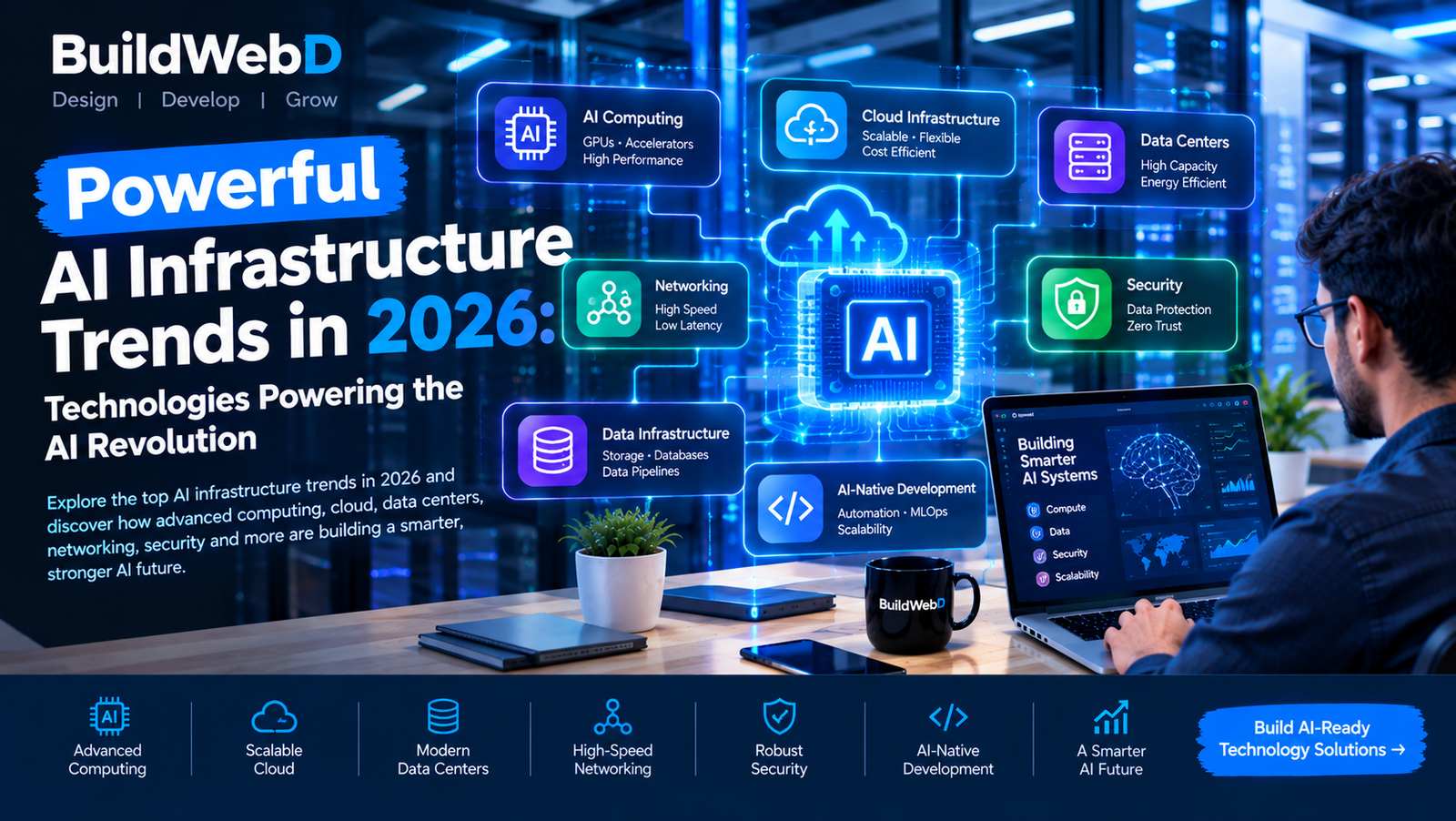
Artificial intelligence is no longer limited to chatbots and experimental software. Modern AI applications depend on a large technology foundation that includes computing power, cloud platforms, data centers, networking, storage, cybersecurity, and specialized hardware.
This foundation is becoming increasingly important as businesses move from experimenting with AI to deploying AI-powered applications at scale. Understanding the AI infrastructure trends in 2026 can help businesses and technology teams understand what is changing behind today’s AI applications.
What Is AI Infrastructure?
AI infrastructure is the combination of hardware, software, networking, cloud services, data systems, and security technologies required to develop, train, deploy, and operate artificial intelligence applications.
A modern AI infrastructure environment can include powerful processors, GPUs, AI accelerators, high-speed networks, cloud computing platforms, data storage, databases, machine learning platforms, monitoring systems, and security controls.
As AI applications become more demanding, infrastructure is becoming an important part of technology strategy rather than simply a background IT function.
Why AI Infrastructure Is Becoming Important
One of the most important AI infrastructure trends in 2026 is the movement from small AI experiments toward larger production systems.
Businesses are using AI for customer service, software development, analytics, automation, content generation, cybersecurity, recommendation systems, and business intelligence. These applications require reliable infrastructure that can process large amounts of data and support continuous workloads.
The infrastructure supporting AI must therefore provide sufficient computing capacity while also managing performance, security, scalability, and operational costs.
AI Computing Is Becoming More Specialized
Traditional computing environments are not always optimized for modern AI workloads. AI models can require significant parallel processing, making specialized processors increasingly important.
GPUs and other AI accelerators can perform large numbers of calculations simultaneously, making them useful for training and running machine learning models.
This is one reason AI computing platforms are becoming a major part of modern technology architecture. Businesses building serious AI applications need to consider not only software models but also the computing environment required to run them efficiently.
AI Data Centers Are Evolving
Data centers are becoming an important part of the AI infrastructure discussion. AI workloads can require substantial computing resources, memory, networking capacity, cooling, and electricity.
Modern AI data centers therefore need infrastructure designed around high-performance computing rather than traditional enterprise workloads alone.
Organizations are increasingly considering factors such as processor capacity, network performance, storage, cooling systems, energy efficiency, and geographic location when designing AI infrastructure.
The growth of AI is consequently influencing how future data centers are planned and operated.
Cloud Computing Remains Important
Cloud computing continues to provide businesses with flexible access to computing resources.
Instead of purchasing every server and accelerator in advance, organizations can use cloud infrastructure to access computing, storage, databases, networking, and AI services according to their requirements.
For startups and smaller businesses, this can make AI development more accessible. For larger organizations, cloud platforms can provide scalable infrastructure while supporting distributed teams and multiple applications.
However, cloud architecture needs careful planning because AI workloads can become expensive when computing resources are not optimized.
Hybrid Infrastructure Is Gaining Attention
Not every AI workload needs to operate entirely in a public cloud environment.
Some organizations may keep sensitive information within private infrastructure while using cloud platforms for scalable computing or development workloads. This creates hybrid environments that combine private and public resources.
Hybrid infrastructure can be useful when organizations need to balance scalability, security, compliance, performance, and cost.
The right architecture depends on the business requirements, type of data, regulatory environment, and AI workload.
AI Networking Is Becoming Critical
High-performance AI systems depend not only on processors but also on fast communication between computing resources.
When large AI workloads are distributed across multiple processors or machines, the network connecting those systems can become an important performance factor.
This means modern AI infrastructure requires high-speed networking, efficient data movement, and architecture designed to minimize unnecessary communication delays.
As AI systems grow, networking becomes an increasingly important component of overall infrastructure design.
Data Infrastructure Supports Better AI
AI systems are only as useful as the data available to them.
Businesses need reliable systems for collecting, storing, processing, securing, and managing data. Databases, data warehouses, data lakes, pipelines, vector databases, and data governance systems can all play important roles in modern AI applications.
Poor-quality or poorly organized data can reduce the effectiveness of AI systems regardless of how powerful the underlying model is.
For this reason, data architecture should be treated as a core part of AI infrastructure planning.
AI Security Is Becoming Essential
Security is another major part of the AI infrastructure trends in 2026 landscape.
AI systems can introduce new risks involving data leakage, unauthorized access, malicious inputs, model manipulation, insecure APIs, and automated actions.
Businesses therefore need security controls across the entire AI environment. Identity management, access controls, encryption, monitoring, secure development practices, and AI-specific governance can help reduce unnecessary exposure.
Gartner’s 2026 cybersecurity research highlights agentic AI, AI security platforms, identity management for AI agents, and post-quantum cryptography among important security considerations.
Confidential Computing Can Protect Sensitive Data
Another emerging infrastructure approach is confidential computing.
The concept focuses on protecting data while it is being processed rather than only protecting data when it is stored or transmitted.
This can be particularly relevant for businesses handling sensitive information or operating in regulated industries.
As AI applications increasingly process business, customer, financial, and operational data, protecting information throughout its lifecycle becomes an important infrastructure consideration.
AI-Native Development Needs Better Infrastructure
Software development itself is also changing.
AI-native development platforms can help developers create applications with AI assistance throughout the development process. These workflows can involve code generation, testing, debugging, documentation, and automated development tasks.
However, AI-assisted development still requires reliable infrastructure, security controls, testing systems, version management, and human review.
Gartner lists AI-native development platforms among its strategic technology trends for 2026, alongside AI supercomputing, confidential computing, multiagent systems, AI security platforms, and digital provenance.
How Businesses Can Prepare
Businesses exploring the AI infrastructure trends in 2026 should begin with their actual requirements rather than immediately purchasing expensive technology.
The first step is understanding which AI workloads the business needs to support. Some applications may only require cloud-based AI services, while others may need dedicated computing, private infrastructure, specialized data systems, or stronger security controls.
Businesses should also evaluate data quality, cybersecurity, scalability, cloud architecture, monitoring, and long-term operational costs.
A flexible infrastructure strategy can allow organizations to experiment with AI today while creating a foundation for larger deployments in the future.
The Future of AI Infrastructure
The future of AI infrastructure trends in 2026 is not about one technology replacing everything else. AI systems increasingly require a combination of specialized computing, cloud platforms, data architecture, networking, cybersecurity, and intelligent software.
Gartner’s current 2026 technology outlook places AI infrastructure alongside multiagent systems, confidential computing, AI security, domain-specific models, and digital trust as interconnected technology priorities.
This means infrastructure decisions will increasingly influence how quickly and securely businesses can adopt AI.
Conclusion
AI infrastructure trends in 2026 show that the future of artificial intelligence depends on much more than advanced models. Powerful computing, scalable cloud systems, high-performance networking, reliable data infrastructure, cybersecurity, and efficient architecture are becoming essential parts of successful AI deployment.
Businesses that understand these infrastructure requirements can make more informed technology decisions and create systems that are prepared for increasing AI workloads.
At BuildWebD, we help businesses adopt modern technology through web development, AI-powered solutions, cloud-ready applications, automation, and scalable digital infrastructure designed for evolving technology needs.
Add a Comment