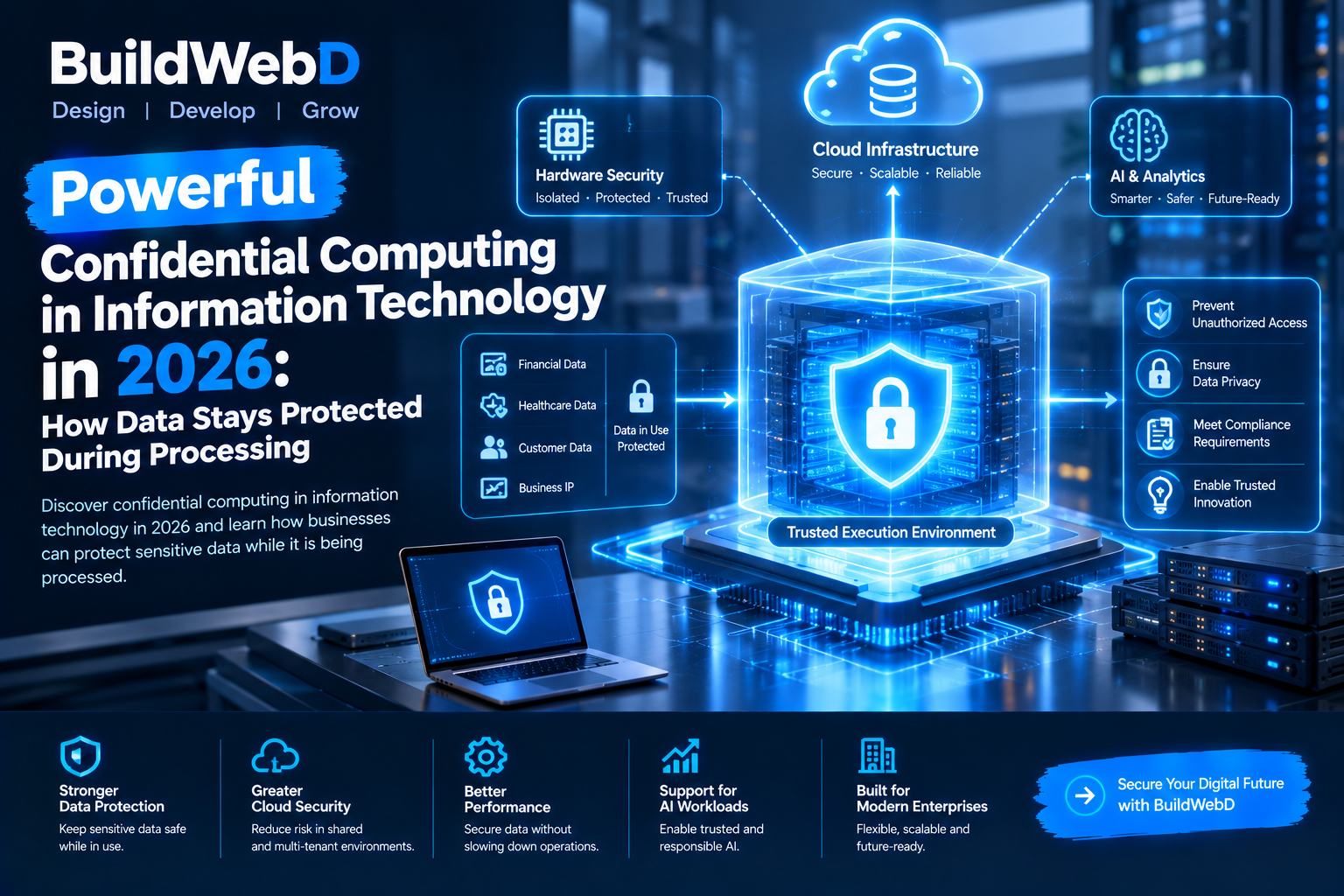
Businesses rely on cloud platforms, artificial intelligence, digital payments, and connected applications to manage sensitive information. However, protecting data while it is stored or transferred is only part of the cybersecurity challenge. Information must also remain secure while applications actively process it.
This is where confidential computing in information technology in 2026 becomes increasingly important. This approach helps protect sensitive information during processing by isolating workloads inside hardware-based trusted execution environments. It gives organizations another layer of security as they modernize their digital infrastructure.
From financial services to healthcare and enterprise AI, confidential computing can help businesses strengthen privacy, improve trust, and reduce certain risks associated with processing sensitive data.
What Is Confidential Computing?
Confidential computing is a security approach designed to protect data while it is being processed. Traditional security measures commonly focus on data at rest, such as files stored on a server, and data in transit, such as information moving between an application and a cloud service.
Data in use presents a different challenge because applications must access information to perform calculations, generate results, or execute transactions.
Confidential computing addresses this challenge through trusted execution environments (TEEs). These hardware-supported environments isolate selected workloads and help prevent unauthorized access to their contents, including from certain privileged software or infrastructure layers.
The exact protection depends on the processor, platform design, configuration, and threat model. It is not a replacement for encryption, access controls, or secure application development. Instead, it adds another security layer to a broader protection strategy.
Why Confidential Computing Matters in 2026
As organizations adopt AI tools and move more workloads to cloud platforms, they increasingly need to process information that cannot be exposed unnecessarily. This includes financial records, customer details, business strategies, proprietary datasets, and confidential research.
Confidential computing in information technology in 2026 matters because it helps organizations address the security gap that can exist while sensitive data is actively being used.
For example, a company may need to analyze customer information through a cloud-based service without giving the cloud infrastructure unnecessary access to the underlying data. A suitable confidential computing deployment can help reduce exposure during that processing.
The approach is also relevant to AI workloads. Organizations may want to use sensitive business data with AI models while strengthening safeguards around the processing environment. As Gartner identifies confidential computing as a strategic technology trend, it deserves attention during infrastructure and security planning.
How Does Confidential Computing Work?
Confidential computing generally combines specialized hardware capabilities, trusted execution environments, and verification mechanisms.
First, a supported processor establishes an isolated execution area. An application or selected workload runs within this protected environment, separating its sensitive operations from other parts of the system.
Second, hardware-backed protections help restrict unauthorized access to the workload’s memory and execution state. Depending on the platform, these controls can reduce exposure to the host operating system, hypervisor, or other privileged components.
Third, remote attestation may allow a separate system to verify that a workload is running in an expected, trusted environment before releasing sensitive data or credentials. The verification process and security guarantees vary by implementation.
Finally, applications continue performing their normal tasks while the protected environment provides additional safeguards.
This is the core idea behind confidential computing in information technology in 2026: protect information not only when it is stored or transferred, but also while it is being processed.
Key Benefits for Modern Businesses
1. Stronger Data Privacy
Organizations can use confidential computing to limit exposure of sensitive information during processing. This is especially useful when workloads run on shared or externally managed infrastructure.
2. More Secure Cloud Workloads
Cloud computing provides flexibility, but businesses may have concerns about privileged access and infrastructure trust. Confidential computing can help reduce specific risks by isolating supported workloads.
3. Better Protection for AI Workloads
AI systems may process proprietary documents, customer records, or confidential datasets. Suitable confidential computing environments can add safeguards around certain data-processing operations, although they do not automatically prevent model-level leaks or insecure application behavior.
4. Improved Collaboration
Different organizations sometimes need to analyze shared information without broadly exposing their individual datasets. With appropriate architecture and governance, confidential computing can support more controlled collaboration.
5. Support for Security and Compliance Goals
Businesses handling regulated information can evaluate confidential computing as part of their broader security controls. However, using it does not automatically guarantee compliance with any specific law or industry standard.
Where Is Confidential Computing Used?
Confidential computing in information technology in 2026 has potential applications across several industries.
Banking and financial services: Financial institutions can explore protected environments for fraud analysis, risk calculations, and sensitive transaction processing.
Healthcare: Healthcare organizations may use suitable confidential environments when processing sensitive medical information, subject to applicable privacy requirements and system safeguards.
Artificial intelligence: Businesses can evaluate protected execution for selected AI inference and data-processing workloads involving confidential information.
Cloud services: Cloud providers and customers can use supported confidential virtual machines or containers to strengthen workload isolation.
Research and analytics: Organizations can investigate secure ways to collaborate on sensitive datasets while limiting unnecessary exposure.
The suitability of each use case depends on the technology, performance requirements, legal obligations, and the security threats the organization needs to address.
Challenges Businesses Should Consider
Despite its advantages, confidential computing is not a complete cybersecurity solution.
Compatibility is one challenge. Applications may require architectural changes or specific hardware and cloud services before they can use confidential environments effectively.
Performance is another consideration. Security features, memory limitations, and workload design can affect application speed and operating costs. Businesses should benchmark real workloads before making deployment decisions.
Key management and attestation also require careful planning. Teams must determine who can approve workloads, how credentials are released, and what happens if a system fails verification.
Most importantly, confidential computing cannot eliminate vulnerabilities inside an application. Weak authentication, malicious code, excessive permissions, insecure APIs, and poor data handling can still create security risks.
Before deploying confidential computing in information technology in 2026, businesses should define their threat model, assess platform capabilities, test performance, and establish monitoring and incident-response procedures.
How to Prepare Your IT Infrastructure
Start by identifying applications that process highly sensitive information. These may include customer databases, financial workloads, AI applications, or proprietary business systems.
Next, consult your cloud provider or hardware vendor to determine which confidential computing capabilities are available. Review the isolation model, attestation options, supported workloads, key management, and limitations.
Run a small pilot before migrating critical systems. Measure performance, test failure scenarios, and verify that the application behaves correctly inside the protected environment.
Finally, combine confidential computing with established security practices, including encryption, identity management, least-privilege access, secure coding, vulnerability testing, and regular audits.
A phased approach helps organizations understand the benefits and limitations before committing to a wider rollout.
The Future of Confidential Computing
As AI adoption and cloud-based operations continue to expand, protecting data during processing will remain an important part of security architecture. Confidential computing may become particularly valuable for organizations that need stronger trust boundaries around sensitive workloads.
Future developments will depend on hardware improvements, easier deployment tools, wider platform support, and clearer verification processes. Businesses should follow these developments without assuming that every workload requires confidential computing.
The strongest strategy is to select security controls according to the sensitivity of the data, the operating environment, and the consequences of unauthorized access.
Conclusion
Confidential computing in information technology in 2026 offers organizations an additional way to protect sensitive data while applications process it. By combining trusted execution environments, hardware-backed isolation, and verification mechanisms, businesses can strengthen security across selected cloud, analytics, and AI workloads.
However, successful adoption requires more than enabling a hardware feature. Organizations must evaluate their risks, choose compatible platforms, manage access carefully, and maintain strong application security practices.
At BuildWebD, we believe modern digital solutions should be designed with performance, reliability, and security in mind. Whether you are upgrading business applications or planning a more secure digital infrastructure, the right technology strategy can help your organization prepare for the future.
Add a Comment