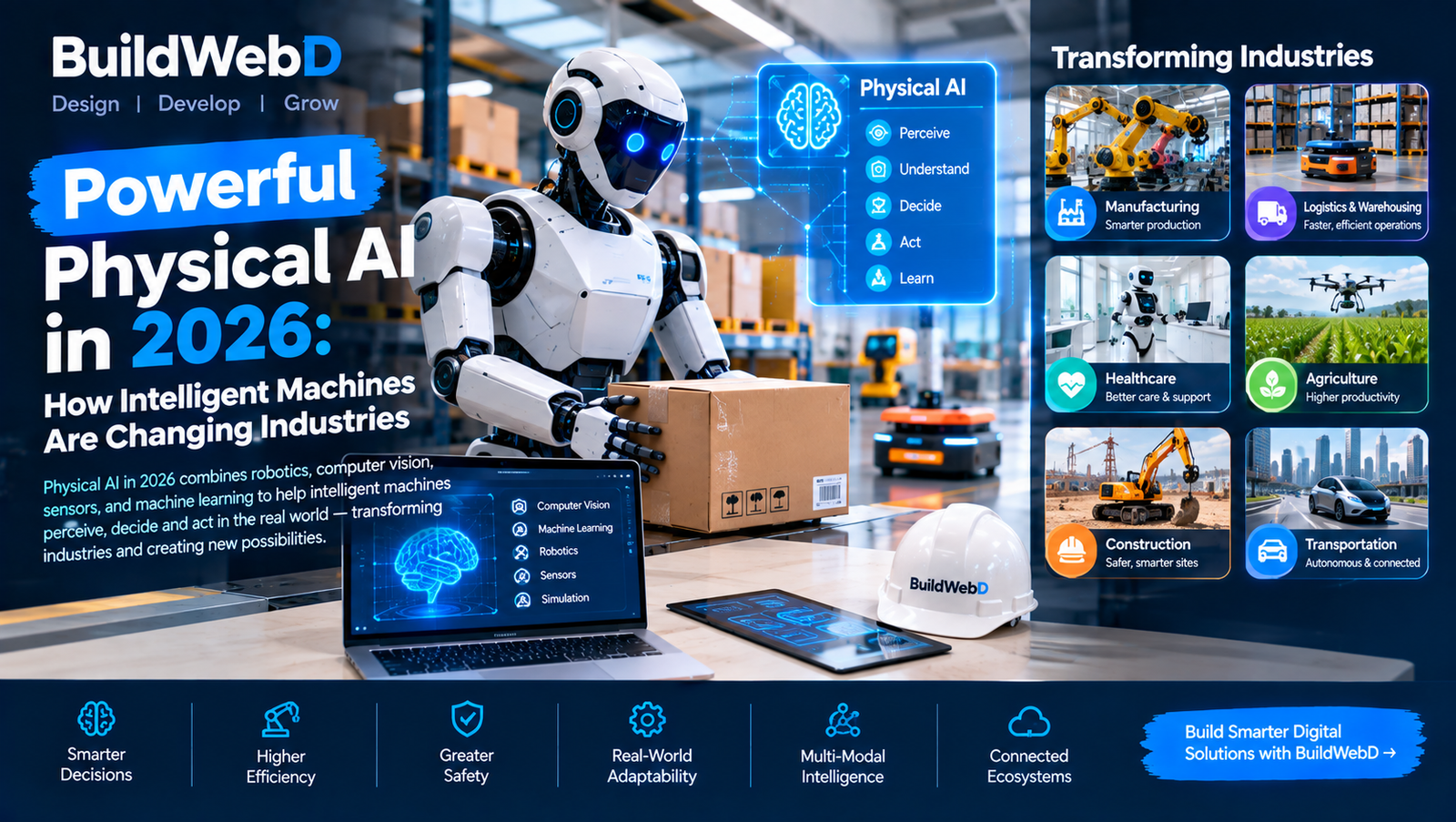
Physical AI in 2026 is moving beyond demonstrations and research labs into practical environments where machines can perceive surroundings, understand situations, make decisions, and act in the physical world. Unlike traditional software that operates mainly on screens and servers, physical AI connects intelligence with robots, vehicles, industrial equipment, drones, and other machines.
What Is Physical AI?
Physical AI combines artificial intelligence with sensors, robotics, computer vision, machine learning, simulation, and real-time control. The goal is not simply to generate information but to help a machine understand its environment and respond appropriately.
A warehouse robot, for example, can identify objects, plan a route, avoid obstacles, and adjust its movement. A factory system can monitor equipment, detect unusual behavior, and coordinate robotic actions. These capabilities make physical AI in 2026 an important technology direction for organizations exploring automation.
Why Physical AI Is Growing
Several technology improvements are making intelligent machines more practical. AI models are becoming better at understanding images, video, language, and multiple types of data. At the same time, sensors, processors, simulation platforms, connectivity, and robotics software are improving.
Another important change is the growing ability to train and test intelligent machines in simulated environments before deploying them in the real world. Simulation can help teams evaluate navigation, safety, object handling, and operational scenarios without putting physical equipment at unnecessary risk.
Physical AI in 2026 is therefore not based on one breakthrough. It is the result of multiple technologies becoming capable enough to work together.
How Physical AI Works
A typical physical AI system has several connected layers. Sensors collect information about the environment. AI models interpret that information. Planning systems determine what should happen next. Control software translates decisions into physical actions.
This creates a continuous loop: sense, understand, decide, act, and learn.
For example, an autonomous mobile robot can use cameras and other sensors to understand its surroundings. Its software can identify people, shelves, pathways, and obstacles. A planning system then selects a safe route, while control systems manage movement.
This combination separates physical AI from ordinary automation. Traditional automation usually follows predefined rules. Intelligent machines can respond to changing conditions and unexpected situations.
Key Applications
Manufacturing is one of the most important areas for physical AI in 2026. Intelligent robots can support inspection, material handling, assembly, maintenance, and quality control. Instead of repeating exactly the same movement, advanced systems can adapt to variations in objects and operating conditions.
Warehousing and logistics are another major opportunity. Robots can move goods, organize inventory, assist picking operations, and navigate changing warehouse layouts. When connected to business systems, these machines can become part of larger automated workflows.
Healthcare is also exploring intelligent machines for assistance, logistics, rehabilitation, and specialized procedures. The technology must meet demanding safety and reliability requirements, but the potential benefits include greater precision and support for overworked teams.
Agriculture, construction, energy, transportation, and field services can also benefit. Drones and autonomous machines can inspect infrastructure, monitor environments, transport materials, or perform repetitive tasks in locations that may be difficult or dangerous for people.
The Role of Multimodal AI
One reason physical AI in 2026 is becoming more capable is the growth of multimodal AI. Machines can combine visual information with language, audio, sensor readings, maps, and other contextual data.
Consider a service robot receiving a spoken instruction while also analyzing a camera feed. Instead of treating the instruction and environment separately, the system can connect them. This allows the machine to understand what the user wants and where the requested action should occur.
Multimodal intelligence can make machines more flexible, but it also increases the need for careful testing, monitoring, and control.
Why Simulation Matters
Testing physical systems in the real world can be expensive and risky. Simulation offers a way to create digital environments where AI systems can experience many situations before deployment.
Developers can test different layouts, weather conditions, obstacles, machine behaviors, and operational scenarios. This can shorten development cycles and expose problems earlier.
For businesses adopting physical AI in 2026, simulation will become an important part of development because successful deployment depends on more than an impressive AI model. The entire system needs to operate reliably under real-world conditions.
Challenges Businesses Must Consider
Physical AI introduces challenges that do not exist in ordinary software. Safety is critical because a software error can potentially become a physical incident. Organizations also need strong cybersecurity because connected machines can become targets for attackers.
Data quality is another challenge. Sensors can produce incomplete, noisy, or misleading information. AI systems need robust ways to handle uncertainty rather than assuming every input is correct.
Cost and integration also matter. A business may need new hardware, networking, software platforms, maintenance processes, and employee training. The best strategy is usually to begin with a clearly defined operational problem instead of deploying intelligent machines simply because the technology is new.
Skills Needed for the Physical AI Era
The growth of physical AI in 2026 will create demand for skills across several fields. Robotics engineers, AI engineers, computer vision specialists, embedded developers, simulation experts, automation engineers, cybersecurity professionals, and data specialists can all contribute to these systems.
Web and software developers can also play a role by building dashboards, control interfaces, monitoring platforms, APIs, and business applications that connect physical systems with enterprise software.
The Future of Physical AI
The next stage will likely involve more coordinated systems rather than isolated robots. Fleets of machines may share information, coordinate tasks, and respond to changing operational requirements.
As AI becomes more capable and hardware becomes more connected, physical AI could become part of everyday business infrastructure. The most successful implementations will not necessarily be the machines with the most advanced models. They will be the systems that combine intelligence, safety, reliability, useful workflows, and measurable business value.
For organizations evaluating physical AI in 2026, the right approach is to start with a practical use case, establish safety requirements, measure performance, and expand gradually. This makes the technology easier to manage and gives teams a clearer path from experimentation to production.
How Businesses Can Prepare
Businesses interested in physical AI in 2026 should begin by identifying repetitive, time-consuming, hazardous, or operationally complex processes that could benefit from intelligent automation.
The next step is to evaluate the required hardware, sensors, connectivity, AI models, software platforms, and security controls. A small pilot can help organizations understand technical requirements before making a larger investment.
Companies should also consider how intelligent machines will communicate with existing enterprise systems. APIs, dashboards, cloud platforms, databases, and workflow software can connect physical operations with the wider digital environment.
Conclusion
Physical AI in 2026 represents a major shift from software that only processes information toward systems that can understand and interact with the real world. Robotics, multimodal AI, computer vision, simulation, sensors, and connected infrastructure are coming together to create more adaptive machines.
For businesses, the opportunity is not simply to own intelligent robots. It is to redesign repetitive, complex, or risky workflows around technology that can perceive, reason, and act. Organizations that focus on practical applications, security, safety, and measurable outcomes can build a stronger foundation for the next generation of intelligent technology.
BuildWebD can help businesses explore the software, AI, web, and digital infrastructure needed to connect emerging technologies with real business goals.
Add a Comment