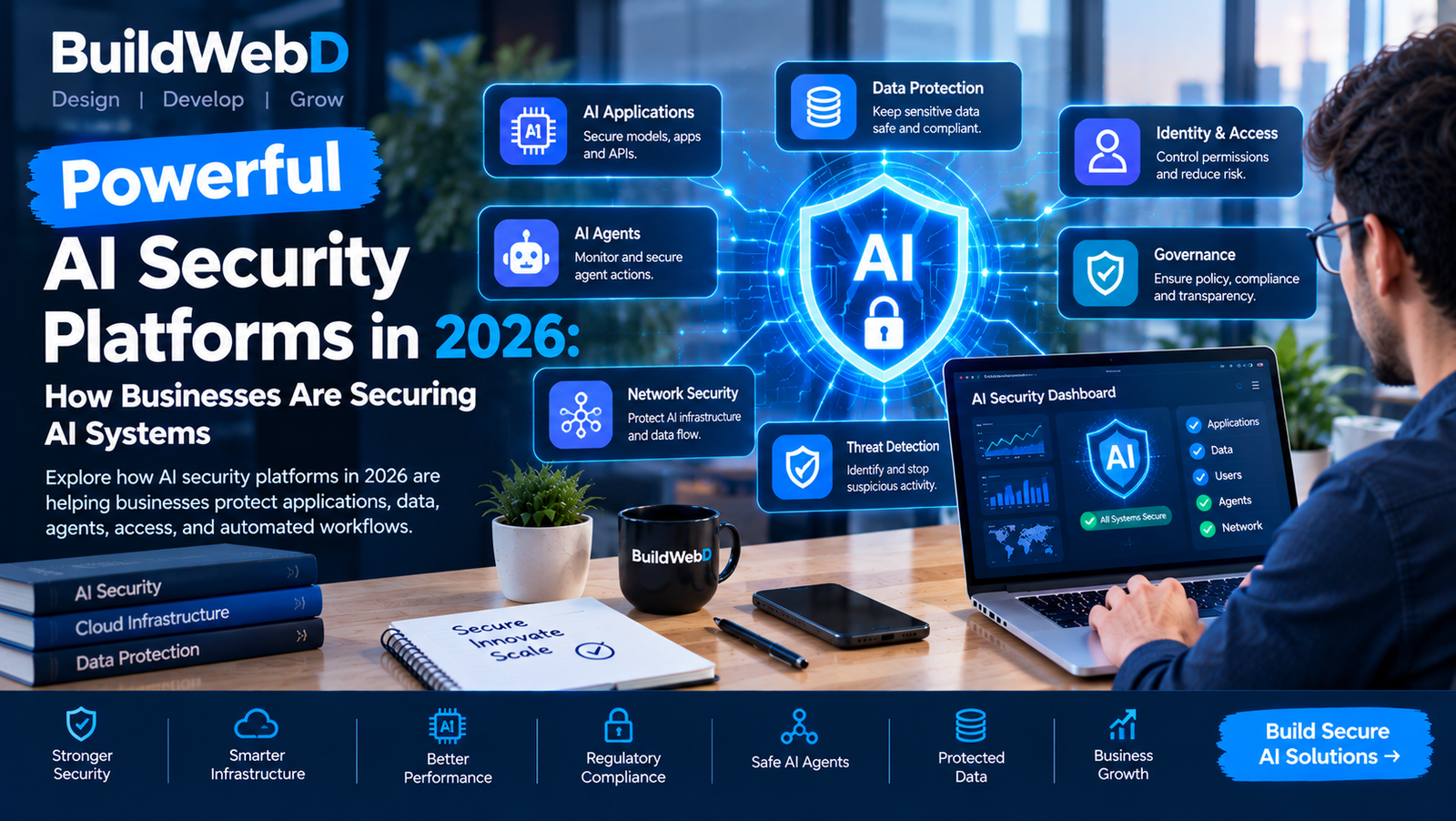
Artificial intelligence is becoming part of software, customer service, business operations, analytics, cybersecurity, and everyday digital workflows. As organizations adopt more AI-powered applications, securing these systems is becoming an important part of modern Information & Technology strategy. AI security platforms in 2026 are emerging as a way for businesses to manage AI risks while continuing to use AI for productivity and innovation.
AI security is no longer limited to protecting traditional servers or databases. Organizations now need to consider AI models, prompts, data, APIs, agents, applications, user permissions, and automated actions. This changing environment is creating demand for security technologies designed specifically for AI-powered systems.
What Are AI Security Platforms?
AI security platforms are technologies designed to monitor, protect, and control AI applications and AI-powered workflows. They can help organizations identify AI usage, protect sensitive information, manage access, detect suspicious activity, and establish security policies.
Traditional cybersecurity tools remain important, but AI applications introduce additional risks. For example, an AI system may process confidential information, interact with external tools, connect to business databases, or allow an AI agent to perform actions automatically.
This makes AI security platforms in 2026 an important part of the broader enterprise security environment.
Why AI Security Is Becoming More Important
Businesses are adopting generative AI, AI assistants, AI-powered software, and autonomous agents at a rapid pace. These technologies can improve productivity, but they also create new security considerations.
An employee might accidentally enter confidential information into an AI application. An AI application could expose sensitive data through an improperly configured integration. An AI agent could also receive more permissions than it actually needs.
Security teams therefore need greater visibility into how AI is being used. They also need ways to establish policies, monitor activity, and respond when AI-related security problems occur.
Protecting Sensitive Business Data
Data is one of the most important assets handled by AI systems. Businesses may use customer information, financial records, internal documents, product information, source code, and other sensitive data with AI applications.
AI security solutions can help organizations establish rules around what information AI systems are allowed to access and process. Data protection can also include monitoring prompts, controlling application access, and identifying potentially sensitive information.
Businesses should avoid treating AI tools as completely separate from their existing data-security strategy. AI security should work alongside identity management, encryption, access controls, monitoring, and traditional cybersecurity practices.
Managing AI Access and Permissions
AI agents can increasingly interact with software, APIs, databases, and business systems. This creates a new challenge: determining what an AI system is actually allowed to do.
For example, an AI assistant used for customer support may need access to customer records but should not automatically have permission to modify financial information. A development agent may need access to code repositories but should not have unrestricted access to production systems.
AI security platforms in 2026 can help organizations create stronger controls around AI identities, permissions, and activities. The principle of least privilege is particularly important because limiting unnecessary access can reduce the potential impact of a compromised or misused AI system.
Defending Against Prompt Injection
Prompt injection is another important AI security concern. It occurs when manipulated instructions influence an AI system to ignore intended behavior, reveal information, or perform an unintended action.
The risk becomes more significant when AI applications are connected to external tools or internal business systems.
Businesses can reduce these risks by combining input validation, access controls, monitoring, application security, and human oversight. AI security platforms can provide additional visibility into AI interactions and help security teams identify suspicious behavior.
Securing AI Agents
AI agents are changing how businesses think about automation. Instead of simply generating an answer, an agent may be able to plan tasks, use tools, retrieve information, and complete multiple steps.
This creates a larger security surface. The more actions an AI agent can perform, the more important it becomes to control its permissions and monitor its activity.
Organizations should define which actions agents can perform independently and which actions require human approval. High-impact operations should receive stronger controls than low-risk activities.
Monitoring AI Applications
Visibility is essential for effective security. Organizations cannot easily protect AI systems if they do not know which AI applications are being used, what data they access, or what actions they perform.
AI monitoring can include application discovery, user activity, model interactions, API usage, data movement, policy violations, and unusual behavior.
Centralized visibility can help IT and security teams understand the organization’s AI environment and identify potential weaknesses before they become larger problems.
AI Security and Software Development
AI is increasingly involved in software development. Developers may use AI assistants to generate code, review code, troubleshoot errors, or accelerate application development.
This creates both opportunities and risks. AI-generated code still needs security testing, code review, dependency analysis, and proper deployment controls.
Development teams should integrate AI security into the software development lifecycle rather than treating it as a final-stage security check. Secure coding practices, automated testing, dependency monitoring, and access management remain important.
AI Governance Is Becoming Part of IT Strategy
AI security is closely connected with governance. Businesses need clear rules covering approved AI applications, sensitive data, user permissions, third-party AI services, agent behavior, and incident response.
A practical AI governance strategy should answer questions such as:
Which AI tools can employees use?
What business information can AI applications access?
Which AI agents can perform automated actions?
When is human approval required?
How should AI-related security incidents be reported?
Who is responsible for monitoring AI systems?
Clear answers can help organizations adopt AI without creating uncontrolled technology environments.
How Businesses Can Prepare for AI Security
Businesses do not need to transform their entire technology environment overnight. A practical approach is to start by identifying existing AI usage.
Organizations can create an inventory of AI applications, models, agents, APIs, and integrations. They can then classify sensitive data, review permissions, establish acceptable-use policies, and implement monitoring.
Security teams should also test AI applications for common risks such as unauthorized access, data leakage, prompt manipulation, insecure integrations, and excessive agent permissions.
Regular security reviews are important because AI systems and their integrations can change quickly.
The Future of AI Security Platforms in 2026
The future of AI security will increasingly involve centralized visibility, automated monitoring, stronger identity controls, AI-specific application security, and governance.
As organizations deploy more AI agents and intelligent applications, security tools will need to understand not only traditional software behavior but also AI-specific interactions and automated decision workflows.
AI security platforms in 2026 are therefore becoming part of a broader shift toward secure, controlled, and observable AI adoption. Businesses that build security into AI projects from the beginning can create stronger foundations for future digital transformation.
Conclusion
AI is becoming a major part of modern technology, but successful AI adoption requires more than powerful models and applications. Businesses also need strong security, governance, monitoring, and access controls.
AI security platforms in 2026 can help organizations protect AI applications, manage sensitive data, control AI agents, monitor activity, and respond to emerging risks. The goal is not to slow down innovation but to create a safer environment in which businesses can use AI confidently.
As AI continues transforming Information & Technology, companies need technology partners that understand both innovation and security. BuildWebD can help businesses build modern digital solutions with scalable development, AI integration, security-focused practices, and technology strategies designed for the evolving digital landscape.
Add a Comment