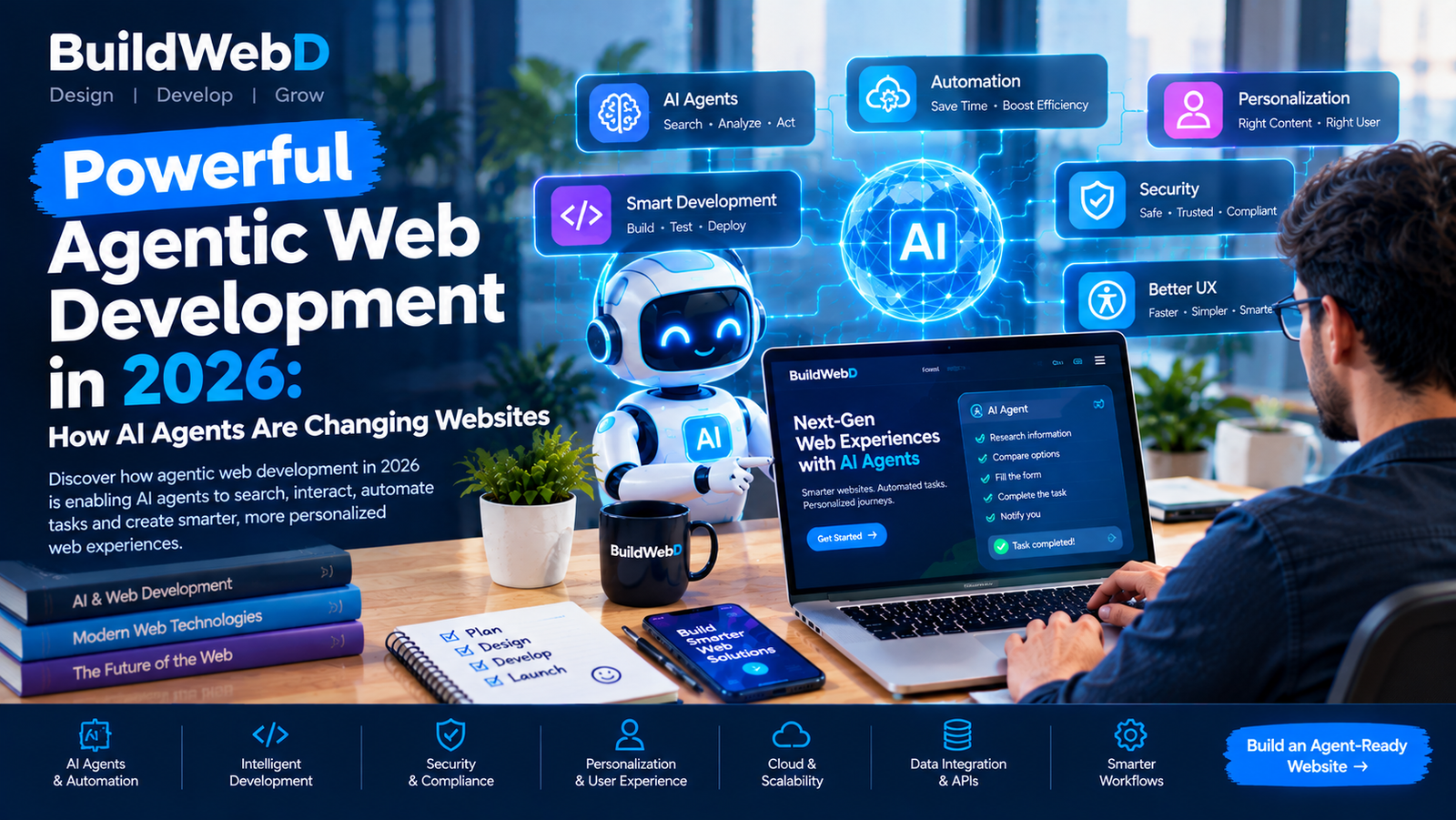
The web is entering a new phase. Websites are no longer designed only for people to click, scroll, search, and submit forms. Increasingly, software agents are becoming another type of visitor—capable of finding information, completing tasks, interacting with services, and helping users make decisions.
This shift is creating a new development approach known as agentic web development in 2026.
Instead of building websites only for human interaction, developers are beginning to think about how websites can work effectively with AI agents while remaining fast, secure, accessible, and useful for people.
What Is Agentic Web Development?
Agentic web development in 2026 refers to creating websites and web applications that can interact with AI agents and support automated, goal-oriented tasks.
Traditional websites depend heavily on users performing individual actions.
For example:
Traditional workflow:
User → Search → Open page → Find information → Fill form → Submit
An agent-enabled workflow could become:
Agent workflow:
User gives a goal → AI agent finds information → Website provides structured data → Agent performs permitted actions → User receives the result
This does not mean humans disappear from the process. Instead, websites become more capable of supporting both human users and software agents.
1. AI Agents Become a New Type of Web User
One of the biggest developments behind agentic web development in 2026 is the emergence of AI agents that can perform multi-step tasks.
Instead of simply answering questions, agents can potentially:
- Search websites
- Compare products
- Find documentation
- Complete workflows
- Retrieve information
- Interact with APIs
- Schedule tasks
- Submit approved requests
- Connect different services
For web developers, this creates a new requirement: websites need to make important information and actions understandable to both humans and machines.
2. Websites Need Better Structured Information
Agent-friendly websites depend heavily on clear structure.
Semantic HTML, structured data, meaningful headings, descriptive links, accessible forms, clean URLs, and well-organized content can make websites easier to understand.
Developers should avoid creating important functionality that depends entirely on visual appearance.
A well-structured page gives users, search engines, assistive technologies, and AI systems clearer information about what each element means.
3. APIs Become More Important
Websites traditionally expose functionality through visual interfaces.
Agentic applications can also interact through APIs.
For example, an ecommerce business could provide APIs for:
- Product information
- Inventory
- Pricing
- Orders
- Shipping
- Customer accounts
Instead of an agent attempting to interpret every visual element, properly designed APIs can provide controlled ways to retrieve or update information.
This makes API-first thinking increasingly important for modern web development.
4. Agent-Ready Websites Need Strong Security
More automation also creates more security responsibility.
An AI agent that can access information or perform actions must have clearly defined permissions.
Developers should consider:
- Authentication
- Authorization
- Rate limits
- API permissions
- Input validation
- Audit logs
- Human approval
- Data privacy
- Abuse prevention
Not every action should be automatically available to an agent.
For sensitive operations such as payments, account changes, or deleting information, businesses may require explicit human confirmation.
5. Agentic UX Will Change Website Interfaces
The traditional chatbot is only one possible AI interface.
Future web applications can combine agents with dashboards, forms, search, recommendations, notifications, and traditional navigation.
Imagine a business website where a visitor says:
“Find the right service for my company and prepare a consultation request.”
Instead of simply displaying a chatbot response, the website could guide the user through relevant questions, recommend an appropriate service, collect approved information, and prepare the next step.
The interface becomes more goal-oriented.
6. Performance Still Matters
Agentic functionality does not eliminate the importance of website performance.
Fast loading, responsive interactions, efficient JavaScript, optimized assets, caching, and modern rendering strategies remain important for human visitors.
Modern browser capabilities are also expanding. The 2026 Baseline program includes new HTML, CSS, JavaScript, and Web API features that developers can evaluate when building modern experiences.
The goal should be simple: use modern capabilities without unnecessarily increasing complexity.
7. Accessibility Becomes Even More Important
Agentic websites still need to work for real people.
Accessible headings, keyboard navigation, form labels, semantic HTML, appropriate contrast, descriptive controls, and screen-reader compatibility should remain part of development from the beginning.
The W3C is actively developing WCAG 3.0, with its September 2026 Working Draft addressing accessibility across modern digital experiences.
Agentic development should therefore complement—not replace—human-centered accessibility.
8. Developers Become AI Workflow Orchestrators
AI agents are also changing how developers build websites.
Developers can use AI tools to assist with coding, debugging, documentation, testing, research, and repetitive implementation work.
Current 2026 web-development coverage describes AI-driven development workflows, automated design handoffs, server-first architectures, and agentic interfaces as important directions for the industry.
The developer’s role increasingly involves defining architecture, reviewing generated work, maintaining quality, protecting security, and connecting multiple systems.
9. Businesses Can Prepare for Agentic Websites
Businesses do not need to rebuild their entire website around AI immediately.
A practical approach is to start with the foundation:
- Improve website structure.
- Organize business information clearly.
- Build reliable APIs where appropriate.
- Strengthen authentication and permissions.
- Improve accessibility.
- Optimize website performance.
- Identify repetitive customer workflows.
- Add AI assistance where it creates measurable value.
- Keep humans involved in sensitive decisions.
- Monitor how users and automated systems interact with the website.
This creates an adaptable foundation for future technologies.
The Future of Agentic Web Development
The biggest change may not be the disappearance of traditional websites. Instead, websites could become more useful environments where humans and AI agents interact with the same underlying information and services.
The emerging agentic web also raises important questions around permissions, identity, machine-readable information, security, and how websites should respond to automated visitors. Industry discussions in 2026 increasingly describe agents as a new audience for the web.
For developers and businesses, the opportunity is to build systems that are flexible enough for this next stage without sacrificing usability for people.
Conclusion
Agentic web development in 2026 represents a major shift in how developers think about websites. Modern websites increasingly need to serve humans, search systems, applications, and AI agents while maintaining strong performance, accessibility, security, and usability.
Businesses that prepare their websites with clean architecture, structured information, reliable APIs, secure permissions, and thoughtful AI integration can create a stronger foundation for the evolving web.
At BuildWebD, we help businesses combine modern web development, AI solutions, performance, security, and user-focused experiences to build websites prepared for the future.
Add a Comment