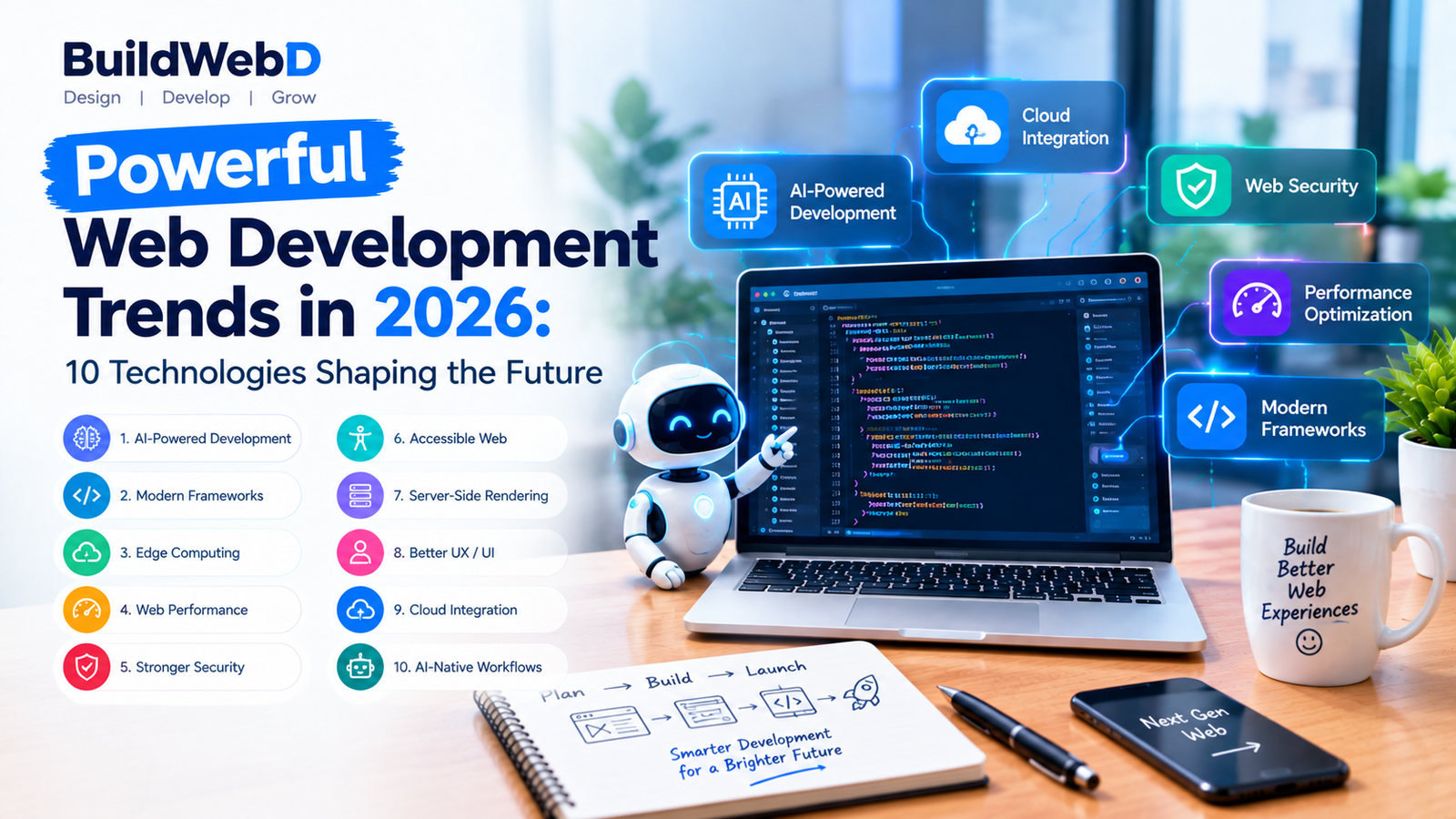
The web development industry is changing rapidly. Artificial intelligence, modern frontend frameworks, edge computing, stronger security, and performance-focused architectures are changing how websites and web applications are designed and developed.
For businesses, keeping up with the latest web development trends in 2026 can help them make better decisions when building or upgrading their online platforms.
Modern websites are no longer simply digital brochures. They are becoming faster, more interactive, personalized, intelligent, and closely connected with business systems.
Here are 10 important web development trends shaping the future of the web in 2026.
1. AI-Powered Web Development
Artificial intelligence is becoming an important part of the development process.
Developers can now use AI tools to assist with:
- Code generation
- Debugging
- Testing
- Documentation
- Code reviews
- Website components
- Development workflows
The major change is moving from simple AI code suggestions toward AI agents that can handle multiple development tasks.
This makes AI-powered development one of the most important web development trends in 2026.
However, AI-generated code still requires human review, testing, security checks, and proper architecture.
2. AI-Powered Websites and User Experiences
AI is also becoming part of the websites themselves.
Businesses can use AI to provide:
- Intelligent chatbots
- Personalized recommendations
- AI-powered search
- Automated customer support
- Content assistance
- Smart product discovery
- Personalized user experiences
Instead of creating the same experience for every visitor, websites can increasingly respond to user needs and behavior.
3. Server-First Web Architecture
Modern web development is increasingly focusing on server-side rendering and server-first approaches.
Frameworks and architectures that move more work to the server can reduce unnecessary client-side JavaScript and potentially improve performance.
This approach is particularly useful for websites where loading speed, SEO, and user experience are important.
Server-first development is therefore becoming an important consideration for modern web projects.
4. Edge Computing and Edge Deployment
Edge computing brings application processing closer to users.
Instead of every request traveling to a distant central server, edge infrastructure can process certain requests closer to the user.
Potential benefits include:
- Lower latency
- Faster responses
- Better global performance
- Improved scalability
For websites serving users across different countries or regions, edge-based architectures can become increasingly useful.
5. Core Web Vitals and Website Performance
Website performance remains important in 2026.
Users expect websites to load quickly and respond smoothly across mobile devices, desktops, and different network conditions.
Developers should pay attention to:
- Loading performance
- Interaction responsiveness
- Visual stability
- Image optimization
- JavaScript performance
- Mobile performance
- Server response times
A visually attractive website is not enough if users have to wait for pages or interactions to respond.
6. Stronger Web Security
As websites become more connected to APIs, databases, cloud services, and AI systems, security becomes even more important.
Modern development should consider:
- Secure authentication
- Data protection
- API security
- Dependency security
- Access control
- Secure coding practices
- Regular updates
- Monitoring
Security should be considered during development rather than added only after a website is completed.
Zero-trust approaches and software supply-chain security are also receiving more attention in modern web-development workflows.
7. Modern Web Frameworks and Meta-Frameworks
Web developers are increasingly using frameworks that provide both frontend and server-side capabilities.
Modern frameworks can help teams build:
- Dynamic websites
- Web applications
- Ecommerce platforms
- Dashboards
- SaaS products
- API-connected applications
The goal is not simply to choose the newest framework.
Businesses should choose technologies based on project requirements, performance, scalability, developer expertise, maintenance, and long-term support.
8. Better Design-to-Development Workflows
The connection between UI design and development is becoming more integrated.
Modern tools can help designers and developers share components, design systems, specifications, and implementation details.
AI is also making it easier to transform structured design information into development-ready components.
This can reduce unnecessary communication gaps between designers and developers and help teams maintain more consistent interfaces. Figma’s 2026 web-development research specifically highlights AI-driven workflows and more automated design-to-development handoffs.
9. Accessibility as a Development Priority
Modern websites need to work for a wide range of users and devices.
Developers should consider:
- Keyboard navigation
- Readable typography
- Color contrast
- Alternative text
- Accessible forms
- Semantic HTML
- Screen-reader compatibility
Accessibility is not only about compliance. It can also improve usability and make websites easier for more people to navigate.
10. Web Development Becomes More AI-Native
One of the biggest changes in web development trends in 2026 is the shift toward AI-native development workflows.
Developers can increasingly use AI agents to help plan tasks, generate code, run tests, investigate problems, and prepare changes for review.
A 2026 JetBrains developer survey reported widespread weekly use of AI coding agents among professional developers, showing how quickly agent-based development is becoming part of everyday workflows.
The important point is that AI does not remove the need for experienced developers. Instead, developers increasingly need to know how to direct, review, test, secure, and improve AI-generated work.
What Do These Web Development Trends Mean for Businesses?
Businesses do not need to adopt every new technology.
Instead, focus on technologies that solve actual business problems.
For example:
Need better search visibility?
Focus on performance, technical SEO, structured content, and server-side rendering.
Need a faster ecommerce website?
Focus on performance optimization, modern architecture, caching, image optimization, and reliable infrastructure.
Need automation?
Explore AI-powered workflows and integrations.
Need a global audience?
Consider scalable cloud and edge infrastructure.
Technology should support business objectives rather than being adopted simply because it is trending.
How to Prepare Your Website for 2026
If you are planning a new website or redesign, consider these priorities:
- Build a mobile-first experience.
- Choose a scalable technology stack.
- Optimize website performance.
- Follow strong security practices.
- Make the website accessible.
- Build SEO into the development process.
- Consider AI where it provides genuine value.
- Monitor performance after launch.
- Keep dependencies and software updated.
- Plan for future integrations.
A good website should not only look modern when it launches. It should also be maintainable and adaptable as technology changes.
Conclusion
The latest web development trends in 2026 show that the future of websites is becoming more intelligent, faster, more secure, and increasingly AI-assisted.
AI-powered development, server-first architecture, edge computing, performance optimization, modern frameworks, accessibility, and stronger security are all influencing how businesses build digital experiences.
However, the right technology depends on the individual project. Businesses should choose technologies based on their customers, goals, budget, performance requirements, and long-term plans.
BuildWebD helps businesses build modern websites and web applications using practical development strategies, modern technologies, SEO-friendly architecture, ecommerce solutions, and digital solutions. If you are planning a new website or want to modernize your existing website, BuildWebD can help you build a fast, scalable, and future-ready digital presence.
Add a Comment