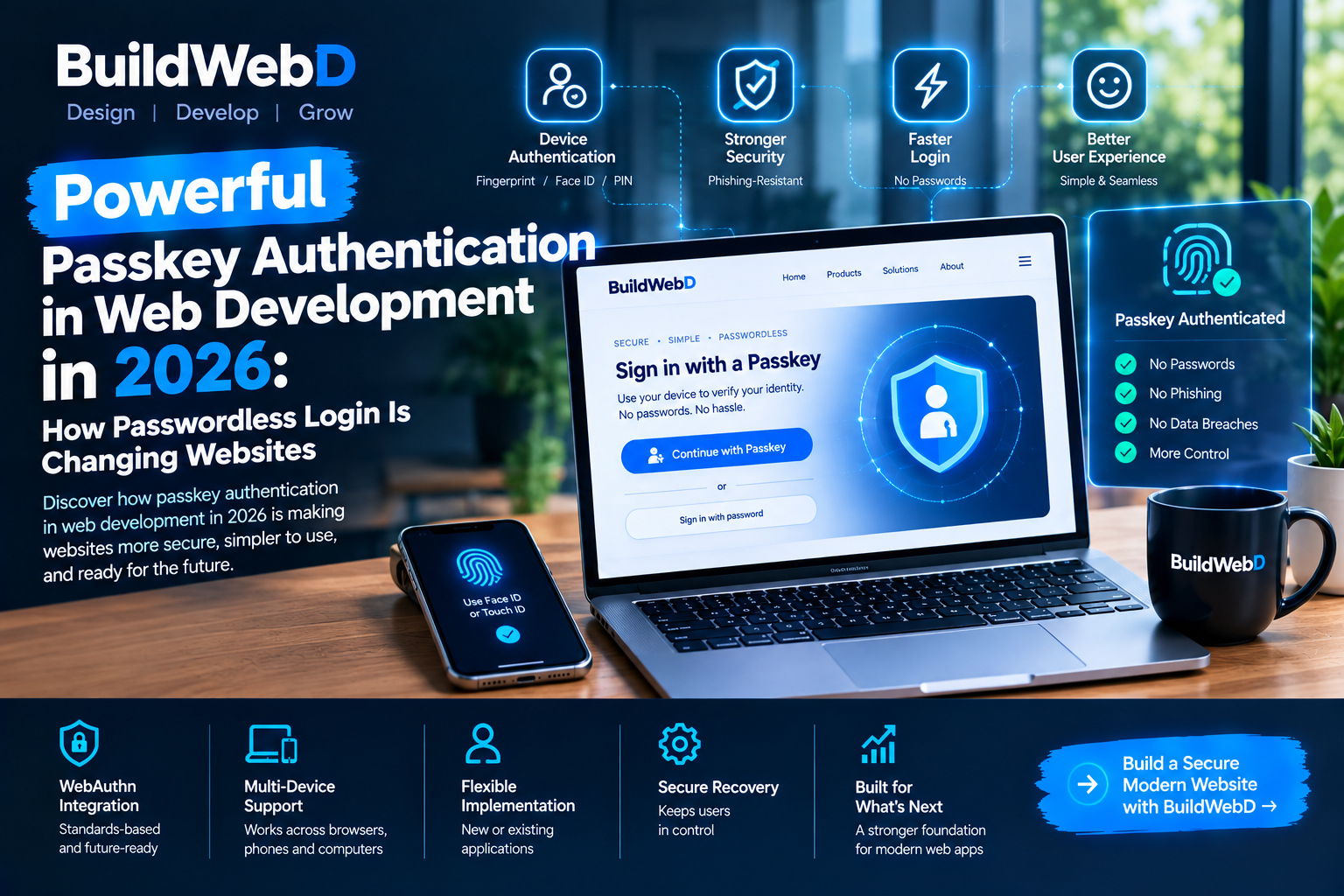
Web authentication is changing rapidly as users expect websites to be secure without creating complicated login experiences. Passwords have traditionally been the standard, but modern applications are increasingly exploring authentication methods that are easier for users and harder for attackers to exploit.
One of the most important developments in this area is passkey authentication in web development in 2026. Passkeys use public-key cryptography and device-based authentication to reduce dependence on passwords. Instead of remembering another secret, users can authenticate using a device unlock method such as a fingerprint, face recognition, PIN, or secure device credential.
What Is Passkey Authentication in Web Development in 2026?
Passkey authentication in web development in 2026 refers to building website and web-application login systems around passkeys instead of relying primarily on traditional passwords.
Passkeys are based on modern Web Authentication technology. During registration, a cryptographic key pair is created. The private key remains protected by the user’s device, while the website stores the corresponding public key.
When the user returns, the website can request authentication from the device. The user confirms their identity through the device’s supported security mechanism, and the website verifies the cryptographic response.
This approach means that the website does not need to store a reusable password for the user.
Why Passkeys Matter for Modern Websites
Security expectations are becoming more demanding. Businesses need to protect customer accounts while keeping login experiences simple enough that users do not abandon them.
This is where passkey authentication in web development in 2026 becomes particularly valuable. Modern browsers and operating systems increasingly support passkey-based authentication, making passwordless login more practical for websites and applications.
Google describes passkeys as resistant to phishing because they are associated with the identity of the website or application where they were created.
For developers, this creates an opportunity to rethink authentication as part of the overall product experience rather than treating login security as a separate technical layer.
How Passkeys Work
The basic process is relatively straightforward.
First, a user creates an account or chooses to add a passkey to an existing account. The browser and device generate the necessary cryptographic credentials.
The private credential stays protected on the user’s device, while the public credential is registered with the website.
When the user wants to sign in, the website sends an authentication request. The browser communicates with the authenticator, and the user verifies access using their device.
The website then validates the response before granting access.
For developers, passkey authentication in web development in 2026 generally involves integrating WebAuthn-compatible authentication into the frontend and backend rather than creating a completely separate authentication ecosystem.
Better Security Against Phishing
One of the strongest reasons to consider passkeys is their resistance to common phishing attacks.
Traditional passwords can be entered into fake websites, reused across services, or stolen through malicious software and data breaches. Passkeys are designed differently because authentication credentials are cryptographically associated with the legitimate website.
This can significantly reduce the value of fake login pages that attempt to collect passwords.
However, passkeys are not a replacement for every security practice. Developers still need secure sessions, account recovery, authorization controls, monitoring, and appropriate protection for sensitive operations.
Improved User Experience
Security can sometimes create friction. Password requirements, reset links, verification codes, and repeated login prompts can make websites frustrating to use.
Passkey authentication in web development in 2026 can simplify this process by allowing users to authenticate through familiar device-level interactions.
For example, a user could open an ecommerce account, select a passkey login option, and confirm access using their phone or computer’s built-in authentication.
A simpler login process can also reduce password-reset requests and help create a smoother customer journey.
Lower Password Management Overhead
Passwords create operational work for both businesses and users.
Users forget passwords. They reuse credentials. They request resets. Organizations must secure password databases and build recovery processes.
Passkeys can reduce some of this complexity because the authentication model does not depend on storing conventional passwords.
For companies building new applications, passkey authentication in web development in 2026 can therefore become part of a broader strategy to simplify identity management while improving account security.
Where Passkeys Fit Best
Passkeys can be particularly useful for applications where account security and frequent authentication matter.
These can include ecommerce platforms, SaaS applications, financial services, membership websites, business portals, healthcare applications, online marketplaces, and customer dashboards.
They can also complement existing authentication systems. Developers do not necessarily need to eliminate every other login method immediately.
A practical migration strategy may allow existing users to continue using established authentication while encouraging them to create a passkey after successful login.
How Developers Can Implement Passkeys
Successful implementation starts with choosing an authentication architecture that supports WebAuthn and passkey credentials.
Developers should design both registration and authentication flows carefully. The frontend needs clear user interactions, while the backend must securely create challenges, validate responses, manage credentials, and maintain authenticated sessions.
Account recovery also deserves significant attention.
A good implementation should explain what happens when users change devices, lose access to a device, or want to authenticate from another platform. Recovery should be secure without becoming so complicated that users are locked out.
Testing across major browsers, operating systems, desktop devices, and mobile devices is also essential.
Challenges Developers Should Consider
Although passkey authentication in web development in 2026 offers important advantages, implementation still requires planning.
Device changes can create confusion if users do not understand how their credentials are synchronized or recovered. Some users may also be unfamiliar with the term “passkey.”
That means good UX copy matters.
Developers should explain what is happening in simple language and provide appropriate fallback and recovery options.
Teams should also consider accessibility, account recovery, session security, privacy, and compatibility before launching a passwordless authentication system.
Passkeys and the Future of Web Development
The larger trend is clear: web development is moving toward authentication systems that are more secure, less dependent on reusable secrets, and better integrated with the devices people already use.
The continued evolution of WebAuthn is also important. In 2026, Web Authentication Level 3 reached Candidate Recommendation Snapshot status, reflecting continued development of the web authentication standard.
For developers, this means authentication should increasingly be considered part of product architecture from the beginning.
Instead of adding stronger login security after an application is built, development teams can design authentication, authorization, recovery, and user experience together.
As browser capabilities improve, passkey authentication in web development in 2026 is likely to become increasingly normal for modern applications.
Conclusion
Passwords will not disappear from every website overnight, but the direction of web authentication is changing. Businesses are looking for ways to provide stronger security without adding unnecessary friction for users.
Passkey authentication in web development in 2026 gives developers a practical approach to building secure and user-friendly login experiences. With proper WebAuthn integration, thoughtful recovery systems, cross-device testing, and clear UX, passkeys can become an important part of modern web applications.
For businesses planning a new website or web application, the right authentication strategy should be considered from the earliest stages of development. BuildWebD can help businesses create secure, modern, and performance-focused web experiences designed for today’s evolving digital environment.
Add a Comment