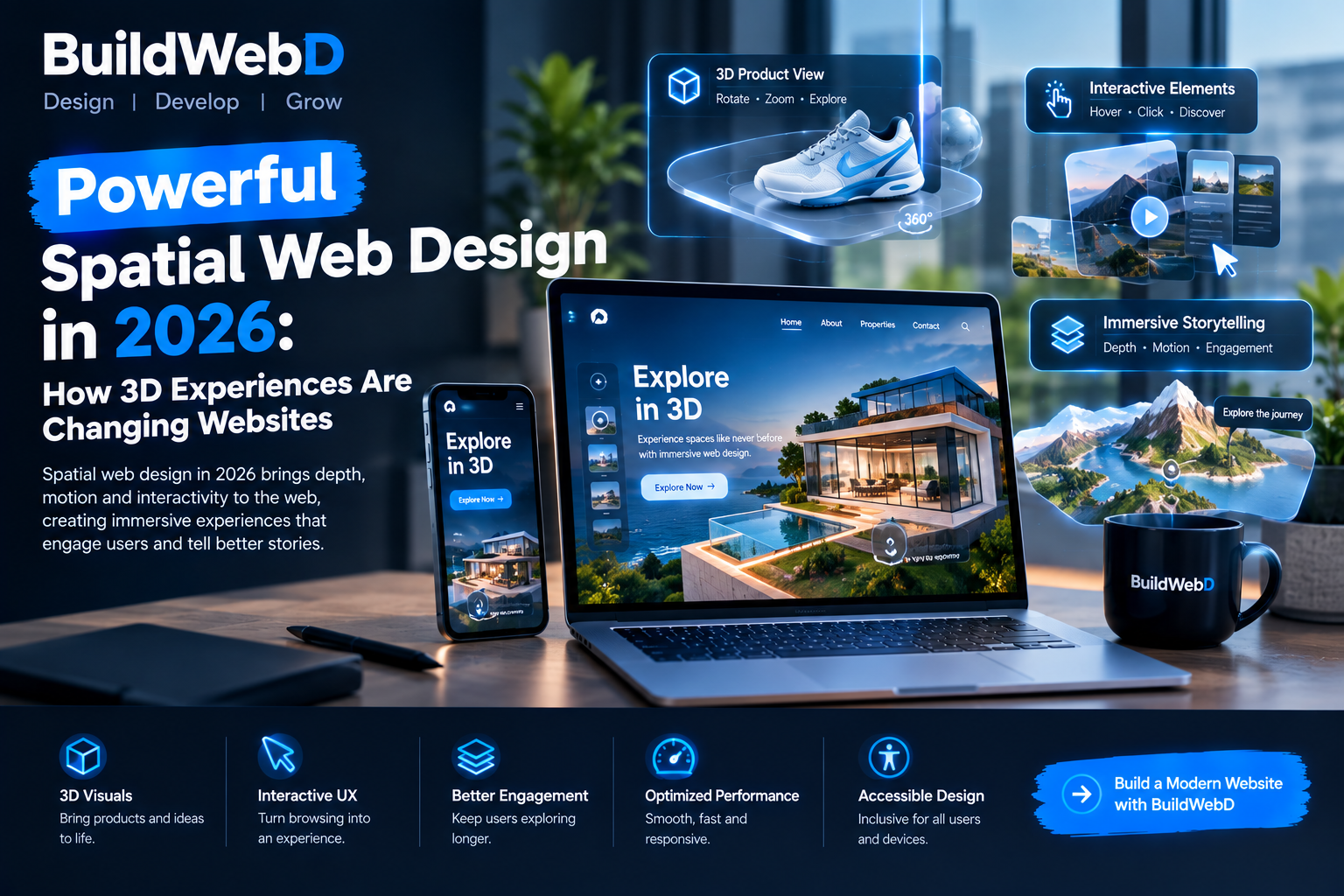
Websites are moving beyond flat layouts and static screens. In 2026, designers are experimenting with depth, interactive 3D elements, layered interfaces, responsive motion, and immersive experiences that make websites feel more like digital environments. This evolution is creating new opportunities for brands that want to stand out without sacrificing usability.
Spatial web design in 2026 focuses on creating websites where depth, movement, visual relationships, and interaction play a meaningful role in how visitors explore information.
What Is Spatial Web Design?
Spatial web design uses visual depth and interactive elements to create a stronger sense of space within a website. Instead of treating every section as a flat block, designers can use layers, perspective, 3D objects, animation, shadows, transitions, and responsive interactions to guide attention.
The concept does not mean that every website needs a complex 3D environment. A simple product visualization, interactive diagram, layered hero section, or animated transition can introduce spatial characteristics.
The goal of spatial web design in 2026 is to make digital experiences more engaging while helping users understand content and navigate naturally.
Why Spatial Design Is Growing
Modern users encounter countless websites that use similar templates, layouts, cards, and stock imagery. As AI-assisted website creation becomes more common, visual differentiation is becoming increasingly important.
Current design research points toward immersive 3D experiences, experimental navigation, motion, and more expressive interfaces as important areas of web design in 2026.
This creates an opportunity for brands to use spatial web design in 2026 as a way to communicate personality and create memorable experiences.
However, visual novelty should always support a purpose. A beautiful animation that makes navigation confusing is not good design.
How 3D Changes Website Experiences
Three-dimensional elements can help visitors understand products, environments, and concepts that are difficult to communicate through traditional images.
For example, an ecommerce website could allow customers to rotate a product and inspect it from different angles. An architecture company could provide an interactive building model. A technology company could use a 3D visualization to explain a complex product.
These experiences can make information easier to explore because visitors are not limited to looking at a single static image.
This is one of the strongest opportunities for spatial web design in 2026: using depth to improve understanding rather than adding 3D simply for decoration.
Spatial Design and Interactive Motion
Motion is another important part of spatial experiences. Elements can move when users scroll, hover, click, or transition between pages.
Purposeful motion can communicate relationships between different elements. For example, an object could expand when selected, a diagram could reveal additional information, or a product could smoothly transition between different views.
Micro-interactions can also provide feedback. A button animation can confirm an action, while a subtle transition can show where new content came from.
The key is moderation. Excessive motion can distract users, increase cognitive load, and affect performance.
Designing Depth Without Overcomplicating the Website
A common misconception is that spatial web design in 2026 requires WebGL, advanced 3D engines, or highly complex animations.
That is not necessarily true.
Designers can create depth using relatively simple techniques such as layered images, gradients, shadows, overlapping components, perspective, sticky sections, parallax effects, and carefully controlled transitions.
These techniques can create a sense of dimension while keeping the website relatively lightweight.
The best implementation depends on the purpose of the page, the audience, the brand, and the available performance budget.
Spatial Web Design for Ecommerce
Ecommerce is one area where immersive design can provide practical benefits.
Online shoppers cannot physically touch products before purchasing them. Interactive 3D models can partially reduce that limitation by allowing users to examine products from different angles.
Furniture websites could provide room previews. Automotive brands could create interactive vehicle models. Fashion businesses could use visual product experiences to highlight materials, details, and features.
When implemented carefully, spatial web design in 2026 can make product discovery more interactive and informative.
Spatial Experiences for Business Websites
Spatial design is not limited to ecommerce.
Technology companies can use interactive diagrams to explain products. Real estate companies can create virtual property experiences. Educational platforms can build interactive learning environments. Creative agencies can use immersive portfolios to demonstrate their capabilities.
Even a corporate website can use subtle depth and motion to create a stronger visual identity.
The important principle is to connect the experience to the brand message. The design should help visitors understand what the company does rather than simply trying to impress them.
Performance Must Come First
One of the biggest challenges with spatial web design in 2026 is performance.
Large 3D assets, high-resolution images, complex animations, and heavy JavaScript can increase loading times. If visitors have to wait for an experience to load, the visual impact may not be worth the cost.
Designers should therefore optimize assets, compress images, use efficient formats, lazy-load nonessential content, and avoid unnecessary effects.
Not every device has the same processing power or network connection. A good spatial experience should provide an appropriate fallback for lower-powered devices and users who prefer reduced motion.
Accessibility and Spatial Experiences
Immersive design should never exclude visitors.
Users may browse with keyboards, screen readers, touch devices, or accessibility settings that reduce motion. Important information should therefore remain available without requiring complex animation or 3D interaction.
Designers should provide readable text, logical navigation, sufficient contrast, accessible controls, and alternative ways to understand important content.
This ensures spatial web design in 2026 enhances the experience without becoming a barrier.
The Role of AI in Spatial Web Design
AI is also influencing the way designers create immersive experiences. AI-assisted tools can help generate concepts, explore layouts, create visual assets, and accelerate prototyping.
However, automated generation does not replace design judgment.
A successful spatial website still requires decisions about hierarchy, usability, brand identity, performance, accessibility, and user behavior. Designers need to determine which elements deserve attention and which effects should be removed.
The combination of AI-assisted workflows and human creative direction can make spatial experiences faster to explore while preserving design quality.
How Businesses Can Use Spatial Design
Businesses considering spatial web design in 2026 should begin with the user journey rather than the technology.
First, identify a part of the website where users would benefit from deeper interaction. This could be product exploration, storytelling, data visualization, service explanation, or portfolio presentation.
Next, choose the simplest technique that solves the problem. A layered animation may be more effective than a full 3D environment.
Finally, test the experience across different devices and network conditions. Measure loading performance, engagement, usability, and conversions instead of relying only on visual appeal.
The Future of Spatial Web Design
The future of web design will likely combine traditional usability with richer digital environments. Websites may increasingly use 3D objects, spatial interfaces, responsive motion, interactive storytelling, and adaptive experiences.
But the most successful implementations will not necessarily be the most complicated.
The strongest spatial web design in 2026 will use technology with purpose. Depth will clarify information. Motion will guide users. Interaction will provide useful feedback. Visual effects will reinforce brand identity.
This approach can create websites that feel modern without becoming difficult to use.
Conclusion
Spatial web design in 2026 is changing how brands think about digital experiences. Instead of treating websites as flat collections of pages, designers can create environments where depth, movement, interaction, and visual storytelling help users explore information.
The opportunity is especially strong for ecommerce, technology, real estate, education, creative portfolios, and brands that need to demonstrate complex products or ideas.
The key is balance. Great spatial experiences should be visually distinctive while remaining fast, accessible, intuitive, and useful.
Businesses that combine thoughtful design with modern technology can create websites that stand out in an increasingly crowded digital environment. BuildWebD can help businesses develop modern web experiences that combine strong visual design, performance, usability, and innovative technology.
Add a Comment