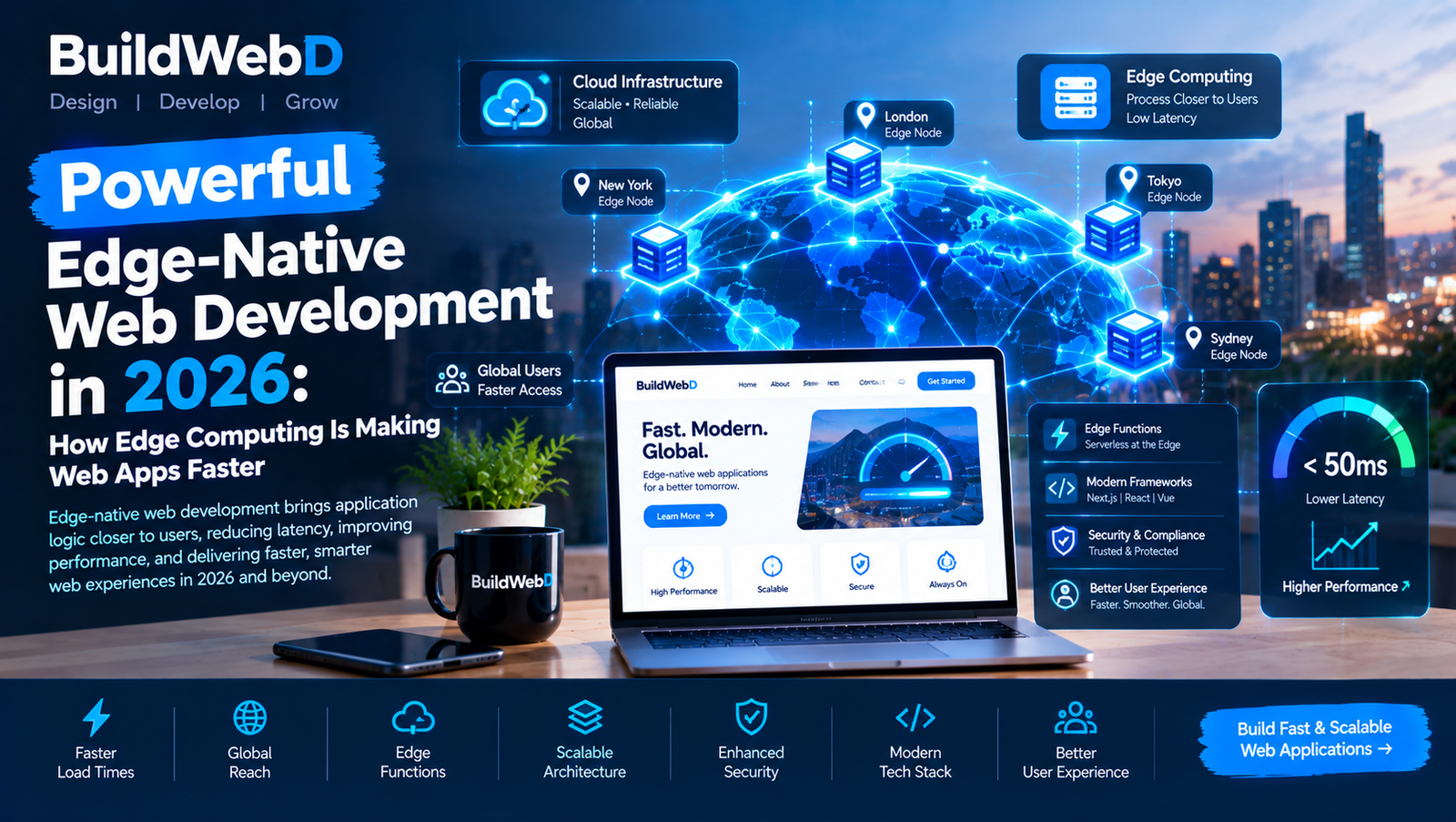
Web users expect websites and applications to respond quickly regardless of where they are located. As businesses serve customers across cities, countries, and continents, traditional centralized application architectures can create performance challenges. This is one reason edge-native web development in 2026 is becoming an important direction for modern web applications.
Instead of sending every request to a centralized server or region, edge architectures allow certain application logic to run closer to users. This can help reduce latency and create faster experiences for applications that depend on quick responses, personalization, authentication, routing, and dynamic content.
What Is Edge-Native Web Development?
Edge-native web development means designing web applications so that suitable parts of the application can run closer to users through distributed edge infrastructure.
Traditional applications may send requests to a small number of centralized servers. An edge-based architecture can distribute selected workloads across locations closer to users.
This does not mean that every part of an application needs to run at the edge. Heavy processing, large database operations, and workloads requiring specialized runtimes may still be better suited to regional servers or cloud infrastructure.
The key idea is choosing the right location for each workload.
Why Edge Computing Matters in 2026
Modern web applications are becoming more dynamic. Websites now provide personalization, real-time features, authentication, APIs, AI-powered functionality, ecommerce experiences, and interactive dashboards.
Users expect these features to feel immediate.
Recent 2026 web-development analysis identifies edge computing as an increasingly important architectural direction, particularly for applications where latency and global responsiveness matter.
Edge-native web development in 2026 therefore focuses on making application architecture more responsive rather than simply making individual pages faster.
How Edge Computing Reduces Latency
Latency is the time involved in sending a request, processing it, and receiving a response.
If a user is located far away from the application’s primary server, network distance can add delay.
Edge computing addresses part of this problem by placing compute capabilities closer to users.
For example, a request for authentication, content personalization, routing, or a cached response may be processed at an edge location rather than traveling all the way to a distant origin server.
The result can be a more responsive experience for suitable workloads.
Edge Computing and Modern Web Frameworks
Modern web frameworks are increasingly designed around flexible rendering and deployment architectures.
Server-side rendering, streaming, server functions, caching, and partial rendering can work with distributed infrastructure to deliver content efficiently.
This gives developers more choices about where application logic should execute.
Instead of thinking only about frontend and backend, development teams increasingly need to think about where each part of the application should run.
Edge Functions for Web Applications
Edge functions allow developers to execute small pieces of backend logic closer to users.
Typical use cases include authentication checks, redirects, request routing, A/B testing, personalization, bot filtering, and response transformation.
These workloads are often relatively small and latency-sensitive.
Platforms such as Cloudflare Workers provide infrastructure for running frontend and backend logic at the edge, along with storage and other services for building distributed web applications.
Edge-Native Web Development and Personalization
Personalized websites can benefit from edge computing because certain decisions can be made close to the visitor.
For example, an application could determine language preferences, regional content, campaign variations, or user-specific routing before sending the final response.
This can help businesses create faster personalized experiences without requiring every request to travel through a centralized application layer.
However, developers still need to consider privacy, caching behavior, authentication, and data consistency when implementing personalization.
Ecommerce Can Benefit From Edge Architecture
Ecommerce websites depend heavily on speed and reliability.
Visitors may browse products, search catalogs, manage shopping carts, authenticate accounts, and complete purchases.
Some of these operations can benefit from edge delivery and edge processing, while sensitive transactional operations may continue to rely on centralized databases and backend systems.
A hybrid architecture can therefore provide the advantages of edge computing without forcing an entire ecommerce platform to move to the edge.
Edge Computing and AI-Powered Applications
AI is creating another reason for developers to consider distributed application architectures.
Some AI-related operations require substantial computing resources and may be better handled by specialized cloud infrastructure. Other lightweight tasks, such as request routing, personalization, filtering, or preprocessing, may be suitable for edge execution.
This can create a layered architecture where edge infrastructure handles latency-sensitive operations while centralized AI infrastructure handles computationally intensive workloads.
The result is not necessarily an “AI at the edge” application in every case, but rather a system where developers select the most appropriate location for each workload.
Edge and Serverless Development
Edge computing and serverless development are related but not identical.
Serverless generally refers to an execution model where developers deploy functions or applications without managing traditional servers directly. Edge computing focuses on where those workloads execute.
A business can therefore use serverless infrastructure without necessarily running everything at the edge.
In 2026, developers increasingly need to understand this distinction when designing application architecture.
Edge Architecture Is Not Right for Everything
Edge computing offers advantages, but it is not a universal replacement for traditional cloud infrastructure.
Some applications require large amounts of memory, long-running processes, complex database transactions, specialized operating-system capabilities, or extensive backend libraries.
These workloads may be better suited to containers, virtual machines, regional serverless infrastructure, or traditional cloud servers.
Recent 2026 technical analysis also highlights the trade-off: edge environments can offer lower latency but may impose runtime and compatibility constraints.
The best architecture is therefore usually a combination of edge and centralized infrastructure.
Security in Edge-Native Applications
Security needs to remain a core consideration when applications become distributed.
Authentication, authorization, encryption, secrets management, API protection, logging, and monitoring need to work consistently across different execution locations.
Developers should also carefully determine which information can safely be processed at the edge.
Sensitive operations may require additional controls, particularly when applications handle financial information, customer data, healthcare information, or confidential business records.
How Developers Can Prepare
Developers interested in edge-native web development in 2026 should begin by understanding application performance rather than immediately migrating an entire application.
Start by identifying latency-sensitive operations.
Then determine which workloads are stateless, which require persistent data, and which depend on specific server-side capabilities.
Caching, authentication, routing, personalization, and lightweight API operations are often good candidates for edge execution.
Heavy computation and complex data processing can remain in regional or centralized infrastructure.
This workload-based approach can produce a more practical architecture than adopting edge technology simply because it is trending.
The Future of Edge-Native Web Development
The web is becoming increasingly distributed. Users expect applications to be fast, responsive, personalized, and available from almost anywhere.
As edge platforms mature, developers will have more options for distributing application logic and combining edge infrastructure with cloud services, databases, serverless platforms, and modern web frameworks.
Edge-native web development in 2026 is therefore not simply about moving servers closer to users. It is about designing applications intelligently so that each workload executes where it makes the most sense.
Conclusion
Modern web development is moving toward architectures that prioritize performance, scalability, and global responsiveness. Edge computing provides developers with another way to achieve these goals by allowing suitable application workloads to execute closer to users.
Edge-native web development in 2026 can be particularly valuable for authentication, routing, personalization, caching, lightweight APIs, and other latency-sensitive operations. At the same time, traditional cloud and server infrastructure remain important for complex workloads and data-intensive operations.
The future of web development is likely to be hybrid, combining edge computing, cloud infrastructure, serverless technologies, modern frameworks, and intelligent application architecture.
For businesses looking to build fast and scalable digital products, BuildWebD can help design and develop modern web applications using performance-focused architecture, responsive development, cloud technologies, and future-ready web solutions.
Add a Comment