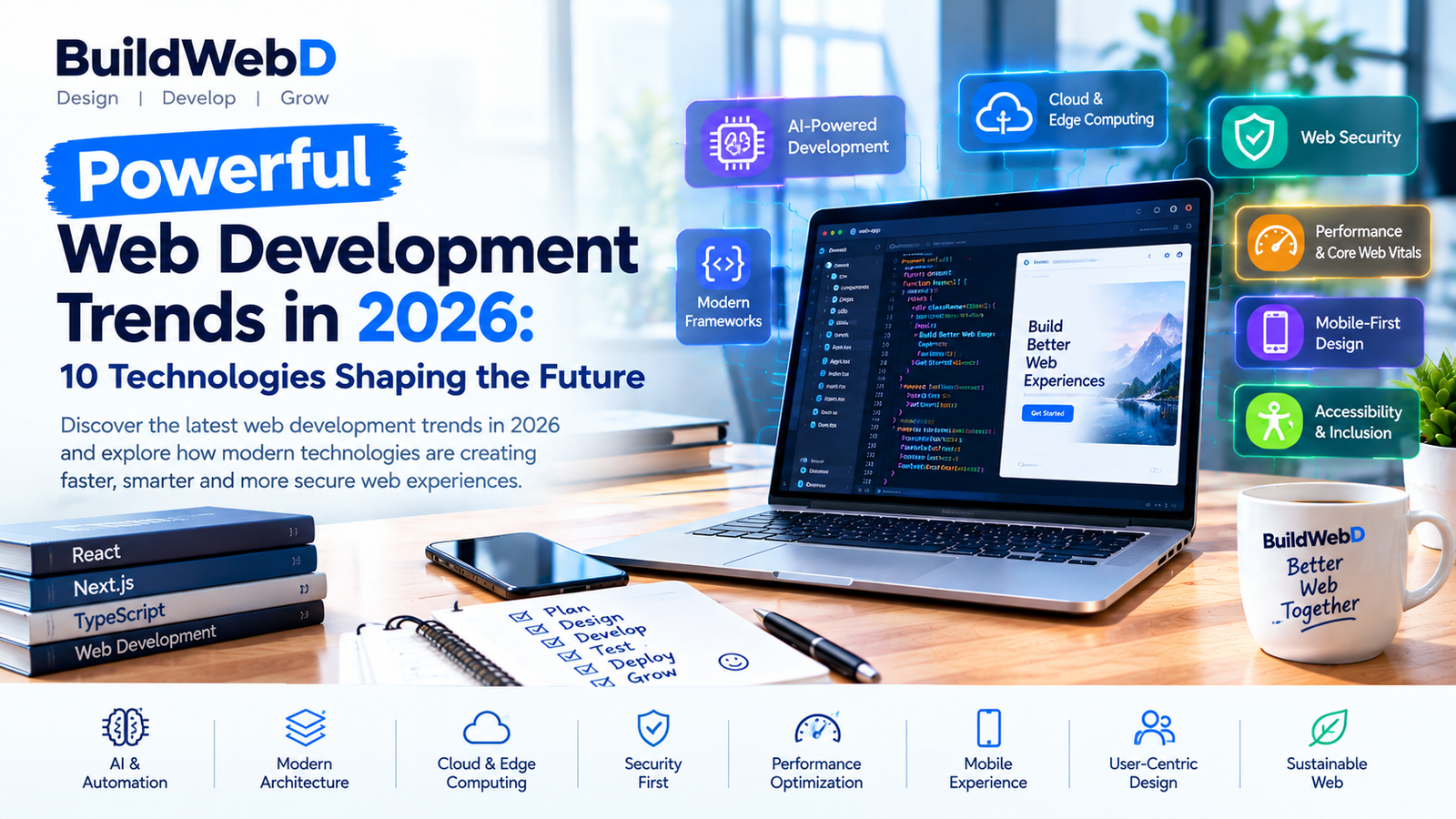
Web development is changing rapidly. New AI capabilities, modern browser features, faster architectures, stronger security practices, and better user experiences are influencing how websites and web applications are built.
For businesses, developers, and startups, understanding the latest web development trends in 2026 can help make better technology decisions and create websites that are faster, more secure, accessible, and easier to maintain.
Here are 10 important trends shaping modern web development.
1. AI-Powered Web Development
Artificial intelligence is becoming an important part of the development workflow. Developers can use AI tools to generate code, explain existing code, create tests, identify potential bugs, write documentation, and accelerate repetitive development tasks.
The biggest change is not simply writing code faster. AI is increasingly being used throughout the software development lifecycle, from planning and development to testing and deployment.
Businesses can benefit from faster development cycles while developers can spend more time on architecture, problem-solving, security, and user experience.
2. AI-Native Development Workflows
One of the most important web development trends in 2026 is the move from basic AI coding assistants toward AI-supported development workflows.
Instead of using AI only to autocomplete code, development teams can use AI to help analyze requirements, generate components, review changes, create tests, and assist with debugging.
However, developers still need to review generated code carefully. Security, performance, maintainability, and business requirements cannot simply be delegated to an AI tool.
3. Server-First Web Architecture
Modern web development is increasingly focused on sending less unnecessary JavaScript to the browser.
Server-side rendering, server components, streaming, and hybrid rendering approaches can help applications deliver content efficiently while keeping interactive functionality where it is actually needed.
This approach can be particularly useful for content-heavy websites, ecommerce platforms, and business applications where performance and search visibility matter.
4. Faster and More Performance-Focused Websites
Website performance remains a major development priority.
Developers are paying closer attention to loading speed, responsiveness, rendering, image optimization, caching, JavaScript usage, and interaction performance.
A modern website should not only look attractive. It should respond quickly and provide a smooth experience across different devices and network conditions.
Performance should therefore be considered during development rather than treated as a final optimization step.
5. Edge Computing and Distributed Applications
Edge computing is another important development direction. Instead of processing every request from a centralized server location, certain workloads can be handled closer to users.
This can reduce latency for applications that require fast responses.
Edge-based architectures can be useful for APIs, personalization, dynamic content, authentication, and applications serving users across multiple geographic regions.
Developers should use edge computing where it solves a real performance or architectural problem rather than adopting it simply because it is new.
6. Stronger Web Security
Security is becoming increasingly important as websites connect with APIs, payment systems, databases, third-party services, and AI capabilities.
Modern development teams need to consider secure authentication, authorization, dependency management, API protection, data validation, secrets management, and secure deployment practices.
Security should be built into the development lifecycle rather than added after a website is completed.
7. Modern Browser Capabilities
Web browsers continue to gain powerful native capabilities. Developers can increasingly build sophisticated experiences using standard web technologies instead of depending on large collections of external libraries.
The Web Platform Baseline project also gives developers a clearer way to understand browser support for modern web features.
Before using a new browser feature, developers should still check browser compatibility and test the actual experience across relevant devices.
8. Accessibility-First Development
Accessibility is becoming a core part of professional web development.
Websites should be designed and developed so that people using keyboards, screen readers, mobile devices, and other assistive technologies can navigate and interact with them.
Developers should consider semantic HTML, keyboard navigation, form labels, color contrast, focus states, meaningful headings, accessible components, and alternative text.
Accessibility is not just a technical checklist. It contributes to a better experience for a broader range of users.
9. API-First and Connected Web Applications
Modern websites rarely operate as isolated systems.
Web applications increasingly communicate with payment platforms, CRM systems, analytics tools, mobile applications, databases, AI services, and other business software through APIs.
An API-first approach can make applications easier to integrate, extend, and maintain.
For businesses planning long-term digital products, a well-designed API architecture can also make future integrations significantly easier.
10. AI-Ready Websites and Web Applications
AI is also changing what users expect from websites.
Instead of simply displaying information, websites can increasingly provide intelligent search, conversational interfaces, recommendations, personalization, automated support, content assistance, and workflow automation.
This creates new opportunities for businesses to turn traditional websites into interactive digital products.
The challenge is to use AI where it provides genuine value rather than adding AI features simply because they are currently popular.
How Businesses Can Prepare for These Web Development Trends in 2026
Businesses do not need to adopt every new technology.
A better approach is to start with business objectives and then select technologies that solve specific problems.
Before developing or redesigning a website, consider:
- Is the website fast enough on mobile devices?
- Is the architecture scalable?
- Is the website accessible?
- Are APIs and third-party integrations secure?
- Can the website support future AI features?
- Is the codebase easy to maintain?
- Are modern browser capabilities being used appropriately?
- Are security and performance tested continuously?
Choosing the right technology is more important than choosing the newest technology.
Final Thoughts
The biggest web development trends in 2026 are centered around smarter development workflows, AI integration, performance, security, modern architecture, accessibility, and better browser capabilities.
For businesses, the goal should not simply be to follow technology trends. The goal should be to build websites and web applications that are useful, fast, secure, scalable, and ready for future requirements.
BuildWebD helps businesses build modern websites and web applications with a focus on professional design, development, performance, SEO, security, and user experience. Whether you need a business website, ecommerce platform, or custom web application, choosing the right development strategy can create a stronger digital foundation for long-term growth.
Ready to build a modern website? Connect with BuildWebD and turn your web development idea into a practical digital solution.
Add a Comment