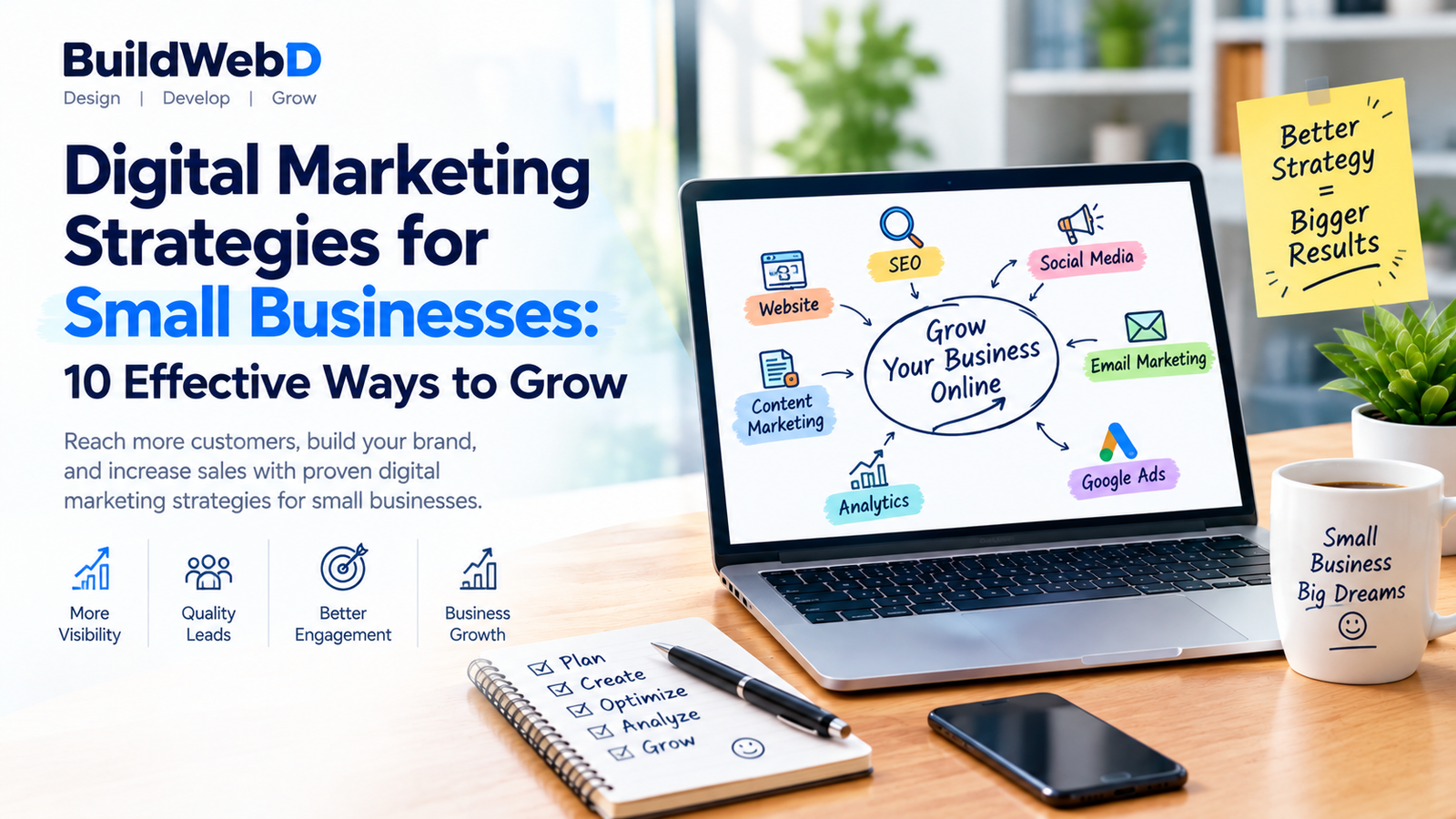
Growing a small business today requires more than having a good product or service. Customers search online, compare businesses, read reviews, visit websites, watch videos, and interact with brands across multiple platforms before making a decision.
That is why having the right digital marketing strategies for small businesses can make a significant difference.
Digital marketing allows businesses to reach potential customers through search engines, social media, email, websites, online advertising, and other digital channels. The key is not to use every available platform. Instead, choose the channels that match your audience and business goals.
Here are 10 practical digital marketing strategies for small businesses that can help improve visibility, generate leads, and build long-term growth.
1. Build a Professional Business Website
Your website is often the foundation of your online presence.
A professional website should clearly communicate:
- What your business offers
- Who your customers are
- Why customers should choose you
- How customers can contact you
- What action visitors should take next
Your website should also work well on mobile devices, load efficiently, and provide an easy user experience.
A good website isn’t just an online brochure. It can become a 24/7 source of enquiries and sales.
2. Invest in Search Engine Optimization
SEO is one of the most important long-term digital marketing strategies for small businesses.
Search engine optimization helps your website become more visible when potential customers search for products or services related to your business.
Important SEO activities include:
- Keyword research
- On-page optimization
- Technical SEO
- Local SEO
- Content creation
- Internal linking
- Website performance optimization
- Search Console monitoring
Instead of trying to rank for every possible keyword, focus on searches that are relevant to your products, services, location, and customers.
3. Focus on Local SEO
If your business serves a particular city or local area, local SEO can be extremely valuable.
For example, a local business may want to appear when customers search for:
- Web design company near me
- Digital marketing agency in Hyderabad
- Best salon in Hyderabad
- Local accounting services
Optimize your Google Business Profile, maintain accurate business information, collect genuine customer reviews, and create useful location-relevant content.
Local SEO should be a key part of digital marketing strategies for small businesses that depend on customers in a specific geographic area.
4. Create Useful Content
Content marketing helps your business answer questions before customers are ready to buy.
You can create:
- Blog posts
- Guides
- Case studies
- Videos
- Infographics
- FAQs
- Social media content
- Industry resources
For example, a web development company could publish articles about website costs, website redesign, SEO, ecommerce, and website performance.
The goal should be to create content that solves real customer problems rather than publishing articles simply because you need more pages.
5. Use Social Media Strategically
Social media can help small businesses build awareness, communicate with customers, and distribute content.
Depending on your audience, you may consider platforms such as:
- YouTube
- X
- TikTok
You don’t necessarily need to be active on every platform.
Choose the platforms where your potential customers actually spend time.
Create a consistent content mix involving educational posts, product or service information, customer stories, behind-the-scenes content, videos, and useful tips.
6. Use Google Ads and Paid Advertising
Organic marketing can take time. Paid advertising can help businesses reach targeted audiences more quickly.
Google Ads can be useful when customers are actively searching for a product or service.
For example, a business selling website development services could target searches related to:
- Website development company
- Web design services
- Ecommerce website development
- Website development for small businesses
Paid advertising should be connected to a specific landing page and measurable business goal.
Don’t focus only on clicks. Track enquiries, qualified leads, purchases, and other meaningful conversions.
7. Build an Email Marketing List
Email marketing remains useful because it gives businesses a direct communication channel with people who have already shown interest.
You can use email to share:
- New products
- Offers
- Blog articles
- Company updates
- Educational content
- Events
- Follow-up messages
For example, a visitor who downloads a business guide could receive a sequence of useful emails before being invited to request a consultation.
Building your own audience can make email an important part of digital marketing strategies for small businesses.
8. Use Reviews and Social Proof
Customers often want reassurance before choosing a business.
Show genuine proof of your work through:
- Customer reviews
- Testimonials
- Case studies
- Portfolio projects
- Before-and-after examples
- Client results
Make sure claims are accurate and supported by real customer experiences.
For service businesses, a detailed case study can be particularly valuable because it shows the problem, the solution, the process, and the outcome.
9. Track Your Marketing Results
One of the biggest advantages of digital marketing is the ability to measure performance.
Track metrics such as:
- Website visitors
- Organic traffic
- Leads
- Conversion rate
- Cost per lead
- Ad performance
- Social engagement
- Email performance
- Sales
Don’t judge a campaign only by likes, impressions, or traffic.
A campaign generating fewer visitors but more qualified enquiries may be more valuable to a business than a campaign generating large amounts of low-quality traffic.
10. Connect Your Marketing Channels
The strongest digital marketing strategies for small businesses don’t treat every channel as a separate activity.
Your website, SEO, social media, content marketing, email marketing, and paid advertising should support one another.
For example:
Google Search → Blog Article → Service Page → Enquiry Form
Or:
Instagram Post → Landing Page → Lead Form → Email Follow-Up → Sales Call
This creates a customer journey rather than isolated marketing activities.
How to Choose the Right Digital Marketing Strategy
You don’t need to implement all 10 strategies at once.
Start by answering three questions:
Who is your target customer?
Understand their location, needs, problems, budget, and online behavior.
What is your business goal?
Your goal could be:
- More enquiries
- More sales
- More website traffic
- More local customers
- Better brand awareness
- More repeat customers
Where does your audience search?
If customers search Google, SEO and Google Ads may be important.
If your audience discovers products through visual content, social media may be more valuable.
If you sell to other businesses, LinkedIn, search, content marketing, and email may deserve more attention.
The best digital marketing strategies for small businesses are the ones connected to a clear audience and measurable business objective.
Common Digital Marketing Mistakes Small Businesses Should Avoid
Avoid these common mistakes:
- Trying to use every social media platform
- Publishing content without a strategy
- Targeting keywords that don’t match customer intent
- Running ads without tracking conversions
- Ignoring mobile users
- Buying fake reviews or followers
- Copying competitors’ content
- Focusing only on website traffic
- Stopping SEO after a few weeks
- Changing strategies without analyzing results
Digital marketing works best when businesses test, measure, learn, and improve consistently.
Final Thoughts
The right digital marketing strategies for small businesses don’t have to be complicated.
Start with a professional website, understand your customers, improve your search visibility, create useful content, build your social presence, and use paid advertising where it makes business sense.
Most importantly, measure what happens after someone discovers your business.
For small businesses, digital marketing should ultimately connect visibility with real business outcomes—more enquiries, more customers, and sustainable growth.
BuildWebD helps businesses build their online presence through website development, SEO, digital marketing, ecommerce solutions, and other digital services. If you want to create a digital marketing strategy designed around your business goals, BuildWebD can help you plan and execute the right approach.
Add a Comment